One ship, carrying fewer planes than a small city airport, helped decide a war that spanned half the globe. Dive with me into a world where steel runways move, horizons shrink, and battles are won long before the enemy can even see who hit them.
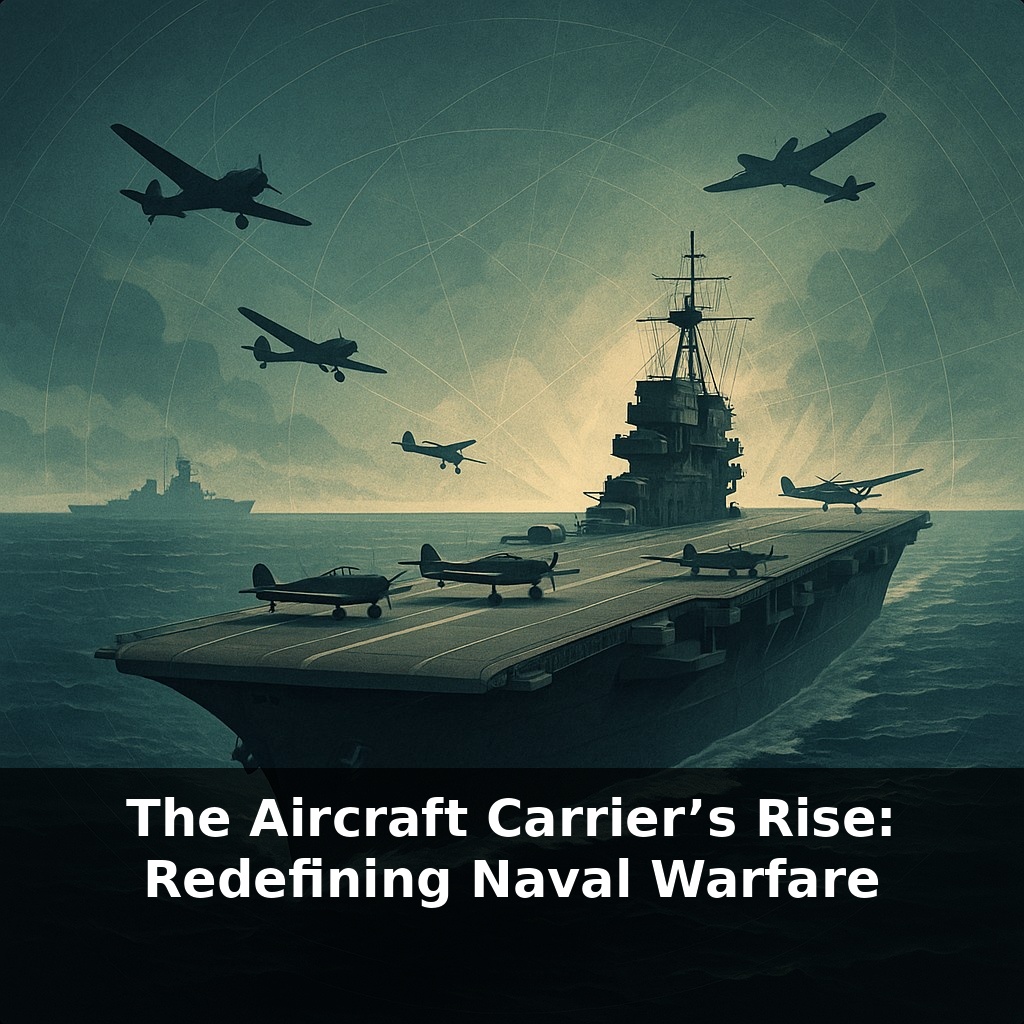
By the early 1920s, most admirals still trusted thick armor and bigger guns, not floating airfields. Carriers were fringe experiments, often converted from unfinished battlecruisers and squeezed into fleets as awkward newcomers. Yet a few navies quietly began testing what happened when you turned the sea’s surface into a mobile launch pad: Britain with HMS Furious and Hermes, Japan with Hōshō and Akagi, the United States with Langley and later Lexington and Saratoga. These early decks were noisy, cramped, and dangerous, but every risky takeoff and brutal landing generated data—about wind over the bow, fuel ranges, strike coordination—that gun clubs had never needed to consider. Naval power was no longer just about who could shoot farthest across the water; it was about who could choreograph the sky above it with the precision of a conductor guiding an orchestra through an unfamiliar, faster piece.
The real shift came when planners stopped treating the new decks as sideshows and started writing war plans around them. In the 1930s, U.S. and Japanese fleets ran large-scale exercises, testing how far a carrier could slip ahead of the battle line, hit first, and vanish. War games at places like the U.S. Naval War College turned chart tables into laboratories, revealing patterns: surprise mattered more than armor, scouting more than shell weight. Each scenario was a rehearsal for a future conflict no one fully understood but everyone felt was coming.
By the late 1930s, the dry abstractions of staff games began to turn into hard steel and doctrine. Designers stretched hulls and widened decks so more aircraft could be spotted and launched in tighter cycles. Elevators grew larger, hangars taller; arresting gear and catapults matured from temperamental gadgets into reliable machinery. Instead of being tacked onto fleets as single, vulnerable units, carriers started traveling with tailored screens of cruisers and destroyers whose job was to keep submarines, surface raiders, and enemy bombers at arm’s length while the “flight deck” did the killing at distance.
The Pacific War exposed, in brutal real time, how fragile and powerful this new system was. Early raids like the British attack on Taranto in 1940 and the Japanese strike on Pearl Harbor weren’t just audacious operations; they were proof that anchored battleships could be rendered useless in a single well-planned blow. At Coral Sea and Midway, fleets clashed without their surface flagships ever seeing each other, trading bomb and torpedo squadrons across hundreds of miles of open ocean. Intelligence, radio discipline, and weather forecasting suddenly mattered as much as gunnery once had.
Success hinged on tempo. Aircrews had to be fed, armed, fueled, launched, recovered, repaired, and turned around in waves, all on a strip of deck barely a few hundred meters long. Below, ordnance teams fumbled with fuses and torpedoes in sweltering magazines, while mechanics coaxed finicky engines back to life. Above, flight directors tried to stack returning aircraft into precise landing patterns before fuel ran dry. A well-run carrier task force began to resemble a carefully balanced ecosystem: scouts pushing out to find the enemy, fighters forming a moving shell of protection, strike aircraft held like a coiled spring until a fleeting window of vulnerability appeared.
By war’s end, lessons were unmistakable. Survivability came from dispersion and defense in depth, not just armor plate. Range trumped line-of-sight firepower. And the fleets that learned to synchronize scouting, timing, and massed airstrikes ended up dictating where and when battles would be fought, turning empty ocean into contested, three-dimensional space.
At Midway, that abstract “ecosystem” of scouting and strike suddenly had names and fatigue-lined faces. Torpedo Squadron 8 from USS Hornet flew in low and slow, without adequate fighter cover, and was almost annihilated. Yet their doomed charge dragged Japanese combat air patrol downward and out of position. Minutes later, high-flying SBD Dauntless dive bombers from Enterprise and Yorktown arrived to find decks cluttered with fueled, armed aircraft. In a span of minutes, hits on Akagi, Kaga, and Sōryū transformed a poised offensive into a catastrophe. A single mistimed search plane launch, a misread contact report, or a delayed refueling cycle could ripple across hours of operations, much like a sudden crosswind can throw off an entire day’s air traffic schedule. Later, in the Cold War, angled decks, steam catapults, and nuclear propulsion pushed this choreography into new territory: heavier jets, around-the-clock alerts, and flight ops no longer tethered to the next refueling tanker or daylight.
Future implications stretch beyond bigger decks or faster jets. Swarms of cheap drones may scout ahead like flocks of seabirds, testing defenses before crewed aircraft commit. Hypersonic weapons compress reaction times to seconds, so decision-making shifts toward algorithms that never tire but can still be fooled. As more nations launch their own flat tops, oceans start to feel like crowded skies: overlapping patrols, jostling flight paths, and constant risk that one misread blip could spark a crisis.
In the end, the real shift isn’t just hardware, it’s mindset: from guarding sea lanes to shaping events ashore, often before crises hit the news. Future decks may host railguns, lasers, and autonomous squadrons cycling like tides. Your challenge this week: follow one ongoing maritime dispute and ask, “Who controls the air above this water—and how?”