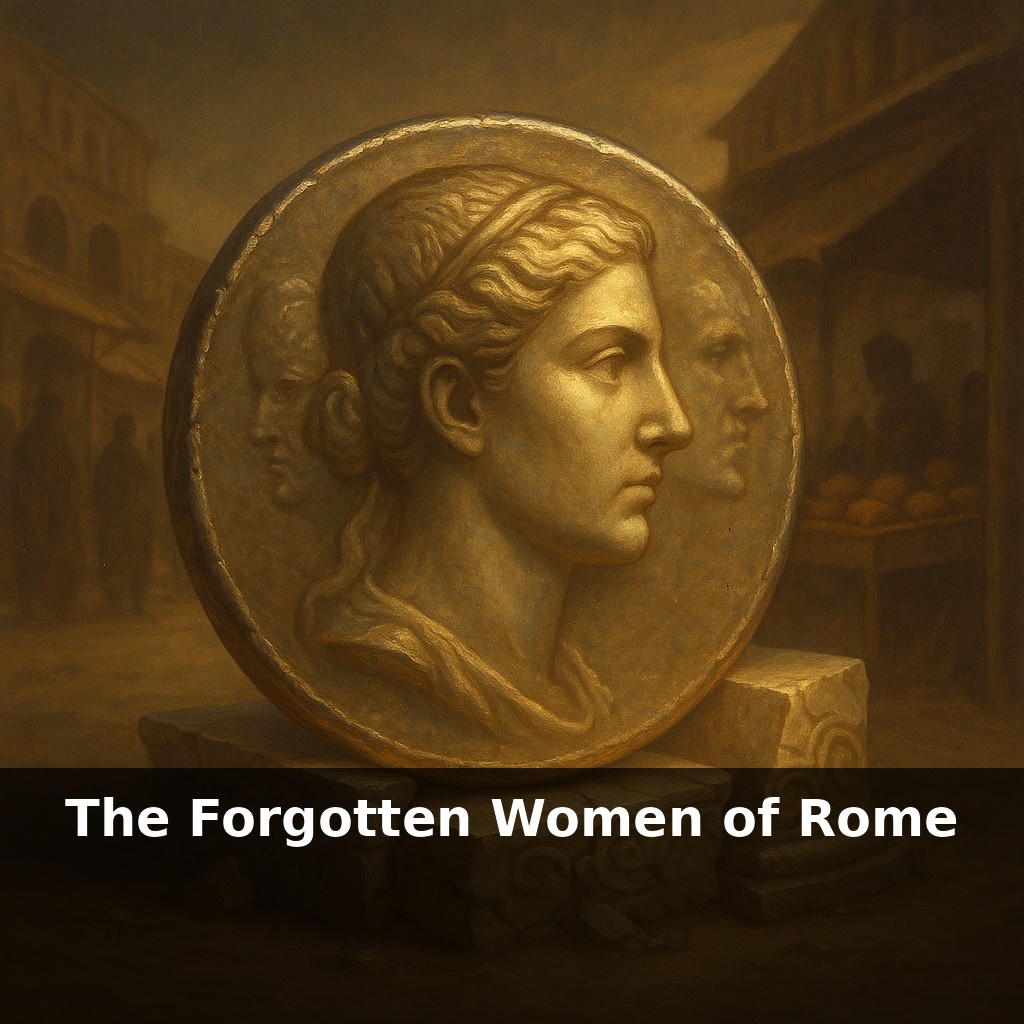
The Forgotten Women of Rome
📝 Transcript
A Roman coin flips in a crowded market—on one side, a general; on the other, a woman’s face. Not a goddess. A real woman, Fulvia, wielding power in a world that claimed she had none. In this episode, we’ll follow the women history tried very hard to write in small print.
Roman streets didn’t just echo with marching boots and senatorial debates; they hummed with women’s deals, prayers, and whispered negotiations. Step away from the grand marble forums and you’d find a baker’s shop where the owner’s name, scratched into a wall, belongs to a woman. Follow a worn alley and you might reach a modest bar, legally registered under a freedwoman who once poured drinks there as a slave. In quiet courtyards, widows signed contracts that kept entire estates afloat, while in temple precincts, priestesses guarded Rome’s sacred fire with a discipline that could cost them their lives. If Rome’s official story is a spotless marble statue, women’s lives are the chisel marks: messy, layered, and essential to the final shape—even when later writers pretended they weren’t there at all.
Step closer to the evidence and the marble surface starts to crack. For centuries, nearly everything we “knew” about Rome’s women came from senators, biographers, and moralists who rarely bothered to record what half the population actually did all day. Only when historians began treating tombstones, shop signs, wax tablets, and legal formulas like a massive, scattered archive did a different picture emerge. Names of lenders, midwives, tavern keepers, textile contractors, and estate litigants surface line by line, like code slowly compiling into an unexpected program: women not as background figures, but as decision‑makers.
Walk into Pompeii’s business district and start reading the painted notices and carved names: roughly a third of the shop and workshop owners we can identify are women. Not silent partners. Not “helping out.” Owners. You see names like Umbricia Janaria on amphorae labels for fish sauce, or freedwomen listed as full participants in manufacturing partnerships. These aren’t isolated curiosities; they signal that Roman commercial law didn’t bar women from contracts or credit, so long as a guardian—on paper, at least—signed off. In practice, that “guardian” often rubber‑stamped whatever a competent woman had already decided.
Roman family law created a paradox. Officially, fathers and husbands towered over households. Yet the moment a woman became *sui iuris*—usually through a father’s death—she might control dowries, inheritances, and investment portfolios. Legal jurists like Ulpian quietly acknowledged this by discussing what happened when an unmarried woman or widow ran an estate for decades. The answer, judging from casebooks: the system flexed to accommodate the reality that these women were effectively bosses, hiring stewards, suing neighbors, and lending money at interest.
Religious offices magnified this visibility. The Vestals had state-supplied housing, front‑row seats at games, and the power to free condemned prisoners with a touch. Their vow of chastity wasn’t just moral theater; it made them symbolically independent of any man’s household, so they could represent Rome itself. The stakes were brutal—live burial for breaking the vow—but the office shows how Romans could imagine women as public guardians when it suited civic needs.
On rare occasions, women stepped into spaces Romans loudly claimed were male monopolies. In civil conflicts, we find references to women funding troops, organizing urban defenses, or negotiating with generals. These glimpses are brief precisely because later writers were uncomfortable with them. Yet they reveal how flexible gendered “rules” became when survival or advantage was on the line—much like a piece of software that behaves differently under stress than its official documentation suggests.
Picture a Roman woman in the textile trade, not spinning in a quiet corner but reviewing accounts like a modern startup founder checking her dashboard. She knows which dye merchant extends the best credit, which shipping agent loses fewer bales in transit, and which neighbor is late—again—on a small but interest‑bearing loan. Her name never makes it into a historian’s grand narrative, yet her choices shape dozens of livelihoods along her street.
Another woman, technically under a male guardian, negotiates marriage contracts for her nieces. On wax tablets, the dowry figures look like simple numbers; in practice, they’re levers. A slightly higher sum can secure a better political alliance, a clause about property return can protect a girl if the marriage collapses.
Even at the city’s edge, a healer scribbles recipes for birth control and fertility aids, trading knowledge with midwives. None of this enters official law codes, yet it quietly alters who survives, who inherits, and whose family line thrives in the next generation.
Future work will not just “add women in” but redraw Rome’s map. As digitised texts and bioarchaeology stack up, patterns of female mobility, diet, and labour will surface like hidden streets in a city‑builder game. We may find migrant barmaids who became lenders, midwives who networked across ports, or textile workers moving cash through informal credit webs. Those models could nudge today’s debates on care work, pay gaps, and who gets counted as an “economic actor” at all.
These women rarely reached marble statues, but their traces keep surfacing: a graffitied nickname, a scratched price list, a recipe for face cream or tooth powder. Follow them and Rome feels less like a parade of emperors, more like a crowded apartment block where cooks, moneylenders, and wet nurses all adjust the city’s heartbeat. Your challenge this week: hunt for the smallest credit line on any project around you—a coder in the “thanks” section, a translator in 6‑point font, a lab assistant on the final slide. Ask what the story would look like if *they* were centered, and what records future historians would need to recover their choices.

Unlock all episodes
Full access to 6 episodes and everything on OwlUp.
Subscribe — $1.99/monthLess than a coffee ☕ · Cancel anytime