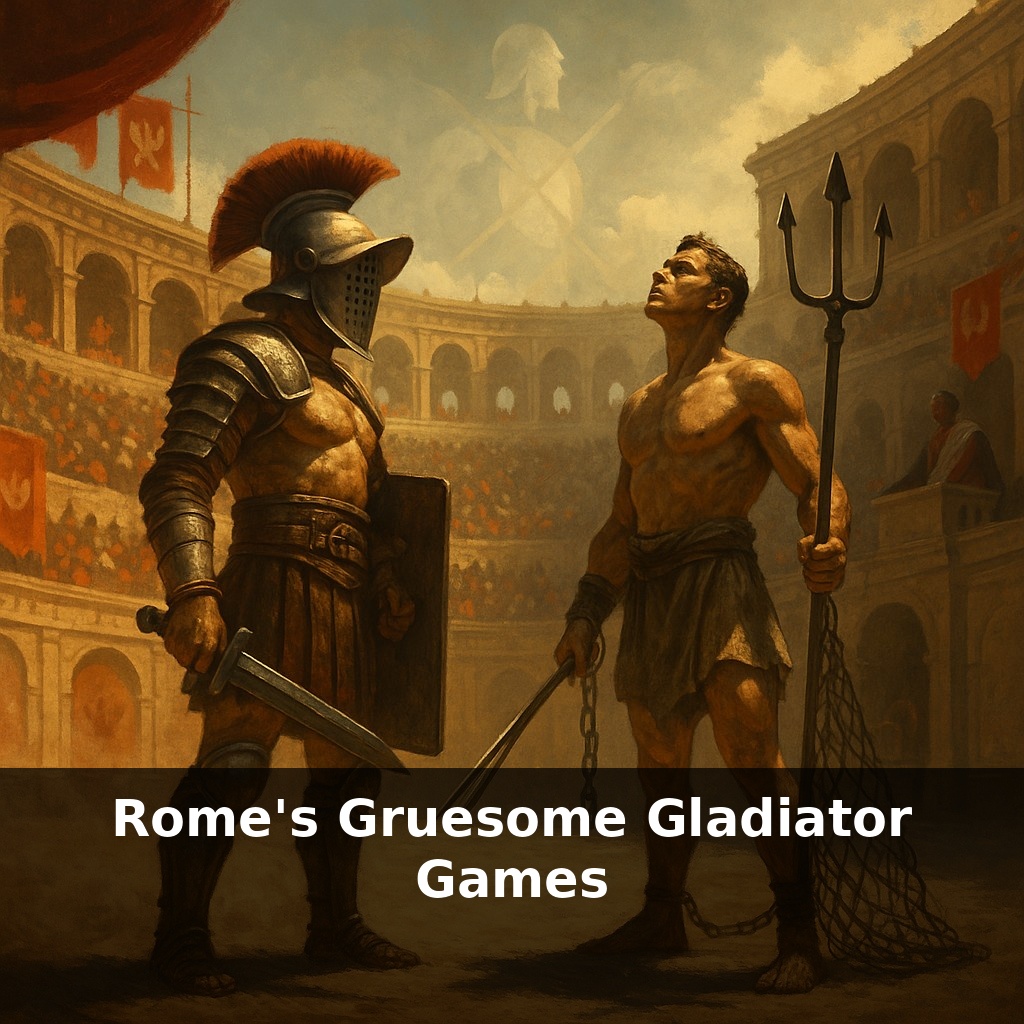
A crowd the size of a small city roars as two men step into the blazing sun—both expensive, highly trained... and legally enslaved. One prays to Mars, one to the emperor, and both know this: the fight isn’t just for survival. It’s for Rome’s soul, on public display.
Below the cheering, the games run on precise calculation. A magistrate has paid a fortune to sponsor today’s show, betting his political future on how loudly this crowd will applaud. Teams of planners have spent weeks pairing fighters by style and skill, the way a clever chef balances flavors on a plate: a nimble net-fighter against a heavy shield-bearer, a veteran crowd favorite against a cocky newcomer. Priests have already checked the omens; engineers have tested the winches that will haul cages, scenery, even artificial forests up from the arena floor. Every trumpet blast, every gate opening, every “accidental” moment of drama is mapped out in advance—not to save lives, but to shape emotions. Rage, pity, awe and gratitude are stirred, layered and served to the masses, course by course, in the emperor’s name.
Behind the sand, an entire industry hums. Contracts are signed for exotic animals, armor is custom-fitted in backstreet workshops, and trainers drill footwork the way a tech startup hammers prototypes—iterate, refine, repeat. Gladiators follow strict diets heavy in barley and beans, bulking up a protective fat layer that might turn a lethal cut into a survivable wound. Inscriptions show star fighters earning prize money, fan nicknames and even endorsement-like patronage. And sometimes, amid thousands of voices in the Colosseum, a woman steps into the arena, sword in hand.
The blood hits the sand, but the first thing Romans notice isn’t gore—it’s form. A murmillo’s shield angle, the precise way a retiarius circles out of range, the moment a wounded fighter raises one finger to signal surrender. This is violence drilled until it looks almost like choreography, judged as much for technique as for impact.
We know from tombstones and scratched graffiti that spectators loved certain “brands” of fighter: the heavy-armed murmillo, the lightly equipped thraex with his curved blade, the net-and-trident men, the horse-mounted equites. Each type came with its own standard moves, equipment, and traditional rivalries. When a program advertised “Murmillo vs. Thraex,” the crowd already had expectations, the way modern fans do when they see two rival styles matched on a bracket. People took sides, argued in taverns, and painted slogans like “Crescens, the net-fighter, the girls’ delight!” on walls.
The actual bout was short by design—about the length of a modern round of intense competition—because intensity, not endurance, was the selling point. Fighters circled, tested each other, probed defenses. A referee with a long staff stepped in if someone broke the rules: no striking a man who’s clearly yielded, no weapons that weren’t approved, no ganging up unless the show was advertised that way. There were even assistants watching for fouls and keeping the pace, the human equivalent of a game clock and rule book.
Gladiators themselves lived in a strange in‑between status. Many were war captives or criminals, branded and locked into barracks-like schools. Yet within those walls, some rose to minor stardom. A successful fighter might negotiate better lodging, extra rations, a share of winnings. Freeborn volunteers—seeking quick cash, to erase debts, or just a shot at glory—signed contracts that spelled out how many fights they owed and what they’d earn if they survived them.
The arena could twist personal fate. There are records of men winning a symbolic wooden sword, the rudis, granting release from the profession—only to keep performing as crowd favorites for higher pay. Others died in their very first appearance, their names preserved only in a harsh line on a stone: “Fought once, died once.”
And over it all loomed the sponsor’s need to impress. A stingy show, too few fighters, or boring matchups could spark mocking chants. An unforgettable sequence of duels, clever pairings, and dramatic reversals might translate into votes, loyalty, and whispered praise in the baths long after the sand had been raked smooth.
Some days in the arena looked less like single duels and more like a carefully programmed “event schedule.” Morning might open with staged hunts, followed by comic mock-battles or myth reenactments, before the prized matchups in late afternoon—prime time, when the largest crowd had squeezed in. Programs carved on stone list lineups the way a festival bill lists bands, with space for surprise acts added at the last minute if the sponsor wanted extra applause.
The crowd’s reactions were data. If a particular pairing drew huge cheers, that style might be booked more often in the next festival; if spectators started leaving early, planners knew the pacing had failed. The most successful organizers learned to “read the room,” escalating risk and rarity as the day went on: unusual weapon types, famed veterans facing impossible odds, or a rare appearance of a female fighter could all be deployed like high-value chips to jolt attention back to the arena at crucial political moments.
Your challenge this week: whenever you see a modern sports or entertainment schedule—prelims, undercards, headliners—ask yourself what emotional arc it’s trying to create, and whose power or profit that arc ultimately serves.
Gladiator games hint at a future where spectacle is less about blood and more about data. As archaeologists pull genomes from bones and engineers rebuild arenas in VR, the “roar of the crowd” becomes a measurable signal, like a seismograph for public mood. States and companies already test trailers, tweak algorithms, and pace releases to catch us at our weakest attention gaps. The arena shrank to a screen, but the contest for our loyalty—and our gaze—never really ended.
Rome’s arenas are ruins now, but their blueprint lingers in places we rarely question: loyalty programs, streaming queues, curated “big events” that pull us in like tides. The Romans learned you could steer a crowd with rhythm and risk; we’re still testing how far that steering goes—one notification, one season finale, one “can’t miss” moment at a time.
Before next week, ask yourself: How would I have felt sitting in the Colosseum watching a real gladiator bleed out for my entertainment, and what does that say about the kinds of violence or humiliation I casually consume today (in movies, games, or online)? If I think about specific gladiators—many of them enslaved, prisoners of war, or criminals—how does recognizing their lack of choice change the way I talk about “sacrifice,” “honor,” or “doing anything for success” in my own life? Looking at one modern spectacle I enjoy (a brutal sport, a viral “public shaming,” or a violent show), what’s one concrete way I can shift from being a passive spectator to someone who questions the cost—on real people’s bodies, dignity, or mental health—starting this week?