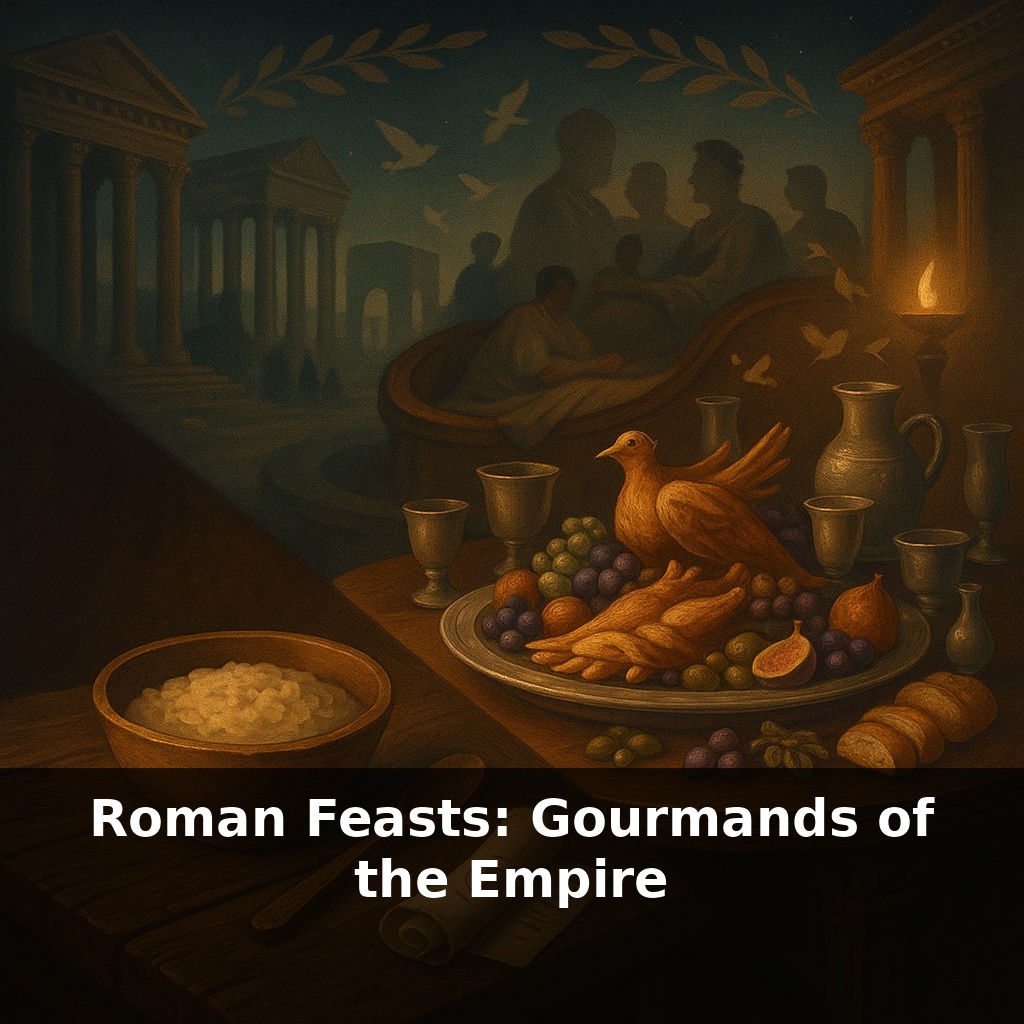
A cookbook from ancient Rome lists around five hundred recipes—yet most citizens lived on plain porridge. Tonight’s story unfolds between those two bowls: a cramped tavern near the Forum, and an elite dining room where the seating chart matters more than the food itself.
Seven thousand songbirds—roasted, sauced, and gone in a night. Roman sources accuse the emperor Elagabalus of such excess, and whether or not the number is true, the accusation itself tells us something: in Rome, what and how you hosted could be as politically charged as a speech in the Forum.
We’re moving now from the menu to the machinery behind it. The feast wasn’t just laid out; it was engineered. Grain ships timed to the sailing season, spice jars stamped with trade marks, and amphorae of fish sauce stacked in coastal warehouses all fed into those hours on the couches. Think of each banquet as the visible tip of a supply iceberg—what the guests saw was only a fraction of the labor, logistics, and quiet calculation beneath.
Our question tonight: when does a meal stop being private pleasure and become public power?
A Roman feast began long before the first platter entered the room. Invitations had to be worded with surgical care, signaling honor without overpromising intimacy. Guests weighed whether to accept, much as modern executives study who else will attend a high-stakes retreat. Inside the house, slaves rehearsed their roles: who carved, who poured, who whispered names so the host never stumbled. Cooks tested sauces against salted fish or honey, tweaking flavors the way a speechwriter trims and sharpens lines. By the time guests reclined, the evening’s script was already set—only the performances were left.
A Roman feast moved in acts, not courses. Guests didn’t simply “sit down to dinner”; they reclined into a choreography that everyone in the room could read. The first decision hit them before the first bite: where they were placed among the three couches of the triclinium. The central couch, middle position—the locus consularis—broadcast top status. To be nudged to the far edge, near the door, was a reminder that your fortunes were… negotiable.
Service reinforced this invisible ranking. The same boar might arrive at all couches, but the choicest cut, carved tableside, went to the honored guest. Others received slices pre-arranged on platters, like getting the same bonus in theory, but only one person’s payment arrives in a velvet envelope. Even conversation was tiered: the host angled his body toward those who mattered most; everyone else spoke across gaps of distance and status.
The food itself played double duty. Everyday staples—bread, olives, lentils—could appear, but dressed up: lentils brightened with imported pepper, fish perfumed by garum from the Spanish coast, fruit drizzled with honey that had its own regional reputations. Exotic elements signaled reach. Flamingo tongue or peacock wasn’t just extravagance; it was a statement that the host’s networks stretched from North Africa’s marshes to Asia Minor’s estates.
Behind the spectacle, preservation quietly dictated possibility. Salting, smoking, and drying allowed fish and meats to travel; amphorae sealed with resin kept oils and wines stable across months. Cold was a luxury: in winter, snow packed into pits or jars created makeshift refrigeration for the most delicate treats. A host who could serve fresh oysters far from the sea, or cherries out of season, was advertising controlled defiance of nature itself.
Literary sources don’t let this power-game pass unchallenged. Petronius sketches hosts who overplay their hand: dishes shaped like zodiac signs, sausages dangling from a model constellation, sauces as confusing as the social signals. Satire mocked the moment when display drowned out taste, when guests left not satisfied but exhausted—and quietly taking notes on what not to imitate.
Guests didn’t just read status from couches; they learned to decode the food itself. A platter heavy with eggs, nuts, and seafood hinted at fertility or new beginnings at a wedding dinner. A leaner spread at a mourning feast signaled restraint, without anyone needing to announce it. Hosts could even slip in quiet commentary: serving cheap cuts artfully disguised to a boastful parvenu, while old aristocrats knowingly tasted the joke.
Menus tracked empire-wide shifts. As Roman power reached deeper into North Africa, more diners encountered flavors driven by cumin and coriander; when trade to the East was disrupted, pepper-heavy sauces grew rarer at tables far from major ports. The same way a modern tech firm’s holiday party menu might suddenly feature plant-based “future foods,” Roman tables reflected fads: a philosopher’s circle favoring simple, rustic dishes; a nouveau riche banker splurging on sweet wines and elaborate pastries to prove he belonged.
Your challenge this week: pay attention to how meals around you encode status, values, and unspoken negotiations. At a family gathering, office lunch, or restaurant, ask yourself: Who chooses the venue? Who orders first—or orders for others? Who is served or served themselves? Note when the “best” item on the table quietly gravitates toward a particular person. Then, take one small, deliberate action to reverse or reshape that pattern—offer a prime portion to someone usually overlooked, or invite a quiet guest to choose the dessert for the group. You’re not recreating a Roman feast; you’re testing how much social gravity still sits on the plate in front of you.
Future implications spill forward from these ancient tables. Recreated fermented sauces hint at low-energy pBuilding on our exploration of Roman excess, innovative protein strategies for crowded cities emerge, like tiny biochemical factories running in pantry jars. Diplomatic dinners borrow Rome’s insight that plates can open doors faster than position papers. And as scholars model dining spaces in VR and train language tools on terse Latin notes, students may soon “attend” a long-vanished evening—and then redesign their own.
In the end, every table you touch becomes a small archive. Leftovers are like margin notes, playlists for the tongue that hint at who felt welcome, who stayed silent, what the group valued. Follow that trail and dining stops being background noise; it turns into a map of power, care, and memory that you’re quietly redrawing with every shared plate.
Before next week, ask yourself: How would a “Roman-style” dinner look in your home if you actually tried to recreate one element—would you experiment with a simple dish like honey-glazed dates or a spiced wine, and what would that teach you about how they experienced flavor? If you imagined hosting guests like a Roman patron, what tiny change in seating, order of serving, or conversation topics could you try at your next meal to spotlight status, generosity, or storytelling the way they did? When you think about how much time and resources elite Romans poured into spectacles of food, what’s one part of your own eating routine (solo lunch, family dinner, weekend treat) you’d like to make more intentional or ceremonial, and what’s the very next meal where you could try that out?