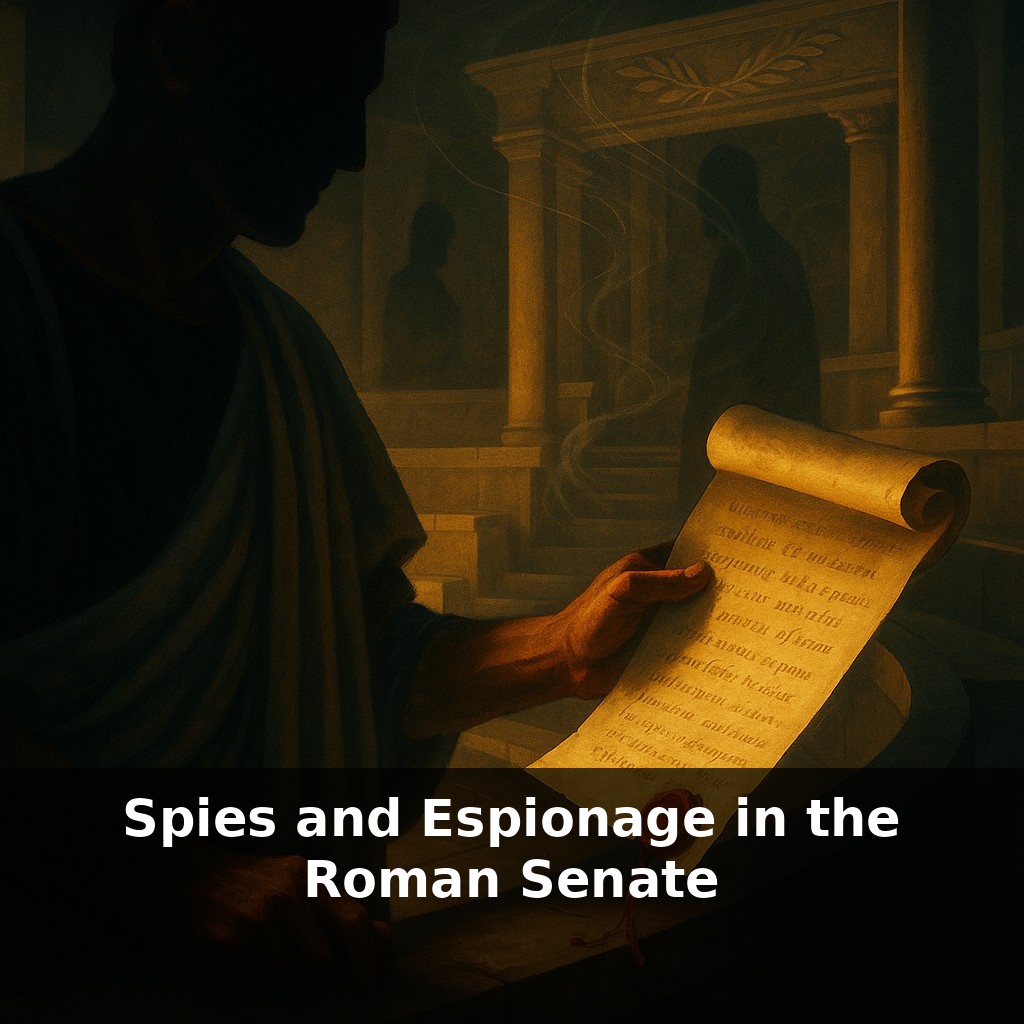
A senator unrolls a letter on the Senate floor—and knows, before reading a word, that it could cost someone their life. In Rome, the deadliest weapons weren’t swords or spears, but whispers, intercepted notes, and slaves forced to repeat what they heard in the dark.
In that same chamber, everyone is both an orator and an eavesdropper. Senators don’t just debate laws—they sample rumors the way a chef tastes sauces, searching for the one hint that changes the whole recipe of power. Some specialize in foreign news from the frontiers, others in the private vices of their rivals, and a few trade entirely in silence: what *isn’t* being said, who has stopped visiting whom, which regular messenger has quietly vanished.
The Senate’s marble steps become an unofficial exchange where clients, freedmen, and provincial envoys trade fragments of information like negotiable currency. A nod, a delayed greeting, a carefully timed entrance to a meeting can speak louder than a speech. Behind formal procedures—roll calls, votes, decrees—lurks a second, invisible agenda: who supplied which secret, who is believed, and who will pay when a rumor proves false.
Behind this choreography of nods and pauses sits a loose ecosystem of Roman “information workers.” Some wear armor: *speculatores* ride ahead of armies, mapping roads, counting enemy tents, noting which local chiefs grumble the loudest. Others look like ordinary clerks and errand-runners. A scribe who copies speeches by day might summarize tavern gossip by night; a courier who carries grain reports also memorizes which governors seem unusually nervous. Senators sift these reports the way a banker handles coins—testing for weight, sound, and the feel of forgeries before risking their fortune on a single piece of news.
Power in this world depends on how far your eyes and ears can reach beyond the Senate walls. A cautious senator doesn’t wait for news to arrive in a neat scroll; he grows his own network the way a careful investor builds a portfolio—diversified, redundant, and always slightly deniable.
At the bottom are clients and freedmen, posted like human sensors in markets, temples, and dinner parties. A provincial governor might quietly pay a ship captain to report which rival’s name gets most cheers at coastal towns. A wealthy matron’s steward notes which young firebrand is suddenly entertaining a lot of visitors after dark. None of this looks like “spying”; it looks like everyday social life, with an extra column of mental bookkeeping.
Above that hum the more formal channels. Military *speculatores* send back reports on legions and border kings, and those reports don’t just shape campaigns—they become political weapons. If a general wants to undercut a rival, he can “leak” a gloomy battlefield assessment to a friendly senator days before a critical vote on funding. The same dispatch, read aloud with a different emphasis, can sound like either imminent victory or catastrophic mismanagement.
Then come the men whose job titles don’t say “spy” but whose daily work might as well. The *frumentarii*, officially tied to supply and administration, ride imperial roads carrying letters that sometimes arrive sealed with extra wax: an emperor’s inquiry about which senator dines with whom, or whether a provincial elite grumbles too loudly about taxes. The Castra Peregrina on the Caelian Hill functions less like a barracks and more like a data center, where streams of reports are sorted, copied, and redirected.
All of this feeds a central paradox: senators rely on intelligence to defend their status, yet every new channel of information can also be turned against them. A well-timed accusation from a *delator*, backed by conveniently “discovered” correspondence, can strip a man of rank and property in a single session—while enriching the accuser with a legal share of the spoils. So each senator learns a defensive art: how to appear fully informed, yet never the obvious source; how to circulate a damaging story, yet leave no traceable path back to his own doorway.
Some of the sharpest operators treat intelligence like a carefully balanced tech portfolio. One senator might “invest” heavily in military news, cultivating officers among the *speculatores* who owe him favors from past votes. Another prefers “domestic data”: stewards in elite houses, scribes in fashionable law offices, teachers who overhear the anxieties of their pupils’ powerful fathers. A cautious few hedge by mixing both—never depending on a single stream of updates that could suddenly go dark.
Caesar, for instance, didn’t just trust battlefield scouts; he paired their reports with letters from local elites and even coded messages using his simple substitution cipher. By cross-checking sources, he could spot when a frontier commander exaggerated threats or when a provincial notable downplayed unrest. Augustus refined this habit into policy, quietly organizing channels that funneled separate report streams to him and to the Senate, letting him see where stories conveniently diverged.
Your challenge this week: Watch a modern political story—local or international—and map the visible and invisible “informants” behind it. Who benefits if key facts are late, vague, or wrong?
Rome hints at a deeper pattern: once leaders discover how intoxicating constant “situational awareness” feels, it becomes hard to give up. Surveillance tools creep from borders to boudoirs, from enemy camps to allies’ dinner tables. For modern states, the risk isn’t simply collecting too much data, but letting fear turn oversight into ritual. Like seasoning, intelligence sharpens judgment only while someone is still willing to ask: who chose this recipe, and who profits if it burns?
In the end, Roman intelligence feels less like a hidden dagger and more like a set of scales, always tipping between curiosity and control. Once you notice who quietly adjusts the weights—who chooses which scraps of news are “credible” and which vanish—it’s like seeing backstage at a play: you start watching the hands, not just the drama.
To go deeper, here are 3 next steps: 1) Pull up Mary Beard’s *SPQR* and read the sections on the late Republic while you listen again to the episode’s bit on senatorial informants—pause and cross-check names like Cicero, Sallust, and Catiline to see how the podcast’s spy stories line up with the main sources. 2) Open the Perseus Digital Library (online) and search Cicero’s *In Catilinam* and Sallust’s *Bellum Catilinae*; skim for any mention of secret meetings, informers, or intercepted letters, and jot a quick comparison to how the episode described those espionage tactics. 3) Fire up a historical strategy game or mod with a Roman Republic setting (e.g., *Total War: Rome II* with a focus on politics/agents) and, for one session, role-play as a senator running an intelligence network—only make political decisions that would make sense if you actually feared informers, bribery, and leaked senatorial debates, exactly like in the episode.