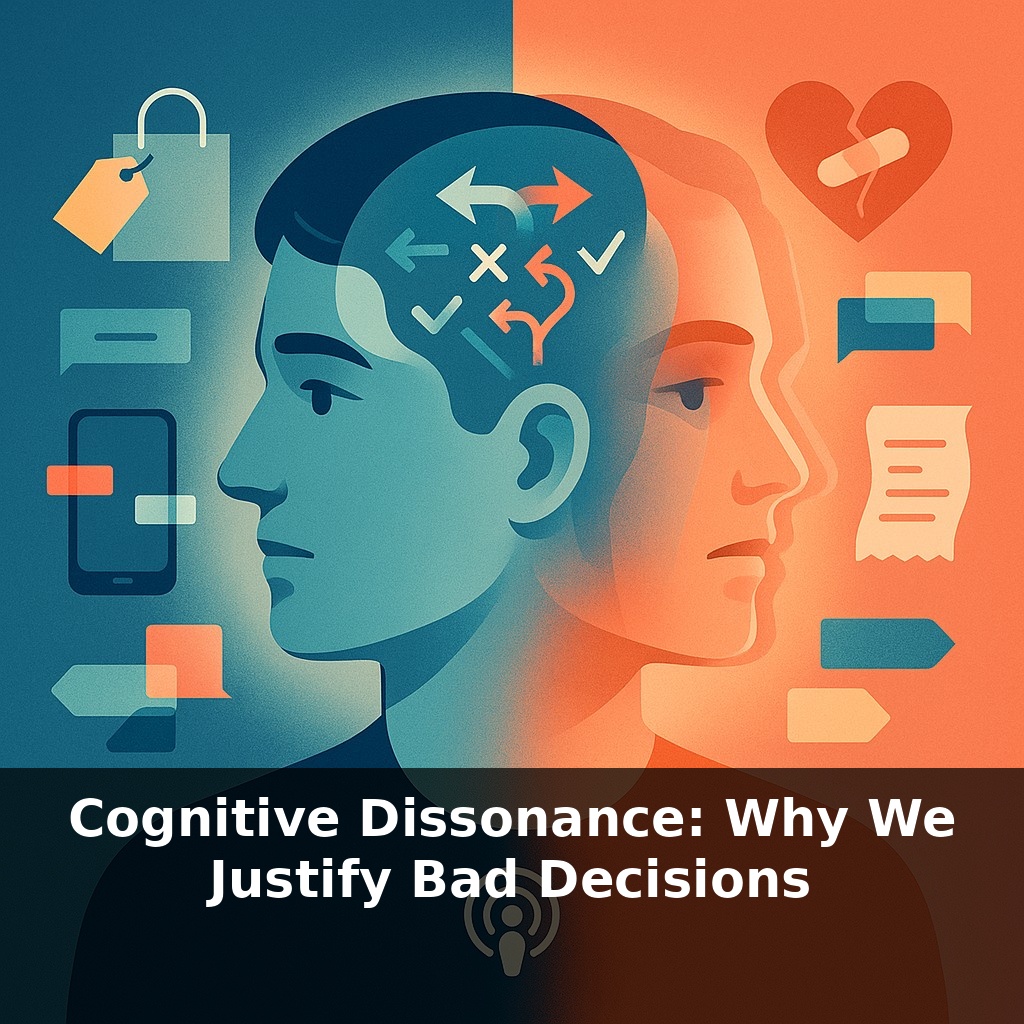
You can feel completely certain you’re right… at the exact moment your brain is quietly rewriting reality. A boring purchase becomes “an investment,” a bad relationship becomes “character building.” The strange part isn’t that we lie—it’s that we mostly lie to ourselves.
We don’t just rewrite reality after the fact; we often stage-manage it in advance. Think about how you talk about a pricey gadget before you even buy it: “It’s for work,” “It’ll make me more productive,” “It’s basically a tax write-off.” That’s not random chatter—it’s your mind quietly laying down psychological bubble wrap so the purchase will feel smart no matter how it turns out. The same thing happens in politics: we praise a candidate’s “tough leadership” today so it’s easier to excuse their scandals tomorrow. In teams, we defend a risky strategy as “bold” and “visionary,” which later helps us call a failure a “learning experience” instead of a mistake. We’re not just cleaning up our stories; we’re preloading justifications so our future selves never have to face the full sting of being wrong.
That mental editing isn’t random glitch—it follows patterns researchers can actually measure. In classic lab experiments, people who did something boring or even pointless later convinced themselves it was meaningful, just because admitting “I did this for a dumb reason” hurt too much. In everyday life, the stakes are higher: voters double down on a failing leader, executives defend a doomed project, couples stretch a dying relationship past its expiry date. The goal isn’t truth; it’s protecting a story about who we are. And the more public the choice, the harder that story is to quietly revise.
The mind’s contortions get especially vivid in the lab. In Festinger and Carlsmith’s 1959 study, people spent an hour on a mind-numbing task, then were asked to tell the next participant it was “interesting.” Some were paid $20, others just $1. Strangely, the $1 group later reported enjoying the task more. The big payment was enough external excuse: “I lied for the money.” The tiny payment wasn’t, so their minds quietly upgraded the experience: “Maybe it wasn’t so bad.” When our reasons are flimsy, our attitudes bend harder to protect the story that we’re sensible.
Modern tools show this process isn’t just storytelling after the fact; it flares up in real time. EEG studies pick up an “error-related negativity” signal just a quarter of a second after we click a choice that conflicts with our values or prior commitments. Your brain flags the mismatch almost before you’re consciously aware of deciding. What happens next—honest correction or creative justification—depends heavily on personality, stakes, and social context.
Markets run on this stuff. After big purchases, most people don’t neutrally assess, “Was this wise?” They go hunting for confirming evidence: glowing reviews, friends’ approval, any hint they “got a deal.” One consumer study found the vast majority of buyers of expensive items engaged in post-purchase rationalization within minutes—sharing proud photos, highlighting minor features, downplaying downsides. The more irreversible the decision, the more energetic the defense.
You see parallel moves in health behavior. Smokers confronted with sharp anti-smoking messages don’t just shrug; they react with elevated counter-arguments: “My grandfather smoked and lived to 90,” “Stress is worse than cigarettes.” The discomfort isn’t abstract guilt; it’s a direct clash between “I’m a rational person” and “I’m doing something I know is dangerous.” Arguing with the message is often easier than changing the habit.
Zoom out, and the same dynamics scale up. Teams double down on failing projects because killing them would mean “We misjudged the market.” Partisans reinterpret every new scandal as proof of media bias rather than rethinking their candidate. Memory even gets edited: we recall weak evidence as stronger, red flags as “not that bad at the time.” Over months and years, these tiny edits can turn one-off missteps into entrenched worldviews.
Your challenge this week: Each time you feel a prickle of defensiveness—about a purchase, opinion, or habit—pause and ask, “If I hadn’t already chosen this, would I choose it now?” Then, just once a day, act as if your honest answer matters more than protecting your past choice.
Think of a startup team that’s just raised a big round. Six months in, metrics are flat. Instead of asking whether the product solves a real problem, they reframe the story: “We’re in stealth growth mode,” “This is about brand-building,” “Investors know it’s a long game.” Each new slide in the pitch deck adds another layer of armor around the original bet.
On a smaller scale, watch what happens after a brutal meeting. A manager who snapped at a colleague might leave thinking, “That was necessary candor,” then later, “Actually, I was modeling high standards.” A week after, the story has evolved into, “I’m the only one willing to say what everyone’s thinking.”
Even friendship groups aren’t immune. When a long-planned trip turns into logistical chaos, no one wants to admit it was poorly organized. So the group narrative slowly shifts: “It was an adventure,” “We’re not like those tourists who over-plan,” “The mishaps made it authentic.” The worse the experience felt in the moment, the more ornate the shared story can become.
Politically, this bias can turn policy debates into loyalty tests: once we “pick a side,” facts feel like threats, not updates. In relationships, it keeps us clinging to “it’s fine” long after both people feel the strain. In workplaces, it rewards confident storytellers over cautious skeptics, so risky bets snowball. As AI systems learn our fault lines, they may serve custom-tailored excuses—like a financial app that highlights only the data that flatters our last impulsive trade.
Noticing this mental auto-tune isn’t about being harsher on yourself; it’s about gaining options. Once you catch the moment your story starts drifting, you can invite friction—friends who disagree, data that stings, drafts that feel rough. Like turning on track changes in a document, you don’t stop editing—you just choose which revisions stay, and why.
Before next week, ask yourself: “Where in my life right now am I clinging to a decision (a job, relationship, purchase, or habit) mostly because I don’t want to admit I might’ve been wrong, and what honest evidence contradicts the story I’m telling myself about it?” When you notice that uncomfortable twinge of “this doesn’t quite add up,” pause and ask: “If a close friend were in this exact situation, how would I explain the pros and cons to them—would I still justify it the way I’m doing for myself?” Finally, pick one recent choice you’ve been defending (like a big expense, a project you won’t drop, or a promise you regret) and ask: “If I started fresh today with no sunk costs, would I make this same decision again—and if not, what small course correction can I commit to in the next 24 hours?”