A majority of managers admit their first reaction to a problem employee is this: “Their attitude is the issue.” Now, hold that thought. Same manager, same day—but when *they* miss a deadline, the story flips: “You won’t believe the chaos I had to deal with this week.”
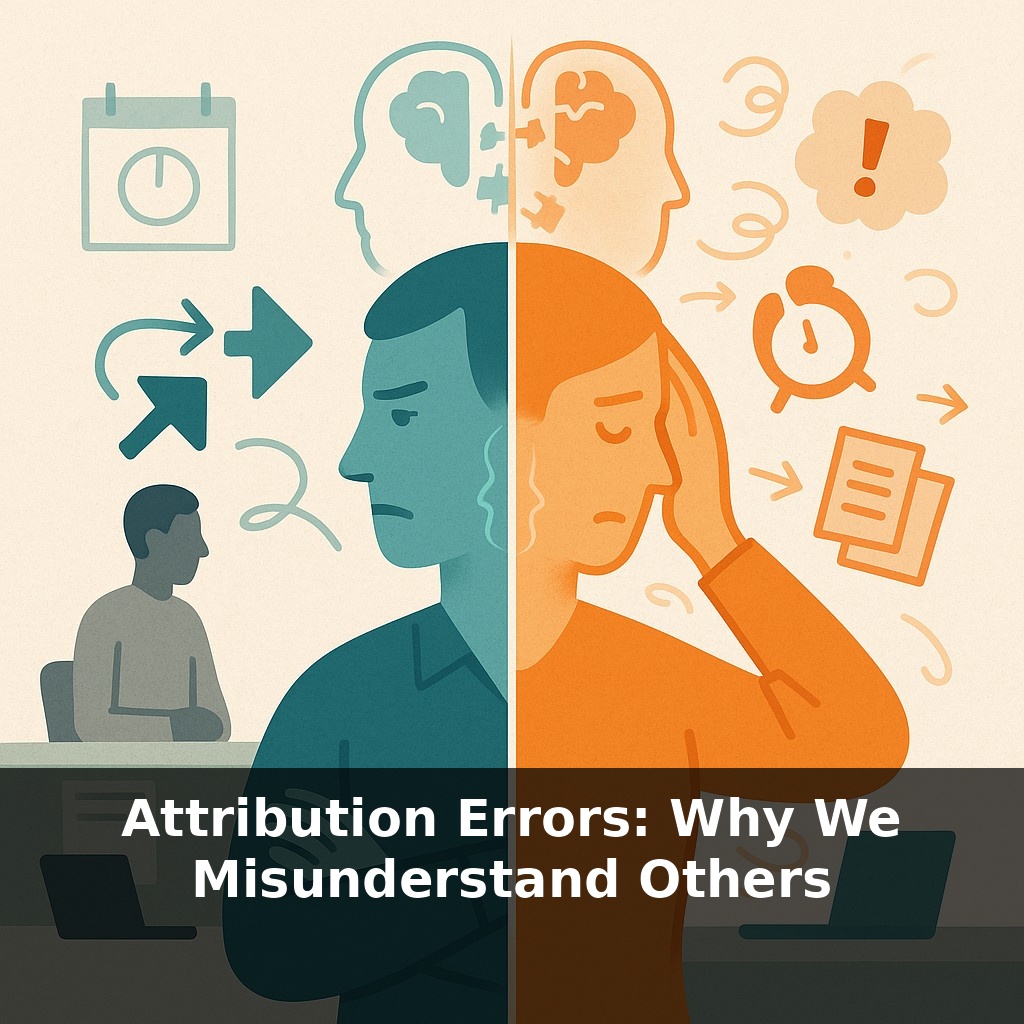
That mental double-standard isn’t random—it’s a built-in feature of how we explain behavior. In psychology, it’s called an attribution bias, and it quietly shapes who gets hired, who gets fired, who gets forgiven, and who gets written off. Across 173 experiments, researchers find we reliably lean on “who they are” explanations while giving ourselves the benefit of “what happened to me” stories.
Think about how we judge a colleague who’s late to a meeting versus our favorite high performer who does the same thing. The first becomes “unreliable”; the second gets a free pass because “they’re swamped this week.” Now scale that up to performance reviews, customer service calls, even news headlines. Our snap explanations become like default settings in a piece of software—hard to see, but constantly running in the background, nudging our reactions, decisions, and relationships.
So what’s really going on under the hood when we make these snap judgments? Part of it is simple: other people’s “situations” are usually invisible to us, while their behavior is right in our face. We see the missed deadline, not the broken tool; the curt email, not the migraine and five back-to-back calls. Our brains fill in those gaps with personality stories because they’re fast, tidy, and feel certain. Over time, those stories harden into labels: “difficult,” “lazy,” “star,” “rock-solid.” And once a label sticks, we start noticing only the evidence that keeps it in place.
Here’s where it gets stranger: we don’t commit just *one* kind of attribution error—we run several overlapping scripts at once.
First, there’s the classic observer/actor split. When you watch someone else drop the ball, the mind jumps to character. But when *you* drop the ball, your attention zooms in on circumstances. You know about the broken process, the unclear email, the last-minute change. Their world is compressed into a single moment; yours comes with a full backstory and director’s commentary.
Second, we quietly bend our explanations to protect our self-image. This is the self-serving pattern: my successes are “because of me,” my failures are “because of the situation.” If a presentation lands, it’s “I prepped well.” If it flops, it’s “the audience was checked out,” or “the brief was vague.” Research consistently shows this tilt: we take personal credit for wins and outsource blame for losses.
The twist: we often reverse that logic when judging people we dislike or groups we distrust. Their failures become proof of who they “really are,” while their successes are dismissed as lucky breaks or external advantages. That’s where attribution errors quietly fuse with stereotyping. Stereotypes live at the group level, but they’re fed by a stream of individual stories we misread and then file under, “That’s just how they are.”
Culture adds another layer. In more collectivist settings, people are trained—subtly but constantly—to scan for relationships, roles, obligations. That habit of attention makes situational explanations more available. In many Western workplaces, by contrast, the air is saturated with individual hero stories, so our interpretive reflexes stay locked on personal traits.
You see this dynamic everywhere performance is evaluated. In hiring, we overrate “grit” and “hunger” while under-weighting tools, mentorship, and starting conditions. In leadership meetings, a team underperforms and the narrative snaps into “weak leader” long before anyone audits incentives or workload. It’s cognitively cheaper to tinker with stories about people than to interrogate systems that might need overhauling.
Limits, though, matter. Attribution errors don’t mean traits are illusions, or that every outcome reduces to context. They mean our mental scales are skewed—and unless we recalibrate, we’ll keep making confident, tidy explanations in situations that are anything but.
In real workplaces, this shows up in subtle but costly ways. A sales rep misses quota three months in a row and quickly becomes “not hungry enough,” while no one checks whether her territory was quietly flooded with low-potential accounts. A nurse speaks sharply during handoff once and is tagged “unprofessional,” yet the understaffed, 12-hour shift behind it goes unexamined. In both cases, the story about the person replaces an investigation of the process.
You can even see it in how we judge entire teams. A customer-support group starts drowning in tickets, and leadership concludes, “They’re not proactive.” Only later—if ever—does someone notice marketing just launched a new feature without documentation.
At a broader scale, think of how investors talk about “genius founders” when times are good, and “clueless leadership” when markets turn, even if the underlying strategy barely changed. That’s attribution error written into the stories industries tell about success and failure.
When we scale misread behavior from one person to whole systems, it quietly shapes policy, law, and code. An HR dashboard that flags “low performers” without context can spread distorted stories the way a bad map misguides every traveler who uses it. The risk grows as AI tools score “risk,” “fit,” or “trustworthiness” from thin behavioral slices. Yet the same data streams could be used to surface hidden constraints—like bottlenecks or biased norms—if we design them to ask “what else might be true?”
Your challenge this week: when someone frustrates you, pause before narrating. Ask, “If this were happening to me, what unseen factors might I mention?” Then, like a good product manager debugging a feature, look for context: incentives, workload, timing, norms. You’re not excusing behavior; you’re upgrading from a flat sketch to a layered blueprint.