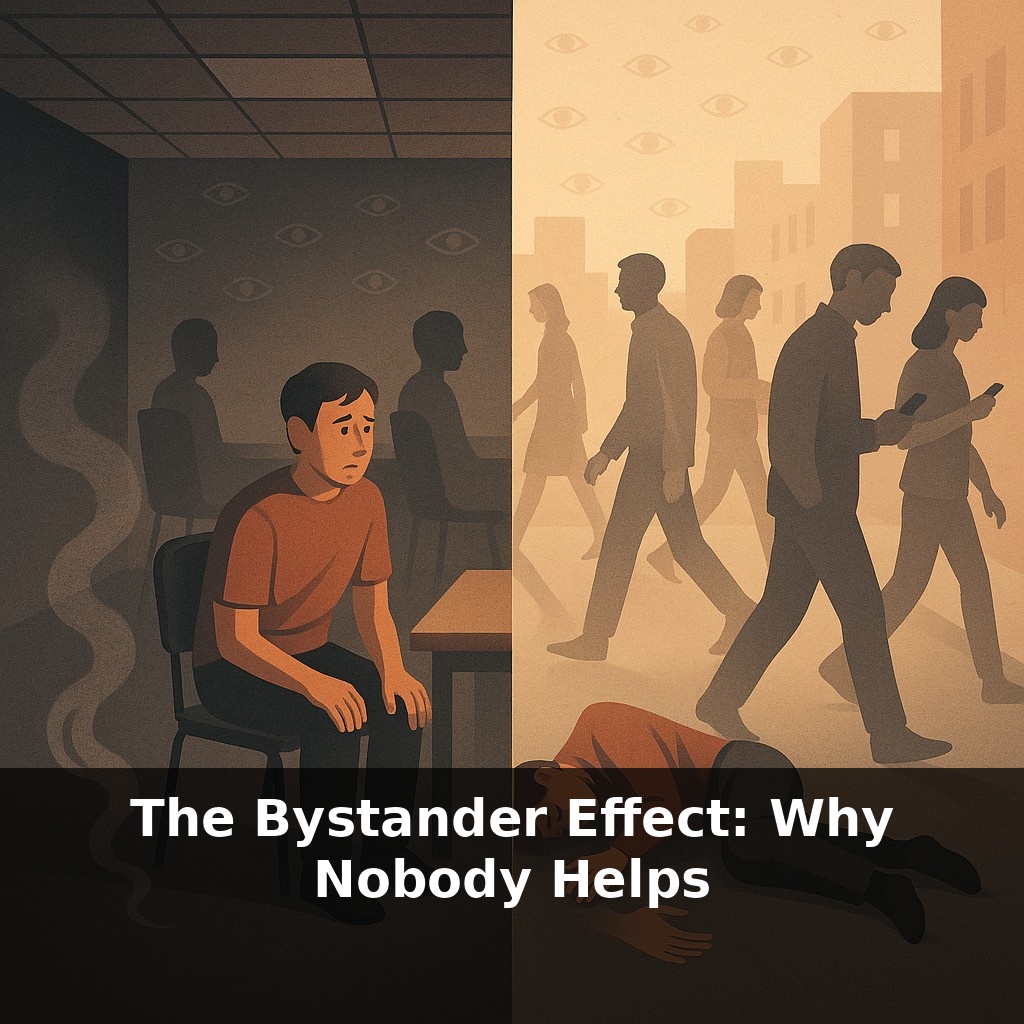
In a famous experiment, thick smoke quietly filled a room… and most people stayed seated. In another, a collapsed runner on a busy street was stepped around for minutes. Why do groups of ordinary, caring people so often freeze, watching an emergency unfold right in front of them?
Seventy-five percent of people alone in a room reported smoke within two minutes. Put three calm strangers beside them, and that number crashed to ten percent. Same smoke, same danger, same human—completely different behavior. This gap between what we *think* we’d do and what we *actually* do in groups is the unsettling territory we’re stepping into now. We’ve already seen how subtle social forces can freeze us; here we’ll zoom in on what *breaks* that freeze. Why does one person stepping forward suddenly unlock a wave of helpers? Why does learning CPR in a fluorescent-lit classroom change what happens on a dark sidewalk at 2 a.m.? And how did laws quietly reshape the moral math in our heads? Think of this as a kind of “social debugging”: we’ll dissect the specific toggles—training, clarity, personal responsibility—that switch people from silent witness to active helper.
Sometimes the crucial difference isn’t *who* you are, but what story your brain thinks it’s in. Are you “just another face in the crowd,” or “the person this moment belongs to”? Research now looks less at generic “bystanders” and more at the tiny cues that flip that story. A shouted “You in the blue jacket, call 911!” cuts through the fog. So does knowing that CPR success can literally triple a stranger’s odds. Even Good Samaritan laws quietly rewrite the script from “I might get in trouble” to “I’m protected if I try.” We’ll explore how these nudges turn silent observers into first movers.
When psychologists zoomed in on *who* actually breaks the freeze, a pattern appeared: it isn’t always the bravest, or the most “moral” person in the room. It’s often the one whose internal story flips *fastest* from “someone should do something” to “this is on me.”
One reliable trigger is *certainty*. Ambiguity is the bystander effect’s favorite fuel. In the smoke-filled-room study, the situation stayed vague; in contrast, when a person very obviously collapses and stops breathing, intervention rates climb. Modern CPR campaigns lean into this: “If they’re unresponsive and not breathing normally, start compressions. You can’t make it worse.” By shrinking the gray zone, they reduce the mental debate that eats up precious seconds.
Another quiet lever is *practice*. People who’ve taken a basic first-aid or CPR course don’t just know more—they *feel* more entitled to act. They’ve rehearsed the script: check, call, compress. In meta-analyses of real medical emergencies, trained laypeople consistently step in more often and sooner. The knowledge doesn’t turn them into heroes; it just removes one line of internal resistance: “I have no idea what to do.”
Then there’s the environment itself. Public access defibrillators with giant, idiot-proof diagrams; subway posters that literally script the words “You—call 911!”; campus bystander-intervention programs that drill students on how to interrupt harassment—these all work the same way. They pre-assign roles before anything happens. You arrive already half-cast as “potential helper,” not “irrelevant extra.”
Interestingly, digital spaces now replay these dynamics at scale. On livestreams where something disturbing happens, thousands may watch, waiting for “someone else” to report it. Platforms that add friction-reducing tools—one-click reporting, visible “X people have already flagged this” prompts—see more users step in. That “second helper” effect from street studies shows up online: once intervention is visible, additional help cascades.
Think of it like a piece of collaboration software set to “read-only” by default. Change the default to “you can edit this,” add a clear button labeled “fix,” and suddenly the same people behave as co-authors instead of passive viewers.
In one study on harassment in bars, staff trained with simple scripts (“Check in, distract, delegate, delay”) stepped in far more often than untrained staff—even though both groups *said* they would help. The difference wasn’t courage; it was having preloaded lines, like actors with a rehearsed scene. On college campuses, bystander trainings that use role-play—actually practicing what to say to a drunk friend or a pushy stranger—produce more real-world interventions months later. Practice moves you from “frozen observer” to “person who’s done this before.”
You can see the same pattern in neighborhoods that run disaster drills. After earthquakes and storms, residents who’ve walked through “Who checks on who? Where’s the meeting point?” are quicker to knock on doors and share supplies. They’re not waiting for “someone official,” because they’ve already been cast in the role of first responder-in-miniature. Just as a well-designed finance app nudges you to save by setting defaults, well-designed environments nudge you to help by assuming you will.
If crowds can be rewired to act, cities may start treating attention like critical infrastructure. Smart cameras could ping nearby phones with tailored prompts—“You in the blue jacket, check on the person at the corner”—turning anonymity into assignment. Online, platforms might spotlight early reporters the way apps highlight top reviewers, normalizing visible intervention. Even workplaces could run “micro-drills” for misconduct, like fire drills for ethics, so pausing a meeting becomes as routine as exiting a building.
So the real experiment isn’t in the lab; it’s in the next crowded hallway, stadium, or group chat you’re part of. Treat each gathering like a pick‑up game where you might be drafted: scan for the person who looks “between players,” test a small move toward them, and notice how quickly the script flips from “someone” to a specific name—possibly your own.
Here’s your challenge this week: At least once a day, deliberately *break the bystander effect* by being the first person to speak up or step in when you notice something off—like someone being talked over in a meeting, a classmate standing alone at lunch, or a stranger looking confused or lost. Each time, consciously use the “diffusion of responsibility” idea from the episode and tell yourself, “Everyone is thinking someone else will help—so I’m going to be the one.” Before the week ends, have at least one moment where you *explicitly* assign help by pointing to a specific person and saying something like, “You in the blue jacket, can you call for help?” instead of hoping “someone” will do it.