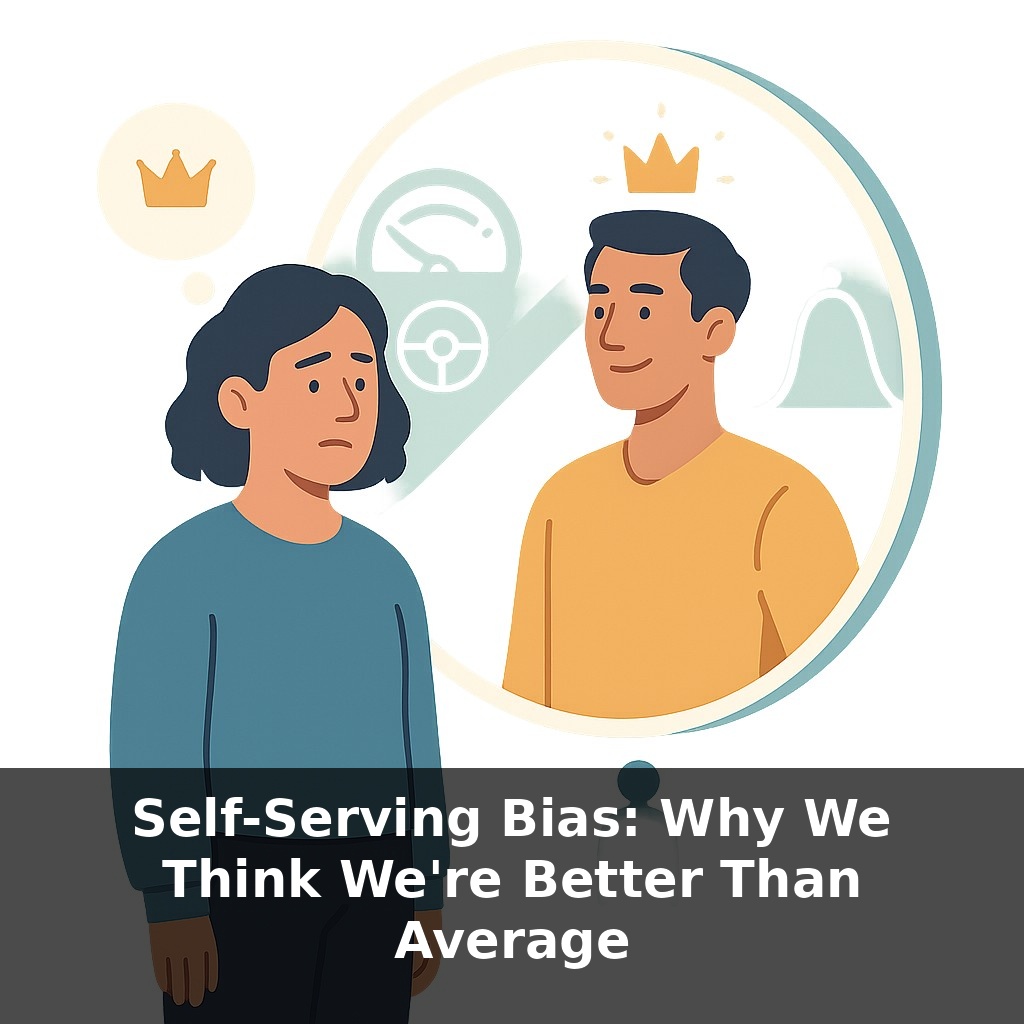
About nine out of ten people say they’re safer drivers than average. Statistically, that’s impossible—so who’s wrong, everyone else or the math? Today we drop into everyday moments where we quietly upgrade ourselves, and ask: why are we all convinced we’re the exception?
Think about the last time something went really well for you—a project at work, a tough exam, even parallel parking in a tight spot. How quickly did your mind whisper, “That’s because I’m good at this”? Now contrast that with a recent failure. The story probably sounded more like, “Terrible timing,” “The instructions were unclear,” or “No one could’ve done better with what I had.”
This quiet pattern—internal credit, external blame—doesn’t just shape how you remember yesterday. It slowly rewrites who you believe you are. It seeps into performance reviews, group projects, even conflicts with friends: we see our own effort, struggles, and good intentions in high definition, while everyone else’s look strangely low-res.
Across a lifetime, those tiny edits add up. We don’t just bend the story—we start living inside the edited version, certain it’s the original.
Now zoom out from single wins and losses to the running tally your brain keeps. It’s not a neutral scoreboard; it’s more like a home-field stadium where the crowd only really roars for your side. When you help a colleague, you see the late nights and invisible prep; when they help you, it shrinks into a quick favor. When feedback lands, praise feels like accurate reporting, while criticism gets mentally “fact-checked” or filed under “they don’t see the full picture.” Over time, this tilted accounting system doesn’t just protect your ego—it quietly edits what you think is fair.
Think about how this plays out in the small, ordinary judgments you make all day.
You glance at a messy shared kitchen and instantly know who’s been doing their part: you. You mentally list the times you took out the trash, wiped the counter, bought dish soap. You don’t have a similar highlight reel for anyone else, so your estimate of “who’s pulling their weight” quietly inflates your own contribution.
Psychologists find this again and again. Ask couples what percentage of the housework they do, the totals regularly add up to 120, 150, even 200 percent. Ask team members who contributed what to a project, and most people feel slightly under-credited. It’s not that everyone is lying; it’s that your own effort is vivid, and everyone else’s is compressed into a vague blur.
Under the surface, several forces are cooperating.
First, attention. You can’t help but have a front-row seat to your own struggles, late nights, and near-misses. That private footage makes your competence feel larger and your sacrifices feel rarer than they look from the outside.
Second, motivation. Seeing yourself as capable, fair, and decent isn’t just pleasant; it’s stabilizing. When something threatens that picture—negative feedback, a bad outcome—your mind leans towards explanations that preserve the story. Not consciously, more like a reflex.
Third, social comparison. You rarely compare yourself to actual population data; you compare yourself to the few people around you, filtered through selective memories. The coworker who missed a deadline looms larger in your mind than the dozens quietly meeting theirs. So “better than average” often means “better than the few examples that stuck in my head.”
And then there’s the reward system. Brain imaging work shows that slightly flattering views of yourself light up areas linked to pleasure and motivation. Your brain is, quite literally, paying you in tiny hits of “that felt good” when you interpret events in self-enhancing ways.
Over time, these nudges add up. You push a bit harder on interpretations where you come out looking competent and reasonable, and relax your standards on stories where you don’t. It’s subtle, but it shapes who you think is to blame, who deserves credit, and how risky your own choices really are.
Think about how this shows up in places that feel “objective.” In performance reviews, you might remember the nights you debugged a crisis or smoothed over a client call that never made it into the slides. So a “meets expectations” rating doesn’t just feel wrong; it feels like the reviewer missed half the movie. In group projects, you recall the three drafts you scrapped before the final version, while others only see the polished result and assume you coasted.
Money decisions aren’t immune either. When an investment goes well, it’s tempting to chalk it up to research and insight; when it tanks, suddenly it was “unpredictable markets” or “bad timing.” Over a decade, that pattern can keep you from noticing which of your habits are actually risky.
The same bias can even color ethics. People who cut small corners at work often see themselves as “basically honest” who made exceptions under pressure, while judging others’ lapses as character flaws. The rules feel slightly more flexible when they apply to you.
As AI, dashboards, and wearables start tracking more of life, your inner narrator may face a quiet rival: numbers that don’t care how hard you tried. That clash can sting—like seeing a fitness app log “3,000 steps” after a day you *felt* nonstop busy. But it’s also a chance. Teams that regularly compare gut feelings with shared metrics can spot blind spots earlier, argue less about “who did more,” and shift energy from defending reputation to improving reality. Over time, the skill won’t be feeling above average, but staying accurately calibrated in a noisy world.
So the work isn’t to stop self-protection; it’s to aim it better. Treat flattering stories like draft versions, not final reports. Ask: “What would this look like on replay?” or “What might someone else reasonably say here?” A mind that can enjoy a confidence boost *and* update when the plot disagrees becomes less fragile—and more trustworthy.
To go deeper, here are 3 next steps: 1) Take the free “Honesty–Humility” and “Self-Enhancement” scales at a site like OpenPsychometrics.org and compare your scores with the episode’s examples of self-serving bias in driving, intelligence, and morality—treat the results as data, not a verdict. 2) Read Carol Tavris & Elliot Aronson’s *Mistakes Were Made (But Not by Me)*, and as you go, pause at each chapter break to ask, “Where do I do this exact thing?” in your work feedback, relationship conflicts, or social media arguments. 3) Install a simple reflection tool like Daylio or Journey and, for the next 7 days, log one event per day where something went wrong, tagging who you blamed first (you, others, or circumstances), then review the week’s pattern against the podcast’s description of the “better-than-average” effect.