The Automatic Brain: Why We Make 95% of Decisions Without Thinking
📝 Transcript
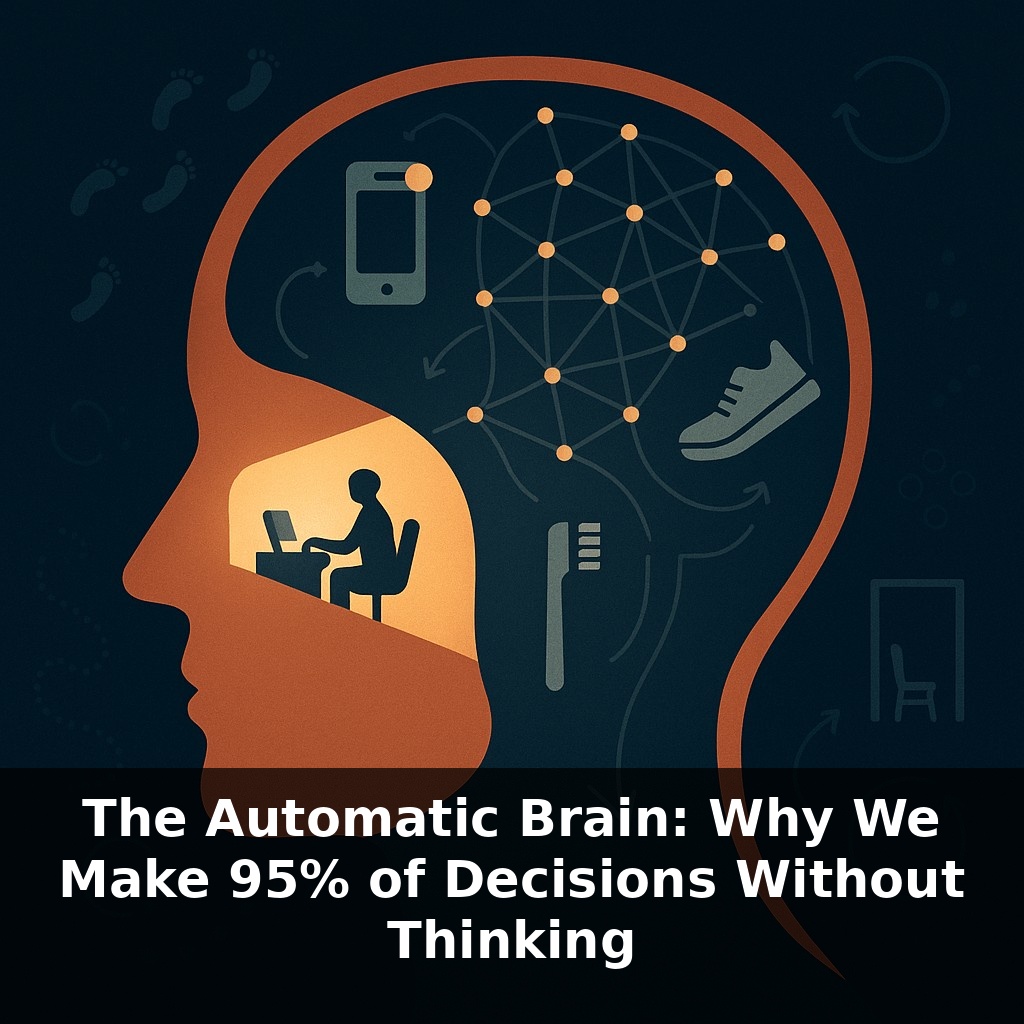
Right now, almost everything you’re doing is being decided by a part of your brain you never hear from directly. You think you’re steering—but your autopilot is. Walking into a room, choosing a seat, glancing at your phone: which of those did you *actually* choose today?
You probably didn’t “decide” which shoe to put on first this morning. Or how long to brush your teeth. Or whether to check your notifications before you got out of bed. Those tiny moves were already wired in—like well‑worn paths your mind slips into before you’re even fully awake.
What’s wild is how *big* the consequences of those tiny, preloaded moves can be. The same automatic patterns that choose your morning routine also nudge who you notice in a meeting, how you respond to a partner’s tone, and whether you scroll past a difficult task or face it.
And most of this runs quietly, triggered by cues you barely register: a buzz in your pocket, a familiar logo, the way a room is arranged. In this episode, we’ll pull those cues into the light—not to shut down your automatic mode, but to see when it’s serving you, when it’s steering you off course, and how others are already designing for the version of you that isn’t fully “at the wheel.”
Marketers, app designers, and even city planners quietly bet on this: if they can control what your brain sees first, they can often predict what you’ll do next. Grocery stores don’t put candy at kids’ eye level by accident. Social apps don’t choose red for notification badges because it’s “pretty”—it’s because your threat‑detection circuits snap to it. Over time, your brain turns those setups into expectations: where to click, what to trust, when to feel left out. In this episode, we’ll trace how environments get “wired into” you—and how to start rewiring them back in your favor.
If we zoom in on those fast, backstage processes, three big systems quietly shape what you end up doing.
First, habits: the brain chunks repeated actions into tight “loops”—cue, routine, reward—until they run with almost no effort. You tie your laces the same way every time not because it’s best, but because your neurons have smoothed that path through repetition. The same structure underlies far less innocent patterns: opening a social app whenever you’re bored in line, reaching for snacks the moment a show starts, replying “yes” to meetings without pausing. Each loop frees up effort—but also narrows your options. The more a loop fires, the less likely you are to even notice alternatives.
Second, shortcuts for judging the world: when a choice feels too complex, fast circuits lean on quick rules. “This looks familiar, so it’s probably safe.” “Everyone else seems into it, so it’s probably good.” That’s how a long list of biases gets teeth in everyday life. In a hiring round, a familiar university logo can feel more “competent” before you’ve read the CV. In investing, recent market news can weigh far more than older, more solid data. These aren’t you being “irrational” on purpose; they’re speed‑ups built for a world where slowness once meant danger.
Third, emotional tagging: experiences get stamped with quiet “approach” or “avoid” labels. Your body tenses in a type of meeting that once went badly. A particular notification sound brings a tiny hit of anticipation. Over time, your brain builds a private map of “good” and “bad” territory, and that map starts guiding your steps long before any conscious reasoning catches up.
Designers exploit all three. A subscription page may highlight the “recommended” plan in a bold color, counting on your tendency to follow the apparent default. A workplace might place the healthiest food at the first point of eye contact, knowing few people will scrutinize every option. Even the layout of your desk can either invite deep work or constant grazing on shallow tasks.
System 1 is like a well‑tuned sports playbook: once rehearsed, the team moves almost automatically, executing patterns without huddling each time. But if the playbook was written by someone with different goals—an app growth team, a political campaign, or just your past self in a very different season—you may find yourself “running plays” that no longer match what you actually want.
Think about how you move through a typical workday. You open your laptop and your fingers go to the same three tabs—email, chat, one news site—before you’ve “decided” your priorities. Or you walk into a meeting room and sit in the same corner you always do, which quietly decides how much you speak up and who you interact with. No one told you to do that today; yesterday wrote the script.
These quiet scripts show up in money, too. Your bank app might surface a big, friendly “Pay minimum” button on your credit card screen. That tiny nudge, repeated monthly, can cost you thousands over years. Or think about streaming platforms: the next episode countdown doesn’t just keep you watching tonight—it trains your future self to treat “one more” as the default.
Urban designers know this well. When a city adds a protected bike lane, cycling rates jump—not because everyone suddenly “chooses health,” but because the path of least resistance changed. Shift the path, and behavior follows.
As more of life runs through sensors and algorithms, those quiet patterns become data. Your grocery trips, late‑night scrolling, even thermostat tweaks can train systems to anticipate you almost better than you do. That unlocks convenience, but also lets companies “steer” choices the way a GPS calmly reroutes you down a toll road. The frontier question isn’t just “What do I want?” but “Who is quietly drafting the script my future self will follow?”
The real opportunity isn’t to shut off your inner autopilot, but to become its architect. Start by noticing where life already feels “pre‑decided”—the app you tap when you’re tired, the tone you slip into under stress. Each is like wet concrete: still soft enough to reshape, firm enough to hold a new groove if you choose to pour it differently.
Before next week, ask yourself: 1) “In what situations today did my ‘automatic brain’ take over—like checking my phone, saying yes out of habit, or reacting emotionally—and what tiny cue (time of day, place, person) usually triggers it?” 2) “If I paused for 5 seconds before one of those automatic reactions, what alternative response would better match the kind of person I want to be?” 3) “What’s one recurring decision (e.g., eating, spending, replying to emails) I can turn into a conscious ‘if-then’ rule—‘If X happens, then I will Y’—so my automatic brain starts working for me instead of against me?”
From this course
Why We Do What We Do
7 episodesUnlock all episodes
Full access to 7 episodes and everything on OwlUp.
Subscribe — $1.99/monthLess than a coffee ☕ · Cancel anytime