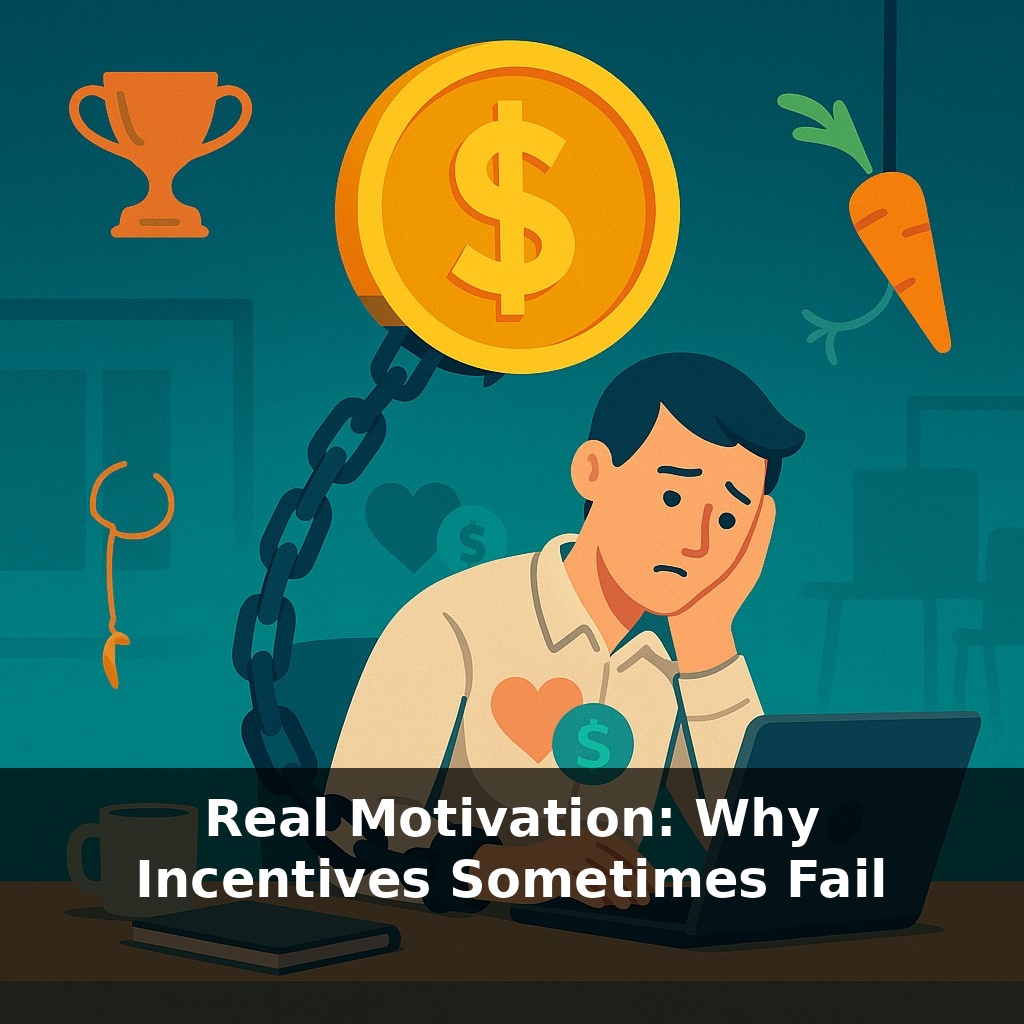
About half the people listening to this are being paid in ways that quietly make them care less about their work. A bonus hits your account, applause in the meeting… and somehow your motivation drops. How does a “reward” turn into the very thing that kills your drive?
In most workplaces, the default fix for “people aren’t doing what we want” is simple: add more money, points, or perks. Sales slipping? Offer a bonus. Deadlines missed? Launch a contest. Someone in a meeting says, “Let’s give people an incentive,” and heads nod as if gravity just spoke.
But the data you rarely hear in those rooms is this: when the incentive feels like a leash, performance on anything complex often gets worse, not better. People start doing only what’s measured, cutting corners, and quietly disconnecting from the parts of the work that once felt meaningful.
And here’s the twist: it’s not just toxic bosses who trigger this. We do it to ourselves—turning hobbies into side hustles, friendships into networks, learning into “upskilling”—layering transactions onto areas of life that once felt freely chosen.
Here’s where the story gets stranger. Large-scale data says most people aren’t loudly rebelling; they’re quietly pulling back. Gallup estimates that “quiet quitting” is now the dominant work style on the planet, draining almost 9% of global GDP. Yet many organizations respond by stacking on more bonuses, more leaderboards, more “top performer” badges. In the short term, numbers may tick up. But below the surface, something shifts: people stop asking, “What’s the best way to do this?” and start asking, “What will get me the points?” Over time, curiosity, courage, and care begin to evaporate.
Here’s the uncomfortable pattern researchers keep finding: when you dangle a prize in front of people, their minds often narrow. Attention shifts from “How can I do this well?” to “How can I get the thing?” That shift sounds small, but it changes *what kind* of effort shows up.
In Deci and Ryan’s work, three ingredients show up again and again when people feel deeply engaged: autonomy (I have a real say in *how* I do this), mastery (I can get better at something that matters), and purpose (this connects to something bigger than my ego or wallet). The twist is that the very tools meant to energize can quietly erode those pillars.
A sales contest that pays the top 10% can broadcast, “We don’t trust your judgment—just chase this one number.” That eats away at autonomy. A teacher paid only on test scores starts teaching to the exam instead of improving as an educator; growth becomes less about craft and more about gaming metrics, so mastery flattens. A nurse offered a small bonus for each patient survey risks feeling that care has been reduced to a customer-satisfaction coupon; purpose gets downgraded to optics.
The data-entry versus problem-solving result from the World Bank captures this divide. When a task is simple and routine, extra pay can act like a stronger battery. When a task is complex, uncertain, or creative, that same battery overheats the system: people rush, rely on clichés, or freeze under pressure.
Companies run into this with “stretch” bonuses that accidentally punish collaboration. If only individual numbers are rewarded, sharing knowledge becomes a cost. You might withhold a clever tactic from a colleague because the system pays you to compete with them, not to build something together.
And the Israeli day-care study shows another twist: once you put a price on a behavior, people can reinterpret it as a legitimate option. A fine can feel less like a moral boundary and more like a fee-for-service. Remove the fee, and the underlying norm is weaker than before.
So the paradox is this: the more you try to *control* people with carrots and sticks, the more you risk weakening the very inner forces that make them reliable, creative, and ethical in the first place.
At one tech company, engineers earned gift cards for closing the most support tickets each week. Within a month, tricky bugs started piling up. People cherry‑picked only the fastest, shallow fixes because the system quietly taught them: speed beats substance. Customers felt it first; trust eroded long before dashboards did.
A different team flipped the script. They kept pay stable but created a rotating “architect of the month” role, chosen by peers for raising others’ game—sharing tools, pairing on gnarly problems, documenting hard‑won lessons. No extra cash, just time, status, and input on the roadmap. Output rose anyway, but so did cross‑team mentoring and patience with hairy projects.
The contrast is similar to refactoring an old codebase versus bolting on quick plugins. Plugins might show instant results, but too many leave the core fragile and opaque. Intentional refactoring takes longer, feels less flashy, yet quietly makes everything else easier, safer, and more scalable over time.
By 2030, more of your “why” will be inferred from data traces—calendar patterns, keystrokes, even how often you pause in tools. Done well, that could feel like a smart coach, surfacing projects that fit how you like to contribute. Done badly, it’s like a GPS that keeps “rerouting” you toward what’s easiest to measure. The open question isn’t just what systems can nudge you toward, but how much say you’ll have in training the nudger itself.
So the next time someone offers “extra” for doing X, you can pause and ask: what invisible cost comes with the deal? Think less about the carrot and more about the path it nudges you onto—like choosing a hiking trail that looks short but erodes the hillside. The experiment ahead isn’t just doing more; it’s protecting the parts of you that do things freely.
To go deeper, here are 3 next steps: (1) Grab Daniel Pink’s *Drive* and read the short section on autonomy vs. incentives, then pick ONE existing bonus/points scheme in your life (like a fitness app streak or sales bonus) and compare it directly against Pink’s three drivers: autonomy, mastery, and purpose. (2) Open the “Nudge for Change” toolkit from the Behavioural Insights Team (BIT) and use their EAST framework (Easy, Attractive, Social, Timely) to redesign a single incentive you’re currently using—e.g., turn a cash-reward habit tracker into a social commitment with visible progress and a clear, time-bound trigger. (3) Install a habit app that supports non-monetary rewards (e.g., Habitica or Streaks) and configure one habit you’ve been “bribing” yourself to do—swap the old reward (like buying something) for an intrinsic-oriented one (leveling up, public streak, or contribution to a meaningful project) and test-run it for the next 7 days.