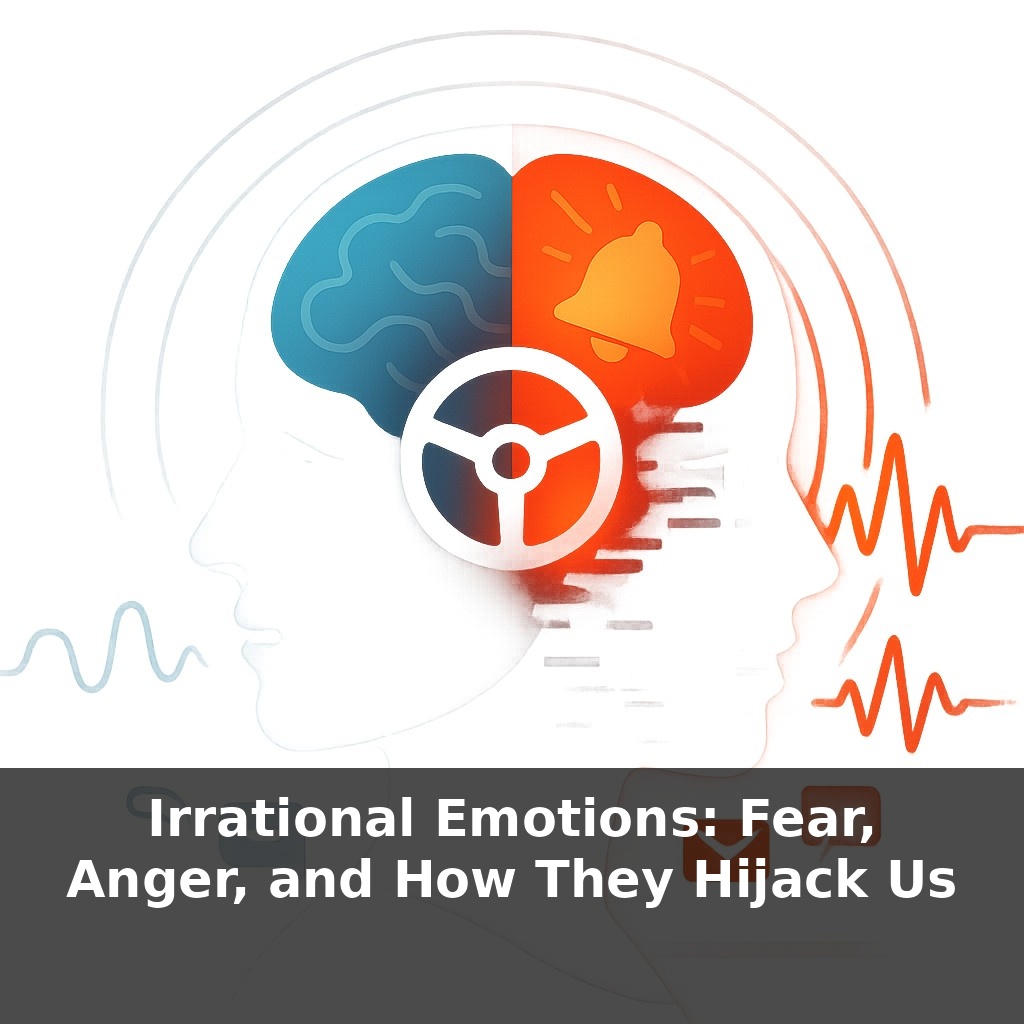
Right now, your heartbeat, your voice, even your next email reply can be hijacked by a brain alarm that goes off before you’re consciously aware of anything. In a single instant, fear or anger can quietly grab the steering wheel of your behavior—while you still feel “in control.”
That hidden alarm doesn’t just change how you feel; it quietly rearranges what you *see* as real. A tense meeting suddenly looks like an attack. A neutral text reads like an insult. The same partner, colleague, or stranger can flip—instantly—from “ally” to “enemy” in your mind, even if they haven’t changed at all.
Under that surge, your brain starts running a different script: people become obstacles, motives seem darker, risks look either enormous or strangely invisible. You’re not just reacting strongly; you’re perceiving a different world.
This is why arguments spiral over minor issues, why groups polarize online, why entire communities can move from concern to outrage in hours. The alarm shifts your inner map of “safe vs. dangerous,” and your thoughts race to keep up, often inventing reasons after the fact. Understanding that shift is the first step to interrupting it—before it turns a passing spike into a lasting story.
When that inner alarm flips your world, it also quietly rewrites your *priorities*. Sudden silence from a friend feels urgent; the email from your boss becomes the only thing that matters; a stranger’s comment online outweighs a decade of real relationships. Your brain starts reallocating “processing power” toward hunting for threats, and away from nuance, curiosity, and long‑term goals. That’s why in these moments you’re more likely to interrupt, to click on sensational headlines, or to double down in arguments: the system built to protect you is now optimizing for *speed* over *accuracy*.
Most people never notice the exact moment that shift happens, because it unfolds faster than your conscious story can keep up. Neuroscientist Joseph LeDoux has shown that one pathway from your senses to your emotional circuits can fire up to about 200 milliseconds *before* the slower, reflective route comes online. By the time you “decide” you’re offended, threatened, or disrespected, your body has already placed a bet.
That bet isn’t random. It’s based on pattern‑matching from your history: arguments you’ve had, failures you still wince about, moments you felt powerless. The network handling this—amygdala, hippocampus, insula, prefrontal regions—is constantly asking: “Have we seen something *like this* before, and how bad was it?” A clipped tone from a colleague can be quietly linked to a parent’s shouting, a delayed reply to memories of being excluded. Your present gets graded using someone else’s exam key: your past self’s.
This is where “irrational” shows up. Under that fast evaluation, you’re more likely to: - Overestimate risks when you feel anxious (economic studies find about 25% inflation in perceived danger) - Underestimate the costs of lashing out when anger narrows your focus to “winning” - Fill in missing information with the worst‑case explanation, then defend it as fact
And yet, these reactions are not destiny. That same network is plastic. With practice, you can change both *how often* the shortcut fires and *how long* it dominates. Cognitive reappraisal—deliberately reframing what something means—has been shown to cut anger intensity by roughly a quarter. Mindfulness training, practiced regularly, can literally reshape the circuitry: eight‑week programs have been linked to reduced amygdala volume and stronger connections to regulatory areas.
The point isn’t to mute emotion or to worship “cold logic.” Emotion is data: it flags what matters, what feels at stake. But when the fastest circuits keep winning the internal race, the data gets distorted. The task is to lengthen the gap between surge and action just enough for a second opinion to weigh in—so your next move reflects both what you feel *and* what you actually value.
You can see this shortcut at work in small, ordinary moments. You’re drafting a careful email, then notice a vague line from your manager: “We need to talk.” Your pulse jumps, focus tunnels, and suddenly the report you were polishing feels pointless. Nothing external has changed in those few seconds except your interpretation, yet your decisions about what matters, what to say, even whether to hit “send” are now being filtered through that spike.
Or take a team meeting: one colleague cuts you off mid‑sentence. Before you register the words, your jaw tightens, you stop listening, and you start mentally composing a rebuttal. Afterward, when you cool down, you might realize they were rushing to meet a time limit. The initial surge wasn’t “wrong” so much as incomplete—it gave you a *draft* reaction.
Think of athletes who’ve trained to pause after a bad call. They still feel the flare, but they’ve practiced a micro‑routine: exhale, adjust posture, reset focus. That tiny inserted step doesn’t erase the feeling; it prevents one moment from dictating the whole game.
Courts, schools, and workplaces are starting to treat emotional hijacks less like moral failures and more like software bugs. Leadership trainings now include “cooldown drills” before negotiations; some judges allow brief regulation breaks for traumatized defendants. Wearables that flag your rising arousal could soon work like a co‑pilot, nudging you to pause before you send that furious message or agree to a lopsided deal. As these tools spread, “think before you act” may become a shared, supported norm, not just advice.
Your challenge this week: when you feel a spike, delay your next move by one extra breath and one tiny question: “What else could this be?” Treat each flare‑up like a pop‑up window—you don’t have to click it. Over time, that small experiment doesn’t erase strong reactions; it turns them into draft versions you can revise instead of final verdicts you must obey.