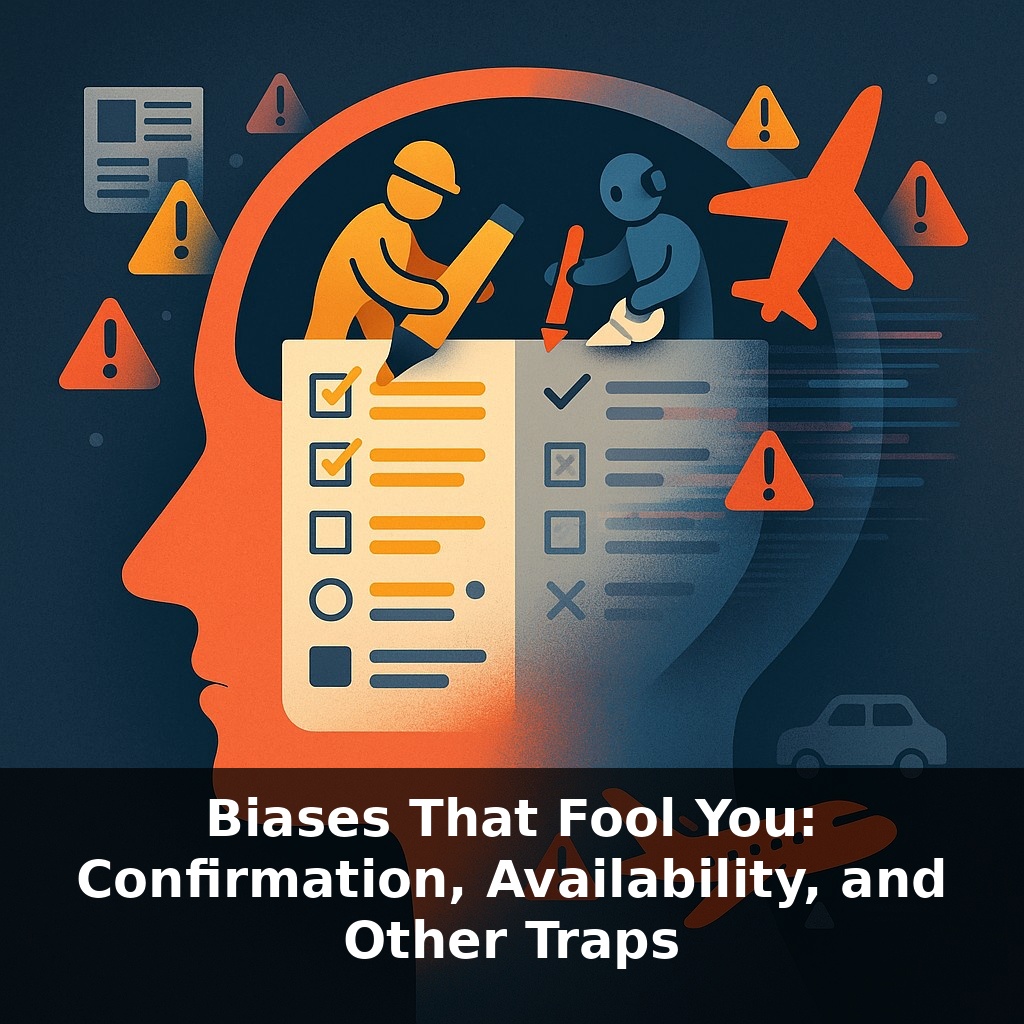
About half of us think flying is more dangerous than driving—despite the data saying the opposite. You’re not bad at math; your brain is cheating. In today’s episode, we’ll step into that cheating process and ask: when do our “gut feelings” quietly rewrite reality?
So let’s move from “my brain is cheating” to “where, exactly, is it editing the test answers?” In this episode, we’re focusing on two of the laziest editors in your head: the one that only highlights what agrees with you, and the one that bolds whatever just walked in the door. These habits don’t just shape what you think about plane crashes and car trips—they quietly steer who you trust, what news you consume, how you vote, and even which doctor’s advice feels “right.”
We’ll look at how these patterns show up in everyday decisions: choosing investments, interpreting medical risks, arguing with friends online, sitting in safety meetings at work. We’ll also see how smart teams—from space agencies to investment firms—have learned to catch these mental shortcuts in the act, not by being more rational superheroes, but by redesigning the situations where important choices are made.
Think about where these mental habits actually bite: not in abstract psychology labs, but when you’re scanning headlines, weighing a job offer, or deciding whether that odd symptom needs a doctor. Bias shows up in the sequence: what you notice, what you remember, and what you dismiss as “noise.” It’s in the meeting where only optimistic projections make it onto the slide deck, or in the family debate where everyone cites stories, not statistics. In each case, perfectly smart people can walk away more confident and more wrong at the same time—and never feel the stumble.
When researchers watch these patterns in real time, they don’t look for dramatic mistakes; they look for tiny tilts that add up. In one Pew study, people didn’t refuse opposing articles—they just lingered 36% longer on pieces that agreed with them. It’s the extra scroll that matters. Over a year of news, that small preference quietly engineers two different realities for two equally sincere readers.
Something similar happens with risk. We “know” flying is safer, yet surveys show nearly half of Americans feel the opposite. The rare, vivid crash leads the mental highlight reel; the millions of uneventful landings never make the cut. In lab setups, psychologists can nudge this highlight reel on command: ask people to recall many examples of something rare, and their estimated probabilities swing 30–40%. Your internal statistician isn’t evil; it’s just trained on anecdotes, not denominators.
These tilts don’t stay in our heads—they get built into systems. Inside NASA before the Challenger launch, engineers had scattered concerns about the O-rings. But the data that didn’t fit the “launch is safe enough” narrative was treated as outlier noise. The official story hardened faster than the evidence did. Something parallel shows up in corporate forecasts: teams most confident in their numbers are often those that never seriously entertained disconfirming scenarios.
That’s why some investment firms now institutionalize dissent. McKinsey reports that funds using formal “red-team” reviews—dedicated groups tasked with breaking the preferred story—cut forecast errors by 15%. The genius isn’t in having super-rational people; it’s in forcing multiple, incompatible stories to collide before money moves.
One helpful way to see this is to borrow from technology: your internal “recommendation engine” is constantly pushing familiar, recent, emotionally charged items to the top of the page. If you never question the feed, you’ll mistake what is easy to see for what is most true.
The hopeful twist: because these distortions are systematic, they’re also predictable. That means we can design frictions and rituals—at home, at work, in policy—that catch the tilt early, before confidence outruns accuracy.
A quick way to spot these patterns is to watch them leak into very ordinary choices. Think about who gets invited to speak in meetings: the person whose last project went well gets called on first, while quieter colleagues with less visible wins stay in the background. Over a year, that “who comes to mind first” shortcut shapes careers more than formal performance reviews. Or picture a hiring panel glancing at a résumé from a familiar university; without anyone saying it out loud, questions get a little softer, smiles a bit warmer, references skimmed more generously. By the end, the “best candidate” can look suspiciously like whoever matched the panel’s starting story. Something similar happens with health decisions: one friend’s dramatic side‑effect tale and a single alarming headline can outweigh a doctor’s calm explanation of trial data, nudging people toward or away from treatments in ways they’d never endorse on paper. None of these moments feel like mistakes; they feel like being “careful” or “just using common sense.”
As more choices are routed through dashboards and algorithms, the “tilt” in our judgments can quietly scale. A single skewed metric on a manager’s screen can redirect whole careers; a flawed training set can steer millions of loan or hiring decisions. Bias audits may become as routine as financial audits, and teams might treat dissent like a core resource—inviting structured pushback the way athletes rely on coaches to spot blind spots they can’t see mid‑game.
Treat this less like fixing a broken compass and more like learning a new instrument: you’ll hit off‑notes while you train your ear. Noticing when you’re clinging to the catchy tune instead of the accurate score is progress, not failure. Over time, that practiced discomfort—checking the chart, not just the chorus—becomes its own quiet form of freedom.
Start with this tiny habit: When you catch yourself nodding along to an opinion you already agree with (like a news story, tweet, or podcast take), pause and whisper to yourself, “What evidence would change my mind on this?” Then, type just one opposite search into Google (for example, add “downsides,” “criticism,” or “opposite view” to the topic) and scan only the first headline you see. If you feel defensive, simply label it in your head as “confirmation bias doing its thing” and move on—no need to debate or go deeper unless you want to.