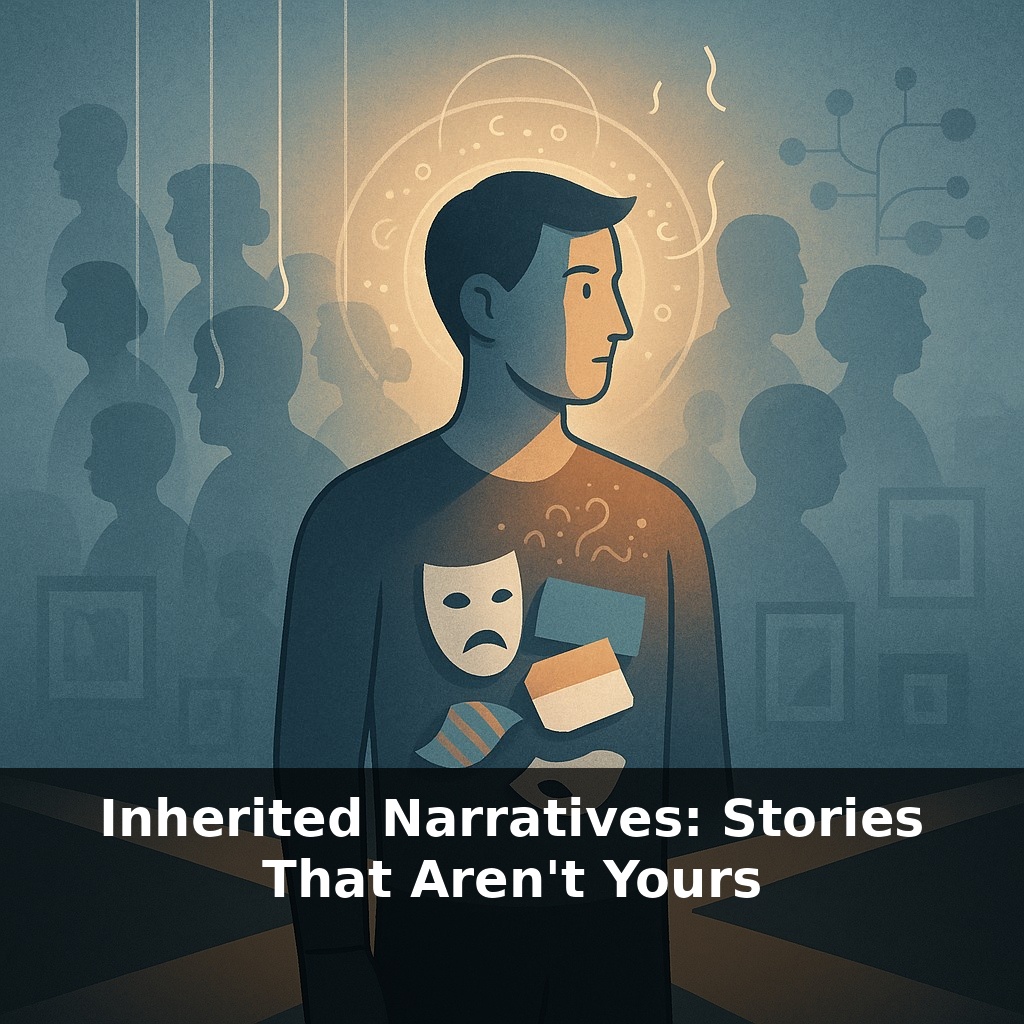
About half your thoughts today will be reruns. Same lines, same roles, same ending. You wake up already cast: the “responsible one,” the “difficult one,” the “quiet one.” Surprisingly, many of those roles were scripted before you ever had a say, and you've been improvising within someone else's narrative all along.
Maybe your story didn’t start with you, either. “We’re not artistic in this family.” “The men here don’t cry.” “In our culture, you pick stability over passion.” Lines like these sound like casual comments, but underneath them lies a significant influence on personal identity.t your nervous system treats them like instructions. Over time, they harden into “truth,” then into identity: you stop applying for certain jobs, hide parts of your personality, or overperform just to stay “the strong one.”
Psychologists call these inherited narratives—beliefs about what people like you can, should, or must do. Sociologists track how they echo across generations; neuroscientists see them in brain pathways that fire so often they become shortcuts. They’re efficient, but not always accurate. The problem isn’t that these stories exist; it’s that most of us never question who authored them—or whether they still deserve a role in the life you’re actually living.
Some of these stories are obvious: the aunt who announces at every holiday, “You were always the stubborn one,” or the teacher who decides you’re “not a math person” and never revises the verdict. Others are quieter, woven into routines—who’s expected to call first, who handles money, who gets praised for sacrificing versus speaking up. Over years, these patterns sink under the surface like background apps on your phone: invisible, always running, silently draining battery. You might only notice them when you try something new and feel a strange guilt, fear, or resistance that doesn’t quite feel like it belongs to you.
Here’s where it gets tricky: most inherited narratives don’t arrive labeled “Warning: This might not be true.” They show up as “just the way things are.” That’s why research matters—because it shows these stories are not mystical fate; they’re patterns with fingerprints.
Psychologists see those fingerprints in repetition. If as much as 70% of your thoughts are repeats, that’s less “fresh insight,” more “syndicated episodes.” Sociologists notice how similar lines appear in different households that share a culture, class, or history: “People like us don’t rock the boat,” “First‑gen kids don’t choose risky careers,” “Women in this community hold the family together.” Neuroscience adds that well‑worn mental routes become the default—not because they’re wise, but because they’re fast.
Some of these hand‑me‑down stories are powerful assets. A grandparent who survived war may pass down a quiet mantra of “We find a way.” Children of migrants often inherit a narrative of grit: “We work twice as hard, we figure things out.” These stories can act like internal scaffolding when life shakes.
Others function more like invisible ceilings. “We don’t talk about feelings” can turn into panic when you actually need help. “Our family just has bad luck with money” can numb your curiosity about learning financial skills. In therapy offices, nearly half of clients point back to earlier family dynamics when they try to explain why they keep repeating patterns they don’t actually endorse.
Sometimes the narrative goes beyond words into the body. Studies on families of trauma survivors suggest that stress can leave biological echoes in later generations: more sensitive alarm systems, different stress‑hormone patterns. You might grow up in relative safety yet still carry an internal expectation that danger is always one step away. That, too, is a kind of story: “The world will turn on you; stay small, stay ready.”
The point isn’t to blame your parents, culture, or history. Everyone is improvising with the stories they were given. The point is to recognize you are now a co‑author. You don’t have to shred the old pages; you can annotate them. “Yes, my family prized self‑sacrifice—and I’m adding a chapter on rest.” “Yes, my culture values stability—and I’m allowed to experiment inside that frame.”
Awareness is the moment you notice, “Oh, this line in my head has a source.” Choice begins right after: Do I still want to live by it, or is it time to edit the script?
Take the label “the reliable one.” In practice, it might look like agreeing to every extra shift, answering messages at midnight, organizing everyone’s crises while ignoring your own check‑ups. Your calendar becomes physical proof of an old assignment you never consciously accepted. Or consider “people like us don’t waste money.” That line can steer you away from obvious splurges—but also from therapy, training, or rest days that don’t look “productive” enough to justify the cost.
These stories slip into career choices too. Someone raised on “art is a hobby, not a job” might keep their creative work buried in off‑hours, showing the polished spreadsheets at reunions and hiding the half‑finished songs. Another person raised with “we always land on our feet” may take bold moves but quietly avoid planning, assuming things will somehow sort themselves out.
Even in friendships, an old role can decide who always initiates, who apologizes first, or who shrinks back when conflict appears, long before you ask what you actually want.
As tools like DNA kits and AI‑built family trees spread, you may soon see your lineage laid out like a spreadsheet: jobs, illnesses, divorces, migrations. That data can quietly nominate you for a future you never chose—like being handed a preset playlist for your life. The opportunity is to treat this flood of history as raw material, not a verdict: use it to spot risks, expand options, and deliberately compose the next tracks instead of hitting repeat on whatever comes preloaded.
With this awareness of inherited narratives, you don’t have to stage a revolution to start shifting these stories; refinement counts. Tiny edits—saying “not today” once, telling a friend the version of your past you usually skip—are like moving furniture: small, but the whole room feels different. Over time, those micro‑moves accumulate into a space that finally looks lived in by you.
Here’s your challenge this week: Choose one inherited story you noticed in the episode—like “our family doesn’t talk about feelings,” “we always play it safe with careers,” or “we don’t air dirty laundry”—and deliberately break it once a day for the next three days. Each day, do one concrete “rule-breaking” act that contradicts that script: tell someone close to you how you actually feel, share a dream that feels “too big” for your family story, or gently question a long-held family belief out loud in conversation. Before bed, say out loud (to yourself or in a voice note), “Today I chose my story instead of the one I inherited,” and describe exactly what you did that proves it.