About half of what you did today wasn’t a real choice. You just ran a script your brain wrote years ago. Now here’s the twist: those same hidden scripts steer families, companies, even whole towns. So the real question is—who, or what, is actually choosing your future?
Forty to forty-five percent of what you did today was habit, not decision. Now zoom that out: families, teams, even neighborhoods can run on “group habits” they barely notice—who gets heard, how conflict is handled, which dreams are quietly labeled “not for people like us.” Those patterns feel natural, even inevitable, because they’ve been rehearsed for years.
But neuroscience and social science quietly agree on something hopeful: repetition doesn’t equal destiny. The same brain regions that automate your morning routine can also learn a new pattern for how you respond to stress, shame, or opportunity. And when even one person in a system behaves differently—sets a boundary, asks a new kind of question, refuses an old role—the whole pattern has to adjust, like a recipe that changes when you swap one key ingredient. This episode is about those small, deliberate swaps that start to bend the future.
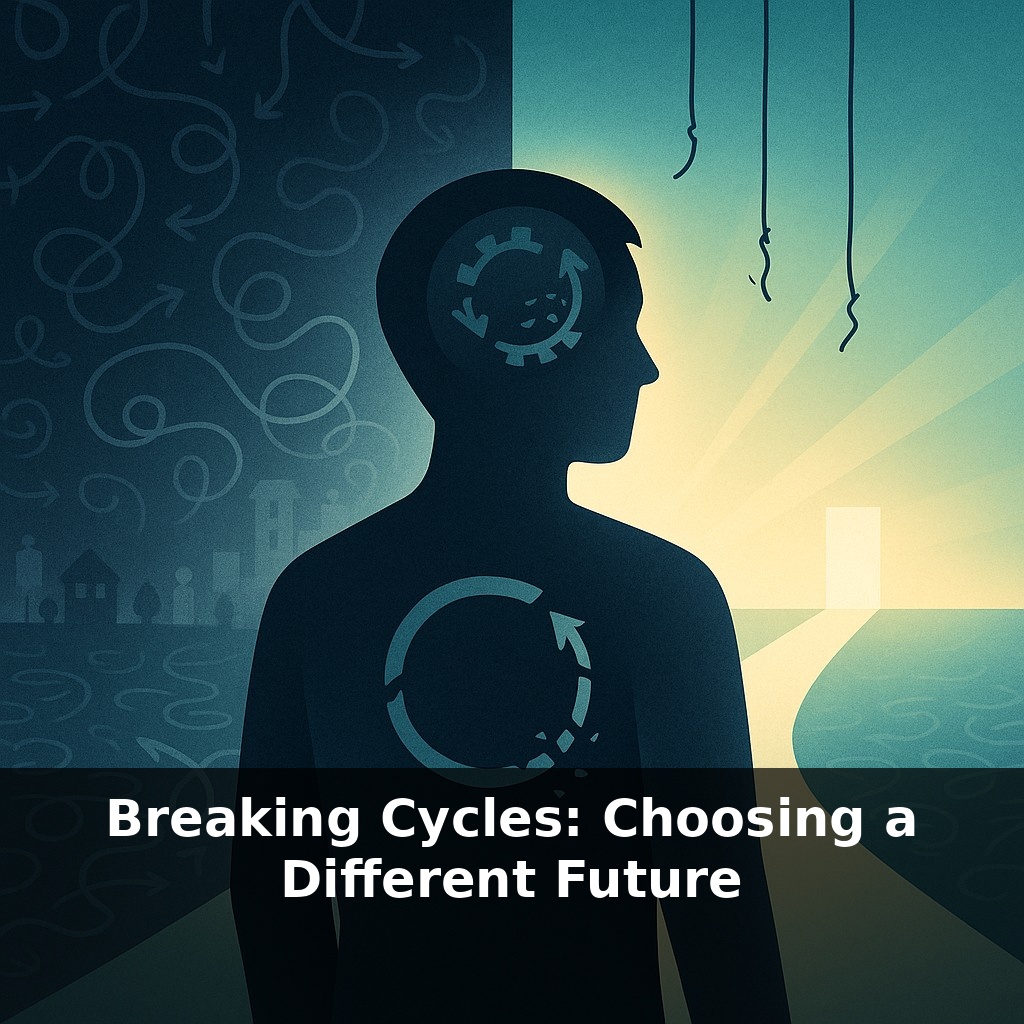
Some cycles are obvious—like scrolling late into the night, snapping in arguments, or always being “the responsible one.” Others hide in plain sight: the job you never apply for because “people like us don’t,” the way your team avoids conflict by drowning in emails, the family rule that big feelings must stay offstage. Research on adverse childhood experiences shows how early patterns can echo into health, income, even life expectancy. Yet statistics also reveal outliers—people and communities that quietly break trend lines and never go back. This episode is about how they do it on purpose, not by accident.
Forty to forty-five percent of your day runs on autopilot, but those “automatic” moves aren’t random—they’re chained together in loops. A feeling, a cue, a thought hits… and your brain reaches for a familiar next step. Over time, these micro-loops braid into a storyline: “I’m the one who fixes everything,” “Nothing ever works out,” “Conflict is dangerous,” “Success means burning out.” Those storylines quietly filter what you notice and what you ignore.
This is where it gets practical. Researchers talk less about “breaking” patterns and more about “interrupting” and “replacing” them. You don’t erase an old pathway; you build a competing one that becomes easier to travel.
There are four leverage points that keep showing up across studies:
1. **Awareness with precision.** Not just “I shut down in conflict,” but “I shut down when someone raises their voice and I’ve already had a long day.” Precision matters because your brain encodes patterns in context. Change the context, and you loosen the loop.
2. **Substitute routines, not just suppression.** Telling yourself “don’t snap” or “don’t drink” leaves a vacuum. The cue and craving are still there. Substitutes that satisfy part of the old “reward” (soothing, status, relief, connection) have a better survival rate.
3. **Supportive environments.** Iceland’s Planet Youth didn’t just tell teens to “make better choices.” They rewrote the after-school and evening environment so the easiest option was also the healthiest. In workplaces, something similar happens when meetings get default agendas, or when Slack channels are restructured to make focus, not frenzy, the norm.
4. **Future anchoring.** The brain is biased toward short-term comfort. But when people regularly rehearse a vivid, detailed future—who they are with, how they spend mornings, what “a good day” looks like—present choices start to feel like votes for or against that future, not isolated events.
One helpful check comes from medicine: a single intervention rarely cures a chronic condition. It’s usually a bundle—medication, physical therapy, lifestyle tweaks, regular monitoring. Long-running patterns in families or organizations respond the same way. You don’t wait for one heroic change; you stack small, boring ones until the “usual outcome” is no longer usual.
A manager notices her team always delays tough conversations until projects are on fire. Instead of another “we need to communicate better” speech, she experiments: every Monday, each person names one small worry out loud. At first, it’s awkward. By week four, problems surface earlier, tempers cool faster, and “we only talk when it’s a crisis” stops being the default storyline.
On a personal level, someone raised in chaos might think, “Calm is for other people.” They start with one predictable ritual: a 10-minute walk at the same time daily, no phone. That tiny pocket of reliability gives their nervous system a new reference point: “Sometimes my body can feel settled.” From there, it becomes easier to decline late-night texts that used to drag them back into drama.
Families do this too. One parent decides that instead of exploding about grades, they’ll ask, “What made this week hard?” Dinner shifts from report cards to problem-solving. The “failure means punishment” script quietly competes with a newer one: “Struggle is something we tackle together.”
If interruption and replacement can reshape loops, the next question is scale: how far out can that ripple? Think of a city block where one neighbor starts hosting Sunday potlucks. Over time, kids swap homework help, adults trade job leads, and “we keep to ourselves” quietly erodes. Zoom out again: schools designed with calm lighting, trauma‑aware staff, and flexible pacing can turn “barely getting by” students into first‑gen graduates who later hire from the neighborhoods they grew up in.
The real leverage isn’t in one dramatic decision; it’s in a string of oddly specific ones: the text you don’t send, the meeting you end on time, the kid you listen to an extra 90 seconds. Think of each as a tiny vote in a long election.
Your challenge this week: change just one “of course I always…” response—and watch who else quietly adjusts.