About eight in ten people say they work better when coworkers share what they know. Yet most of us quietly sit on our best lessons. You solve a problem, close your laptop, and move on—no trail, no teaching, no ripple. This episode asks: what if hoarding knowledge is your biggest bottleneck?
Students who expect to teach score up to 38% higher than those who only study—before they’ve taught a single word. That shift in mindset flips a switch: you stop collecting ideas and start organizing them for someone else’s use. The same thing happens at work when you pause after solving a thorny problem and think, “How would I walk a new teammate through this?” Suddenly your messy intuition has to become a clear recipe: steps, timing, warnings, shortcuts.
In this episode, we’ll explore how turning your experience into guidance doesn’t just help others “catch up”—it pulls you forward. We’ll look at how small acts of teaching can turn isolated wins into reusable playbooks, why explaining your process exposes hidden blind spots, and how informal mentoring, posts, or quick Loom videos can quietly build a culture where everyone’s best lessons stay in circulation instead of evaporating at the end of the day.
Teaching also changes *what* you notice. Once you see yourself as someone who will pass things on, you stop chasing only big, flashy wins and start paying attention to the tiny, repeatable moves that actually carry you through your week. The shortcut you used three times today. The phrasing that calmed a tense client. The way you prepped for a high‑stakes meeting. These details usually evaporate. But when you treat your day like a draft syllabus, ordinary moments turn into usable material—and your calendar, inbox, and meeting notes become a living archive of patterns, experiments, and hard‑won micro‑lessons.
Here’s where this gets interesting: the moments that feel “too obvious” to you are often the most valuable things you can teach.
By the time something feels easy, your brain has compressed it into a blur. You no longer see the micro‑decisions, the checks, the tiny course corrections. That’s why beginners say, “Wait, how did you do that so fast?” and you struggle to answer. The path is clear in your muscles, not in your language.
Teaching forces you to rewind that blur in slow motion.
You start noticing the invisible scaffolding around your work: the template you always duplicate before starting, the three questions you ask yourself before hitting send, the moment in a project where you *always* pause and re‑check assumptions. On your own, that structure stays half‑conscious. When you walk someone else through it, you have to turn that fog into sentences, examples, and if‑then rules.
This is why “near‑peer” teaching—helping someone just a step or two behind you—is so powerful. You still remember what was confusing last month or last year. The acronyms that tripped you up. The part of the process where you wasted days on the wrong thing. A global expert might give the perfect theory; you remember the exact pothole in the road.
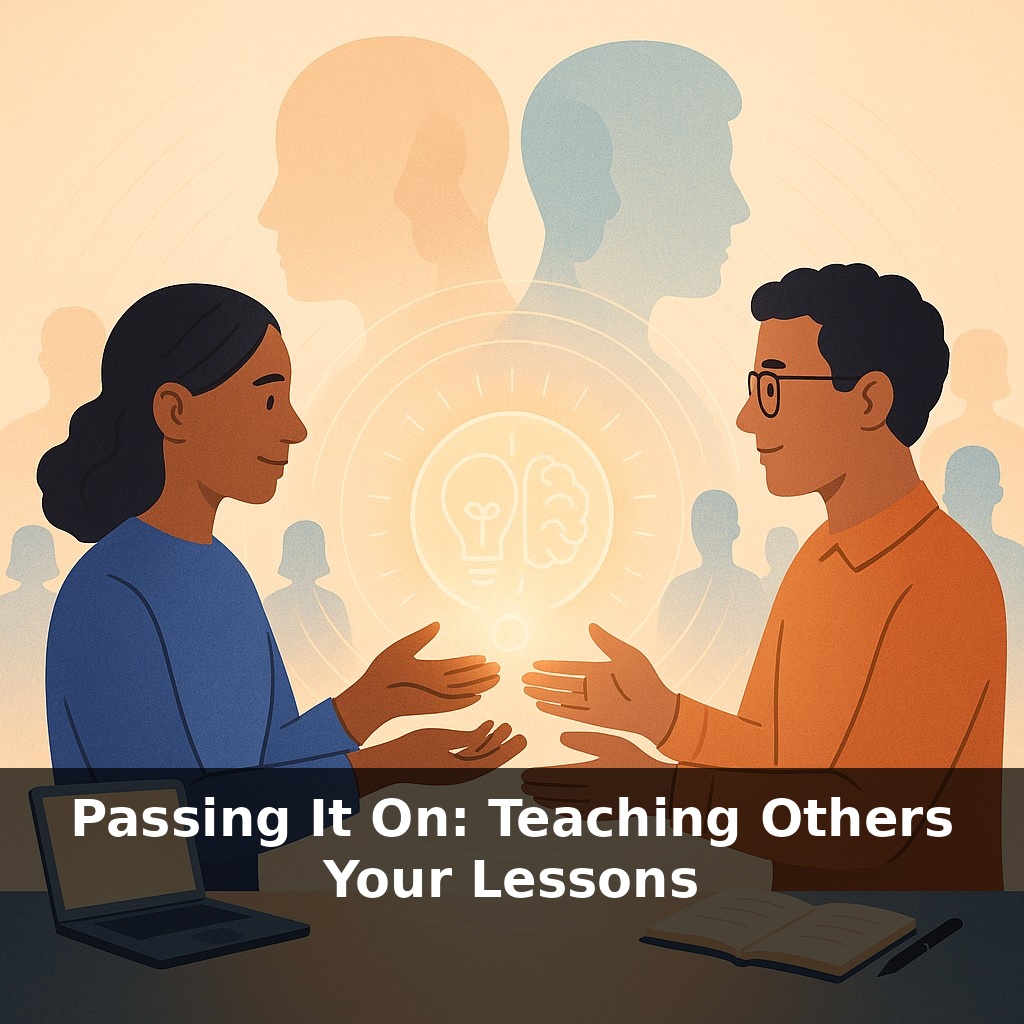
Inside teams and communities, this creates a quiet ladder effect. The person who just figured out a workaround writes a three‑line note or records a 90‑second screen share. The next person doesn’t just copy it; they tweak it, clarify it, or show where it breaks. Over time, these small, imperfect explanations harden into checklists, scripts, and “start here” guides that make future work lighter.
Notice, too, that none of this requires a classroom or a big audience. Answering a Slack question thoroughly instead of with a one‑liner is teaching. Adding a short “Why we did it this way” section to a project doc is teaching. Turning a messy email rant into a short internal FAQ is teaching.
Underneath all of this is a shift in identity: from “person who gets things done” to “person who leaves maps.” Your value stops being measured only in what you complete and starts showing up in how many others can now do something they couldn’t do yesterday—because you took the time to make your path visible.
A practical way to start is to treat each small teaching moment as a “micro‑clinic.” You’re not delivering a lecture; you’re offering a quick consult with just enough depth to change what someone does next. For example, when a teammate struggles with a report you’ve mastered, resist the urge to “just fix it.” Instead, walk them through one decision you’d make differently and why, then let them drive the keyboard while you narrate tradeoffs. Or turn a recurring question in your DMs into a three‑part reply: what you’d do first, what to watch for, and how to know it’s working. Over time, these tiny clinics add up.
You can also rotate roles: one week you’re the “on‑call explainer” for a topic you know; the next week you ask a newer colleague to show *you* how they approached a task you haven’t touched in years. Their fresh method often exposes your outdated assumptions and sparks a joint upgrade neither of you would have created alone.
81% of employees already *know* sharing what they know makes them more effective—but most workplaces still treat teaching as a “nice to have,” not core work. As tools and roles change faster, the real leverage isn’t just *having* experience, it’s how quickly that experience becomes a shared upgrade. Treat your future self as a learner too: leave short “field notes” on what surprised you, what broke, and what you’d try next time. These become early warning systems, not just archives.
Your challenge this week: pick one tiny thing you do well that almost no one sees—how you prep for 1:1s, debug a tricky issue, or calm tense meetings. Once this week, narrate that process in real time *while you do it* for one person: a coworker, friend, or junior. No slides, no polish—just think aloud and let them ask questions. Afterward, write three lines: what they noticed you’d overlooked, what you’d change next time, and where this “mini‑lesson” should live so others can find it.
Treat this as an ongoing draft, not a final book. Some “lessons” will flop, others will land so well people keep quoting them back to you, like a favorite recipe passed around the neighborhood. Follow that trail. Wherever people light up, slow down and document more. You’re not just recalling your history—you’re co‑authoring the next chapter with them.
Try this experiment: pick ONE lesson you’ve learned the hard way in the past year (e.g., how you bounced back from a failure, handled a tough conversation, or changed a bad habit) and teach it to one specific person in your life as if you were recording a mini “podcast just for them.” Before you talk to them, decide on a clear takeaway you want them to walk away with and a concrete example from your own life you’ll share. Then actually deliver it—via a 5-minute voice memo, quick Zoom call, or in-person chat—and afterward, ask them two questions: “What part landed most for you?” and “What was confusing or not helpful?” Notice how their answers shift how you’d teach that same lesson next time.