Week 1: The Identity Shift - You're Not an IC Anymore
📝 Transcript
Half of new managers step into the role with no real training—just a new title and a calendar full of meetings. One week you’re the go-to expert; the next, your old job is still on your desk while your team quietly waits for you to lead. So what exactly changed—besides your email signature?
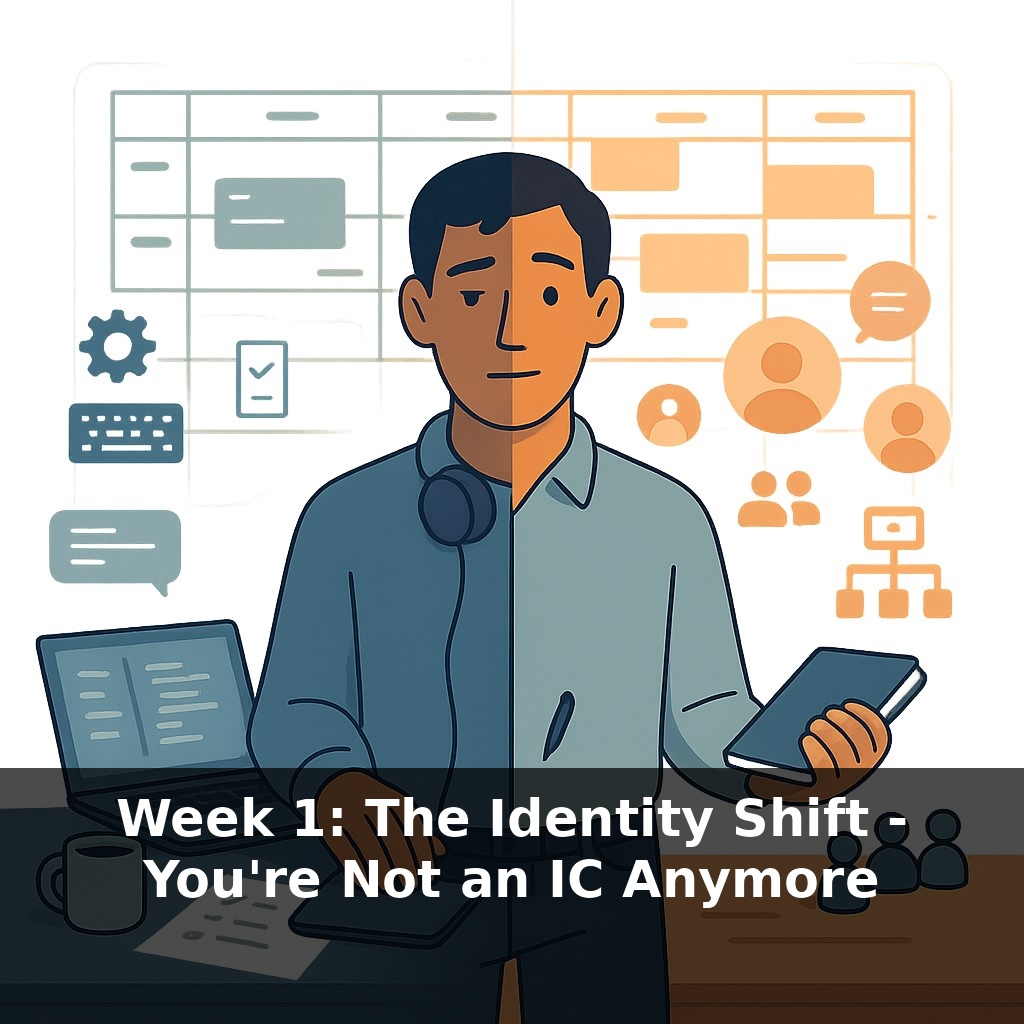
Most people treat that shift as a promotion. It’s closer to a body swap. Your calendar looks different, your conversations change, and—whether you realize it yet or not—everyone around you has quietly rewritten their expectations of you. Yet inside, you still feel like the person who knows how to “just get it done.”
That’s the tension of Week 1: your title has changed faster than your identity.
You’ll notice it in small frictions: you jump in to fix a problem instead of asking questions; you feel guilty when you’re not “producing”; you leave one-on-ones wondering if you added any value. It can feel like you’re faking it in two jobs at once.
This first week isn’t about mastering tools or memorizing frameworks. It’s about recognizing that your old success formula is expiring—and deliberately choosing a new one, before stress chooses it for you.
Right now, your brain is still optimized for your old job. You scan problems for tasks you can grab, not people you can develop. You notice bugs in the code, not gaps in collaboration. That’s normal—and exactly why Week 1 is about awareness, not perfection. Think of this week as slowly tuning a radio from one station to another: for a while you’ll hear both channels at once. You’ll catch yourself jumping into the weeds, overexplaining, or avoiding hard conversations. Those moments aren’t failures; they’re signals that your internal settings are ready to be updated.
Here’s the quiet shock underneath all of this: your strengths didn’t vanish—they just stopped being the main character.
Up to now, your value came from *being* the person who could untangle the gnarly problem at 4:55 p.m. You were rewarded for speed, precision, and owning the hardest pieces yourself. As a manager, those same instincts can quietly sabotage you.
Three big shifts tend to surface first.
**1. From “my work” to “our system”**
When something’s broken, your reflex is to grab it. This week, try pausing one beat longer and asking: *“What would have to be true for this to get solved without me next time?”* That tiny reframe moves you from heroics to system design. Instead of fixing the bug, you might notice unclear ownership, missing documentation, or unrealistic timelines—and your work becomes changing *those* conditions.
**2. From answers to questions**
You’re used to winning by having the right answer. Now, the fastest answer is often the wrong move, because it keeps your team dependent on you. High-performing managers in Google’s research didn’t hover with solutions; they asked questions that unlocked other people’s thinking:
- “What options have you considered?” - “What does success look like here?” - “What’s blocking you from trying that?”
You’re not withholding help; you’re building judgment. That’s slower *today* and dramatically faster three months from now.
**3. From recognition to ripple effects**
You probably got promoted by being visible: shipping the project, saving the launch, cleaning up the mess. Management flips the spotlight. When things go well, the praise lands on your team. When things go badly, eyes turn to you.
This can feel like a loss—until you start tracking different evidence of impact: a quiet team member speaking up more; fewer escalations; a project that ships smoothly without weekend chaos. These are management “wins,” even if they never show up next to your name in a slide deck.
Think of a doctor who stops performing every procedure and instead designs the clinic’s protocols, trains residents, and sets standards of care. They may touch fewer patients directly, but every improvement in that system ripples through thousands of visits.
Your job this week isn’t to force yourself into some idealized manager persona. It’s to notice, with curiosity, when your old instincts clash with what your new role actually needs—and to experiment with choosing differently once or twice a day.
Notice where your calendar *pulls* you this week. A design review invites you to dive into pixels; a planning meeting tempts you to rewrite the doc yourself. In those moments, try zooming out one level and asking, “What’s the conversation only I can lead here?” Maybe it’s clarifying tradeoffs, naming risks others are tiptoeing around, or drawing connections between two teams that rarely talk.
Look for small, concrete proof that your contribution is shifting: a teammate makes a decision without Slacking you first; two people you connected keep working together; a recurring fire drill quietly stops happening. Those are system-level footprints.
In art restoration, experts spend most of their time stabilizing the canvas and environment, not repainting details. The best work is almost invisible: colors stop fading, cracks stop spreading, the piece can finally be seen clearly. Treat your new role the same way—less about adding more brushstrokes, more about creating conditions where the whole picture holds together.
Building on the changes from your first week, your influence will compound in ways that won’t fit neatly in a status update. As your focus widens, the real signal is how people behave when you’re not in the room: which tradeoffs they choose, how they treat each other under pressure, what they escalate versus own. Think of it like tending soil after years of inspecting leaves; subtle shifts in nutrients, moisture, and balance predict next season’s growth. The more thoughtfully you shape those conditions now, the less you’ll need heroics later.
Treat this week like learning a new instrument: the first notes sound off, your hands reach for old chords, and progress feels slow. That’s data, not failure. Your edge won’t come from pretending you’re fluent—it’ll come from noticing which “songs” your team actually needs, and patiently practicing those, one deliberate choice at a time.
Start with this tiny habit: When you open your calendar each morning, say out loud one sentence that starts with “My job now is to…” and finish it with a team-focused outcome (like “help my team ship this feature well,” not “finish my own tickets”). Then, before you click into any personal tasks, send one 1–2 sentence Slack message to a team member asking a coaching-style question (“What’s blocking you on X?” or “What would make this easier for you?”). This keeps nudging your brain from “super-IC” mode into “supporting the system” mode in a way that’s quick and doable every day.
From this course

Your First 90 Days as Manager
7 episodesUnlock all episodes
Full access to 7 episodes and everything on OwlUp.
Subscribe — $1.99/monthLess than a coffee ☕ · Cancel anytime