In under a blink, your new team has already decided if they trust you. Now you’re walking into that first meeting: faces expectant, cameras on, no second take. Some hope you’ll bring clarity, others brace for buzzwords. How you open your mouth next quietly sets the culture.
Most leaders wing that first meeting. They “go with the flow,” talk about themselves for 15 minutes, and leave with polite nods that hide private group chats titled “New boss…” But the leaders who ramp fastest treat that first hour like a high-stakes design problem, not an icebreaker.
They script the first 5 minutes almost word for word. They decide in advance: “These three sentences are what people will quote after I leave.” They plan the first question they’ll ask the team. They choose 2–3 norms to model immediately—like starting on time, pausing for questions, and summarizing decisions.
Small details compound: starting exactly at 9:00, sharing a 3-point agenda, naming clear next steps with owners. In a 45-minute meeting, those choices create 3–5 visible proof points that you are consistent, prepared, and safe to follow.
So instead of obsessing over “nailing” a speech, focus on engineering 3 signals in that first meeting: warmth, clarity, and reliability. Warmth shows up in 2–3 specific behaviors: learning names, asking 1 targeted question about how work actually gets done, acknowledging past wins with concrete examples. Clarity means stating in 2 sentences how decisions will be made and what success looks like in the next 30 days. Reliability is demonstrated by 1 promise you make—and fulfill within 48 hours—plus 1 boundary you keep, like ending on time.
main_explanation: Here’s how to engineer those signals in practice without turning into a robot.
Start by deciding what your team most needs to feel in the first 10 minutes. Pick one word for each dimension: for warmth, maybe “curious”; for clarity, “focused”; for reliability, “steady.” Write them at the top of your notes. Every line you plan should support those three words. If it doesn’t, cut it.
Next, design your “first 60 seconds.” That’s all most people will actually remember. For example:
- 10 seconds: your name, role, and one line about why this team matters to you now, not your life story. - 20 seconds: a concrete, near-term milestone (“In 30 days, I’d love us to be aligned on X so we can ship Y by Z date”). - 30 seconds: one permission statement (“You can push back on my ideas; I’ll tell you when a decision is final versus open”).
Now translate warmth into observable behaviors. Aim for at least 3: - Use people’s names within the first 5 minutes (research shows this increases perceived respect and belonging). - Ask one question that only insiders can answer, e.g., “What’s one thing we do here that outsiders never understand?” - Reflect back something you heard: “I’m hearing that handoffs with Sales are a major friction point—did I get that right?”
For clarity, be ruthlessly specific. Swap “we’ll improve communication” for “by week 4, everyone will know who decides A, who must be consulted on B, and where decisions are documented.” Put 1–2 dates on the screen: a check-in in 2 weeks, and a decision milestone in 4.
Reliability lives in tiny follow-through moments. Make exactly one small, testable commitment in the meeting (“I’ll send a summary with decisions and open questions by 3 p.m. today”). Then overdeliver by 15–30 minutes. If you say you’ll gather input, specify how: “Drop your top 3 concerns in this shared doc by Thursday 5 p.m.; I’ll respond to every comment.”
Finally, script how you will close. Reserve the last 3 minutes to: 1) restate what you heard, 2) confirm next steps with names and dates, 3) say when they’ll next see you act on today’s input.
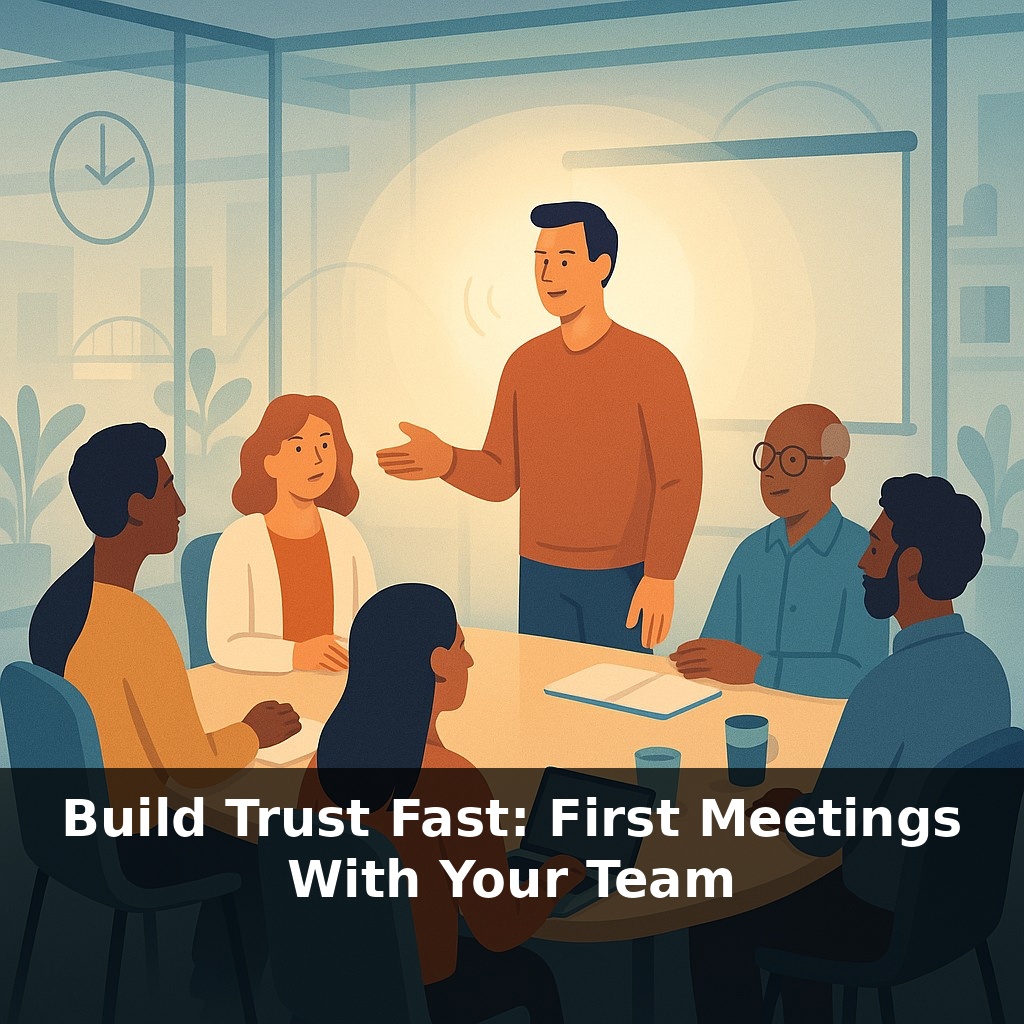
Think of your first meeting as a quick clinical exam: you’re running three fast checks—connection, alignment, and follow-through. Here’s a concrete example. A new VP joins a 12-person product team mid-quarter. She opens with: “In 30 days, we’ll agree on a single priority roadmap through June. My job is to clear blockers; your job is to tell me where the real risks are.” Then she runs a 10-minute round where each person answers two prompts: “One thing that’s working,” and “One thing that slows you down every week.” She captures exactly 12 friction points on a shared screen, stars the top 3, and says, “By Friday 3 p.m., I’ll come back with options on these three only.” After the meeting, she sends a 1-page summary in 41 minutes, not hours, and on Friday she returns with two specific proposals per issue. No inspirational speech—just 3 visible data points that her words and actions match, which is what people actually remember.
Your challenge this week: design and run a “trust sprint” in your next first-team meeting (or reset meeting if you’re not new). Do three things:
1) Before the meeting, write a 60-second opening that includes one 30-day milestone and one clear “permission” statement (e.g., “You can disagree with me in the room; I won’t punish dissent”).
2) During the meeting, collect exactly one concrete blocker from each person in under 15 minutes. Capture them where everyone can see.
3) Before 24 hours pass, close the loop on at least one blocker with a specific action, and tell the team what you did, how long it took, and what happens next.
Treat it as an experiment: after the meeting, note how people’s questions, tone, or responsiveness shift over the next 3–5 days.
Your calendar will soon include AI agents that attend status meetings, summarize discussions, and even flag risks before humans speak. That makes your live interactions too valuable to waste on updates. Use them to show judgment. For example, reserve 70% of your first live session for sense‑making and decisions, while bots handle notes and dashboards. As virtual formats expand, rehearse lighting, eye line, and framing—these will shape how 100+ distributed teammates size you up in 30 seconds.
Use the same rigor for every “first” you face: first 1:1 with an exec, first cross‑team review, first board update. In each, define 1 outcome, 2 signals you’ll send, and 3 questions you’ll ask. Over 90 days, that’s ~30 high‑leverage moments. Review recordings or notes from at least 5 of them to spot and refine your patterns.
Before next week, ask yourself: 1) “If I had a 30-minute first meeting with my new team tomorrow, what 3 concrete things would I share about how I work (e.g., how I make decisions, how I like to receive bad news, what I expect in meetings) so they know what to count on from me?” 2) “Looking at each person on my team, what’s one specific, curious question I could ask in a 1:1 (like ‘What’s one thing you never want me to change about how this team works?’ or ‘When have you felt most proud of your work here?’) that would quickly show I’m genuinely interested in them?” 3) “What’s one real constraint or pressure I’m under right now that I can transparently explain to the team in our next meeting, so they understand the ‘why’ behind my decisions instead of guessing?”