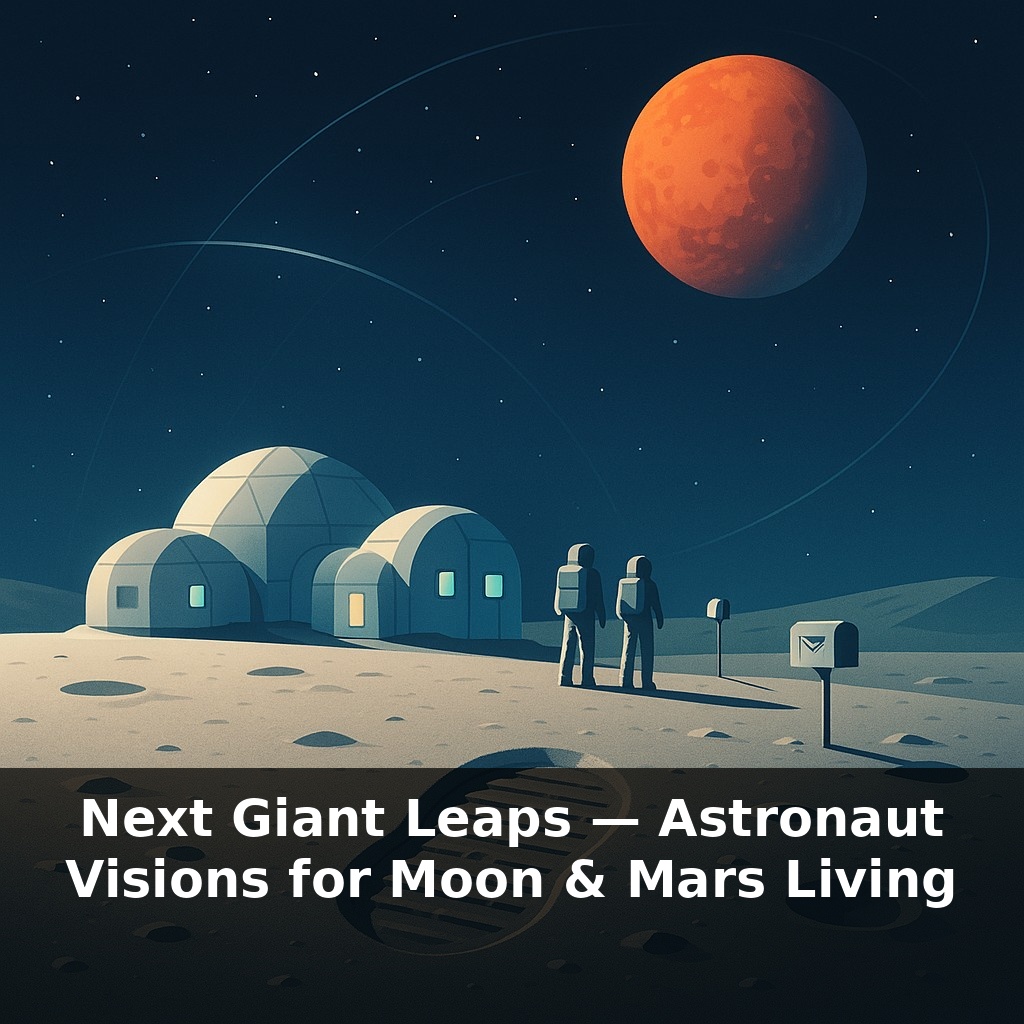
“Within your lifetime, humans may get mail delivered to the Moon before some rural towns on Earth,” one NASA planner joked. A bold claim—but agencies and companies are quietly drawing up real addresses for the first lunar neighborhoods right now.
Those addresses won’t just be for postcards. They’ll mark where fuel depots sit near shadowed craters, where power grids snake across sunlit ridges, where early greenhouses try to coax lettuce from imported dirt. Astronauts planning these outposts talk less like heroic explorers and more like city engineers and paramedics, obsessing over water pressure, backup pumps, and how to calm a crewmate who hasn’t seen a new horizon in six months.
In this episode, we’ll step into their notebooks: how Moon villages and Mars towns might actually function, who gets to move in, and what everyday life could feel like under alien skies.
But these first “neighborhoods” aren’t just dots on a map; they’re choreography in hostile terrain. Mission planners sketch daily rhythms the way composers arrange music: cargo landings on low‑risk days, maintenance during “quiet hours” of radiation, science sprints when crews are most alert. Lunar and Martian clocks won’t match Earth’s neatly, so shift schedules may drift, like jet lag that never quite ends. And every routine—sleep, exercise, even movie night—must be tuned to equipment cycles, power peaks, and the long, slow seasons of another world.
Astronauts sketch these future homes from the inside out, starting with one unforgiving number: mass. Every kilogram launched has to justify its ride, so walls do double duty. On the Moon, thick shells of piled regolith—either shoveled by robots or sintered into bricks with microwaves—don’t just block radiation; they also anchor structures against thermal swings of nearly 300°C between lunar day and night. On Mars, looser soil and thin air push designers toward partly buried habitats, inflatable cores wrapped in rigid shells, and possibly even 3D‑printed arches spanning shallow trenches.
Inside, you don’t get sprawling corridors. Think modular “rooms” that can be rearranged as missions evolve: one unit starts as a lab, later becomes a classroom or medical bay. Windows, if any, are small, shielded, and precious; most “views” come from cameras and panoramic displays that can be tuned to sunrise, Earth‑rise, or a remembered walk through a forest. Lighting cycles will be engineered as carefully as oxygen levels to keep circadian rhythms from drifting too far off Earth time.
Where previous episodes focused on surviving days or months, planners here think in decades. That shifts priorities. Instead of shipping spare everything, they ask, “What can we make there?” Lunar water ice turns into drinking water, breathable oxygen, and fuel. Martian air, rich in CO₂, feeds reactors that crack out oxygen and methane. Metals in local rock could eventually be refined into beams and panels, reducing the endless parade of cargo rockets.
Psychological survival gets equal billing. Crews will rotate between “high‑intensity” and “quiet” zones: loud labs and gyms buffered from soft‑light sleep pods and private nooks. Designers borrow from submarine and Antarctic station experience—clear roles, rituals, and small, controllable choices. The color of your bunk light, the playlist in the shared galley, the right to tweak your personal workspace: these tiny freedoms can matter as much as any new gadget in keeping a settlement from feeling like a gilded prison.
And looming over every blueprint is the knowledge that, for long stretches, help can’t come quickly. So each habitat must slowly learn to behave less like a campsite and more like a village that can patch its own roofs, grow its own food, and heal its own people.
On the Moon, that buried ice isn’t just “water”; in astronaut sketches it’s treated almost like a shared bank account. One “withdrawal” becomes three products: a drink in your cup, oxygen in your tank, and propellant waiting in a nearby tank farm. Crews plan their weeks around those conversions the way farmers follow rainfall—if the extraction rigs slow down, everyone feels it in their checklists and their menus.
On Mars, the thin CO₂ air is penciled in as a quiet workhorse. Feed it into compact reactors and you get oxygen to breathe and methane for ascent vehicles or rovers. Planners talk about pairing these chemical “engines” with solar arrays and nuclear reactors so that no single glitch can freeze a settlement into silence.
Meanwhile, life‑support loops are designed less like straight pipes and more like braided streams. One loop dries your breath, another reclaims humidity from showers, a third combs trace contaminants from cabin air. Together they make sure every liter of water and every whiff of oxygen cycles back through the habitat, again and again, with as little waste as physics allows.
Early Moon and Mars outposts may feel experimental, but their ripple effects reach home. Techniques for reusing air, water, and waste could tighten resource cycles in desert cities. Mining ice and CO₂ teaches us to audit every molecule, much like careful gardeners track each drop of rain. As habitats grow from testbeds to towns, legal and ethical questions emerge: who owns mined volatiles, who arbitrates disputes, and how do we keep exploration from hardening into exploitation?
Our next giant leaps may feel slow—more like tuning an instrument than planting a flag. Each prototype habitat, each ISRU test, is a new note in a song we’re still learning to play. As Moon and Mars blueprints mature, they quietly rewrite what “home” means, nudging us to treat Earth’s air, water, and soil with the same deliberate care we’ll spend on every gram off‑world.
Here’s your challenge this week: Pick one real constraint of Moon or Mars living discussed in the episode—like 1/6 gravity on the Moon, dust abrasion, 20-minute Mars communication delays, or closed-loop life support—and design a one-room “Earth training lab” in your home to simulate it. For three consecutive days, live in that space for at least 30 minutes a day under your chosen constraint (e.g., delayed texting responses to mimic comms lag, strict water rations to mimic life-support limits, or movement rules to mimic low gravity). Each day, adjust one element of your setup to make it more realistic based on what the astronauts described (habitats, EVA routines, or crew roles), and at the end of day three, decide one specific habit you’d keep if you were actually headed to the Moon or Mars.