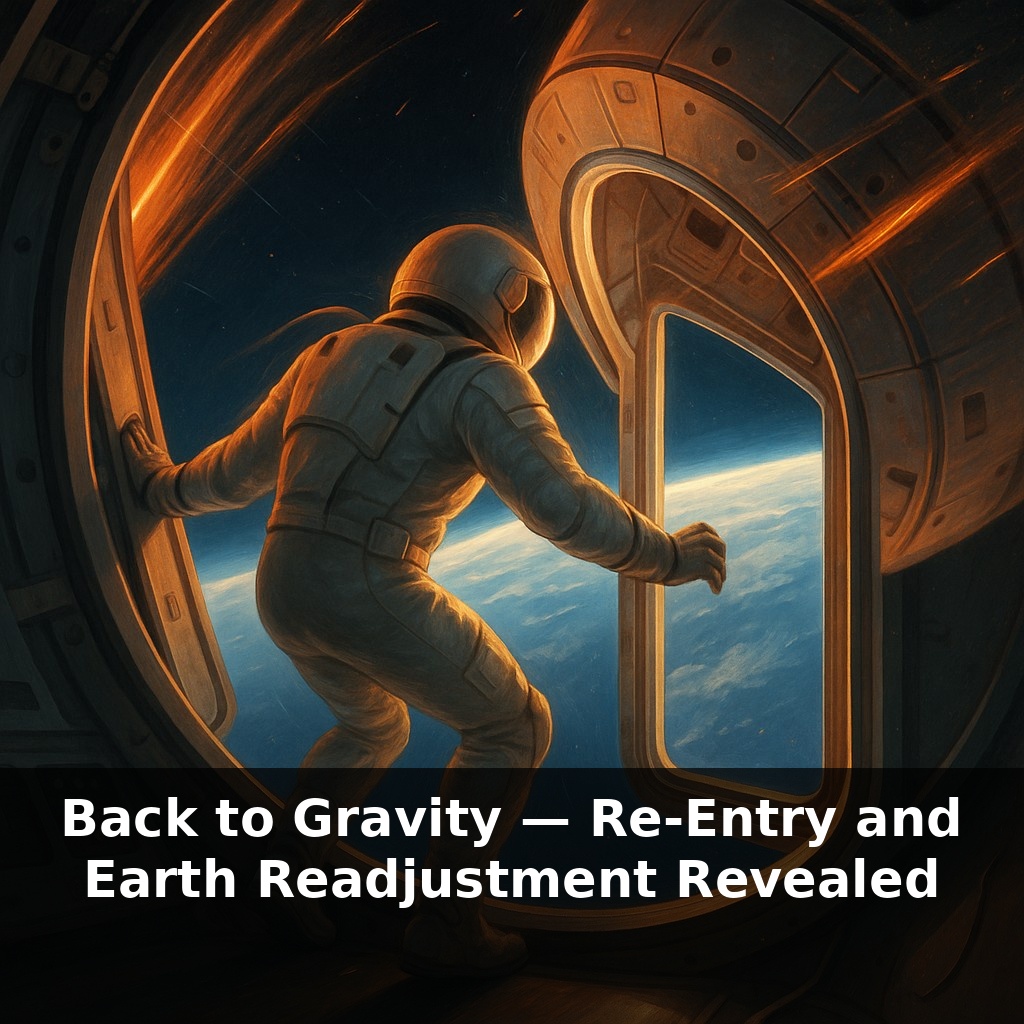
“About half of returning astronauts can’t stand on their own when the hatch opens.” Now drop into their world: the capsule shudders, plasma cuts off radio, gravity slams back on—and the first challenge isn’t a heroic walkout, it’s simply not blacking out.
But that dramatic moment is just the tip of a much longer transition. Long before you see a splashdown on TV, flight controllers have been plotting a corridor through the atmosphere only a few degrees wide. Come in too steep, and heating and G‑loads spike; too shallow, and you risk skipping off the atmosphere like a stone over water. Inside, the crew rehearse every call, because for several minutes of radio silence, the spacecraft is effectively on autopilot with no way to ask for help.
And once the parachutes bloom and the capsule hits water, Earth isn’t “home” yet; it’s a demanding training partner that suddenly turns every small movement into a workout.
On the ground, a whole second mission spins up—only now the “spacecraft” is the astronaut’s body. Flight surgeons, rehab specialists, and researchers crowd in, not just to keep the crew safe, but to capture a fleeting scientific window. Blood pressure, eye scans, balance tests and muscle strength checks all start within minutes, before adaptation blurs the data. Think of it as opening a time capsule of spaceflight’s impact on human biology: fluid shifts, altered reflexes, even mood changes. Each measurement feeds models that will decide who’s fit to fly farther—say, months to Mars—and how we prepare them.
The first big moment after landing isn’t the hatch opening; it’s “ENTRY INTERFACE” on the flight timeline—when the capsule hits the upper atmosphere at over 7 km/s and the clock starts on a precisely budgeted descent. From here, every kilogram of propellant, every degree of angle, and every second of timing has already been traded in simulations years before you flew.
Instead of aiming for a point, re‑entry aims for a *path*. Mission control has drawn a narrow “corridor” of acceptable heating and G‑loads, then loaded guidance software to keep you inside it by modulating lift. Capsules like SpaceX’s Crew Dragon aren’t just falling rocks; by rolling and banking, they can subtly shift their ground track, stretching or tightening the arc so you land near the recovery ships instead of hundreds of kilometers away.
As you plunge, air ahead of the vehicle is squeezed into a super‑hot plasma sheath. It’s that ionized layer that blocks radio, which is why controllers lean so hard on predictive models: they must trust that the spacecraft is doing exactly what the numbers said it would. During those silent minutes, onboard computers compare measured accelerations and rotation rates to an expected “profile.” If things drift too far, they can autonomously tweak attitude or, in some systems, trigger abort modes like reserve thrusters or backup guidance laws.
Closer to Earth, each phase has its own decision gates. Drogue parachutes, then main chutes, have strict “if‑this‑then‑that” rules based on speed and altitude. Sensors constantly cross‑check one another: radar altimeters, GPS, inertial measurement units. If one lies, software can down‑weight it, the way you mentally ignore a single off‑key instrument in an orchestra when everyone else agrees on the tempo.
The moment rescue teams reach the capsule, the focus flips from vehicle telemetry to human telemetry. Heart rate and blood pressure are monitored not just for safety, but to validate countermeasures tested in orbit: resistive exercise, lower‑body negative pressure devices, pharmaceutical trials. Each crewmember is a rare data point in an experiment that can’t be run on Earth.
And “re‑entry” doesn’t end on the deck of the ship or runway—it extends through the first wobbly steps, the drive to the medical facility, the week when your inner ear and cardiovascular system quietly negotiate a truce with full gravity again.
Back on Earth, rehab teams treat the first days like studying a rare storm system: you only get one pass through this exact pattern, so they instrument everything. A returning crew might stand on a force plate that tracks tiny sways, or walk a straight line while cameras map how each joint contributes to balance. NASA’s “Field Test” protocol even has astronauts attempt tasks they’d face after a Mars landing—standing from a prone position, turning quickly, aiming a mock tool—while still in their suits.
For longer missions, some agencies are experimenting with “pre‑habilitation”: targeted strength and balance training *before* launch, tuned to each person’s weak spots. Others test smart garments that gently squeeze the body to help blood vessels relearn their job. Data from these trials feeds into digital “twins” of astronauts—computer models that predict who might be at higher risk of fainting or falling so rehab plans can be custom‑shaped rather than one‑size‑fits‑all.
Future missions will treat re‑entry data like a long weather record—patterns across hundreds of landings guiding design. As private flyers join career astronauts, medical teams may tier “gravity recovery plans” the way trainers customize marathon programs. Algorithms could one day flag who needs in‑flight “tune‑ups” long before landing. On Earth, clinics might borrow these playbooks to help patients stand, walk, and think clearly again after long ICU stays.
So re‑entry becomes less an ending than a rehearsal. Every landing tunes the score for Moon and Mars returns, where help is days away and “wobbly first steps” might happen in a spacesuit on unfamiliar ground. Your challenge this week: notice any moment you “re‑enter” a hard task after time away—how long until your balance, focus, and confidence feel fully back?