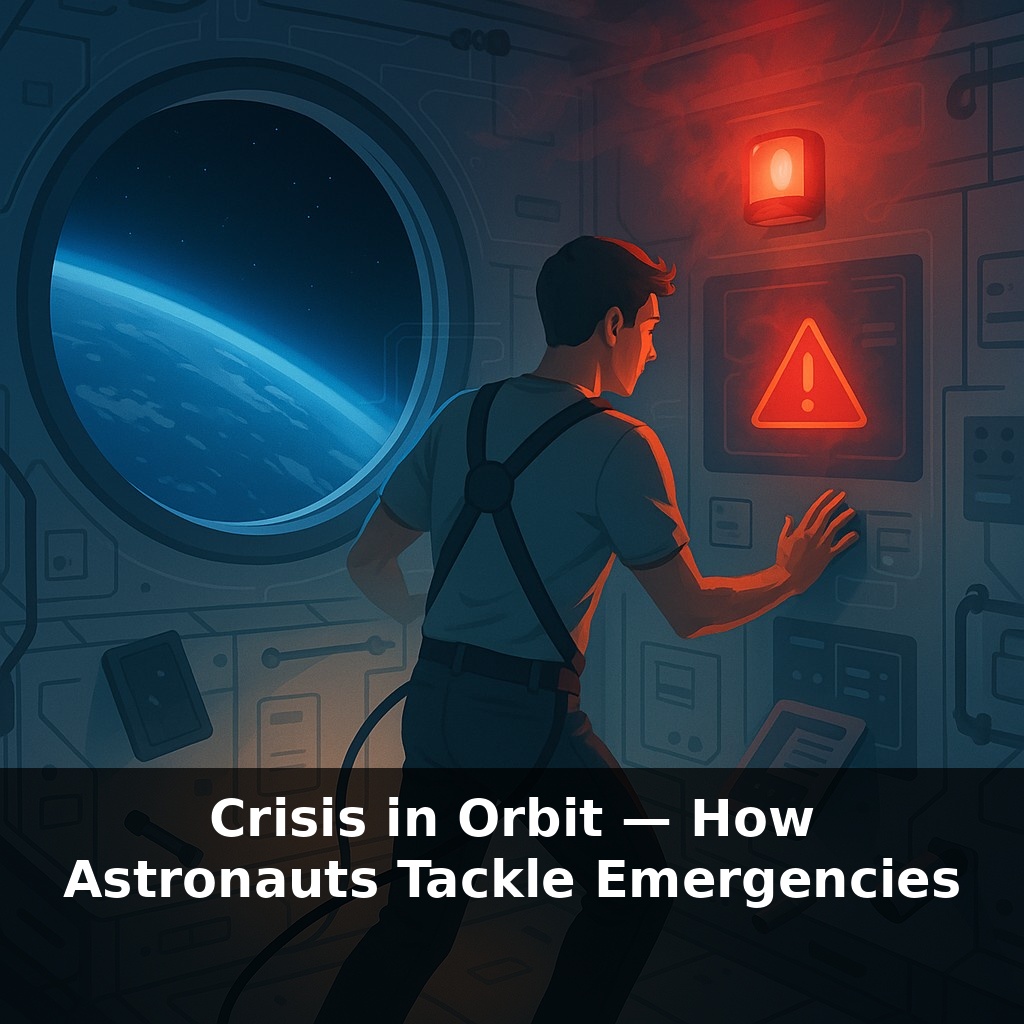
“Failure is not an option” sounds heroic—until you’re staring at smoke in zero‑gravity, miles above any fire department. An alarm shrieks, panels glow red, and every breath suddenly feels like strategy. In orbit, the most dangerous second is the one right before you panic.
Alarms on the Station aren’t rare; false ones happen often enough that astronauts joke the ISS is part spaceship, part smoke detector testing lab. But every siren is treated as if it’s the start of the worst day in orbit. The tricky part is that “worst” isn’t always obvious. A real emergency might begin as a faint smell like overheated electronics, a drifting haze near a laptop fan, or a subtle hiss that could be anything from air leak to a loose valve. In that moment, the crew’s world shrinks to checklists, handrails, and each other’s eyes. They move not like action‑movie heroes, but like chess players in fast‑forward, running through branching “if‑then” trees that have been drilled into muscle memory long before launch. Every response has to be calm, rehearsed, and just aggressive enough to stay ahead of a problem that can spread silently at 28,000 km/h.
On paper, ISS emergencies sort neatly into three bins: fire, bad air, or a breach in the ship itself. In orbit, they rarely introduce themselves so politely. A “fire” might start as a single misbehaving cable, hidden behind panels; “bad air” could be invisible pockets of CO₂ pooling where a crewmate likes to sleep. A “leak” might first show up as an odd noise behind a rack you have to contort around to reach. The crew has to turn those vague hints into a diagnosis fast, tracing clues the way meteorologists track a storm front through scattered data, always asking: is this local weather or the start of a hurricane?
The first thing that happens in any serious event is also the most boring: someone calls “TO THE BOARD.” One crew member straps down at the central computer, pulls up the big picture of the Station, and becomes the human router between orbit and Mission Control. Everyone else suddenly has a lane: one person takes communications, one grabs medical kit and portable oxygen, one starts isolating suspect modules by closing hatches. Roles snap into place in seconds because they’ve already been shuffled a hundred times in simulations.
NASA’s three big categories branch quickly. A hint of smoke means hunting for hot spots with your nose and handheld sensors, flipping fans to see which direction particles drift, and sometimes powering down half a module in one keypress. “Bad air” might send crewmates floating with gas analyzers, sampling corners, duct inlets, even behind racks where exhaled CO₂ can quietly collect. A suspected leak kicks off a slow tightening of the Station’s “skin”: close hatches, log pressures, wait, repeat, narrowing down where the atmosphere is slipping away.
There’s a constant tradeoff between moving fast and not making things worse. Powering off the wrong unit could shut down life-support loops that are actually helping you; closing a hatch too early could trap smoke with someone on the far side. That’s where the choreography with the ground matters. Flight controllers are staring at pressure curves, thermal maps, electrical loads, sometimes spotting patterns minutes before the crew can. The people in orbit bring eyes, ears, and hands; the people on Earth bring data and distance.
If containment fails, the mindset flips from “save the Station” to “save the crew.” That could mean retreating into a smaller, safer volume, configuring systems to run autonomously, or preparing the return craft as a lifeboat—waking it up, powering critical avionics, strapping in with suits sealed. The whole journey from first warning to being ready to undock can unfold in well under a quarter of an orbit, while Earth slowly rotates beneath a crew that’s suddenly thinking very hard about one specific landing site instead of the whole planet.
On real missions, those branching choices sometimes hinge on details as small as a smell or a flicker. During one ISS incident, a faint “hot metal” odor led astronauts to a power supply that had quietly failed behind a rack. No flames, no drama—just a box warm enough to be worrisome. They powered it down, rerouted loads, and only later learned from the ground that they’d likely dodged a bigger problem. Other times, hardware throws a curveball that looks worse than it is: a sudden pressure dip that turns out to be temperature-related sensor drift, or a stubborn CO₂ reading in one corner that’s fixed by tweaking a fan angle by a few degrees.
The closest Earthly parallel might be watching a thunderstorm line on radar: green blobs mean “routine,” yellows demand attention, and a little hook echo in the red can mean “take cover now.” Crews learn to read their own “radar”—telemetry plots, odd sounds, how a module feels when you push off a handrail—and sort routine blips from the patterns that say, quietly but clearly, “this one matters.”
Future stations will be busier crossroads than the ISS, more like airports than outposts, with traffic, tourists, and time delays to mission control. That pushes crisis skills from rare drills to everyday literacy, baked into tools and layouts: color-coded panels, interfaces that highlight the one lever that matters, AI that filters noise like a seasoned editor. On Mars ships, those tools must stand in for an entire ground team—no quick phone call, only what you launched and what you’ve learned.
In the end, space survival is less about heroics than about refining tiny moves—where gear is stowed, how a toolkit opens, who speaks first on a loop. It’s closer to tuning an orchestra than fighting a battle: each alarm a stressful rehearsal that sharpens timing. As missions stretch to lunar gateways and Mars ships, today’s drills become tomorrow’s quiet, invisible safety net.
Before next week, ask yourself: 1) “If I suddenly lost comms with my team for 10 minutes like an astronaut in orbit, what exact checklist would I follow for my current project, and where is that written down so I could grab it under stress?” 2) “In my ‘personal mission control’ (calendar, tools, people), who are the three people I’d call first in a crisis, and do they actually know they’re part of my emergency playbook?” 3) “What is one realistic ‘sim drill’ I could run this week—like an unexpected deadline, a key tool going down, or a teammate being unavailable—and how would I rehearse my response so it feels as automatic as an astronaut’s emergency procedure?”