Understanding Your Equipment and Setup
📝 Transcript
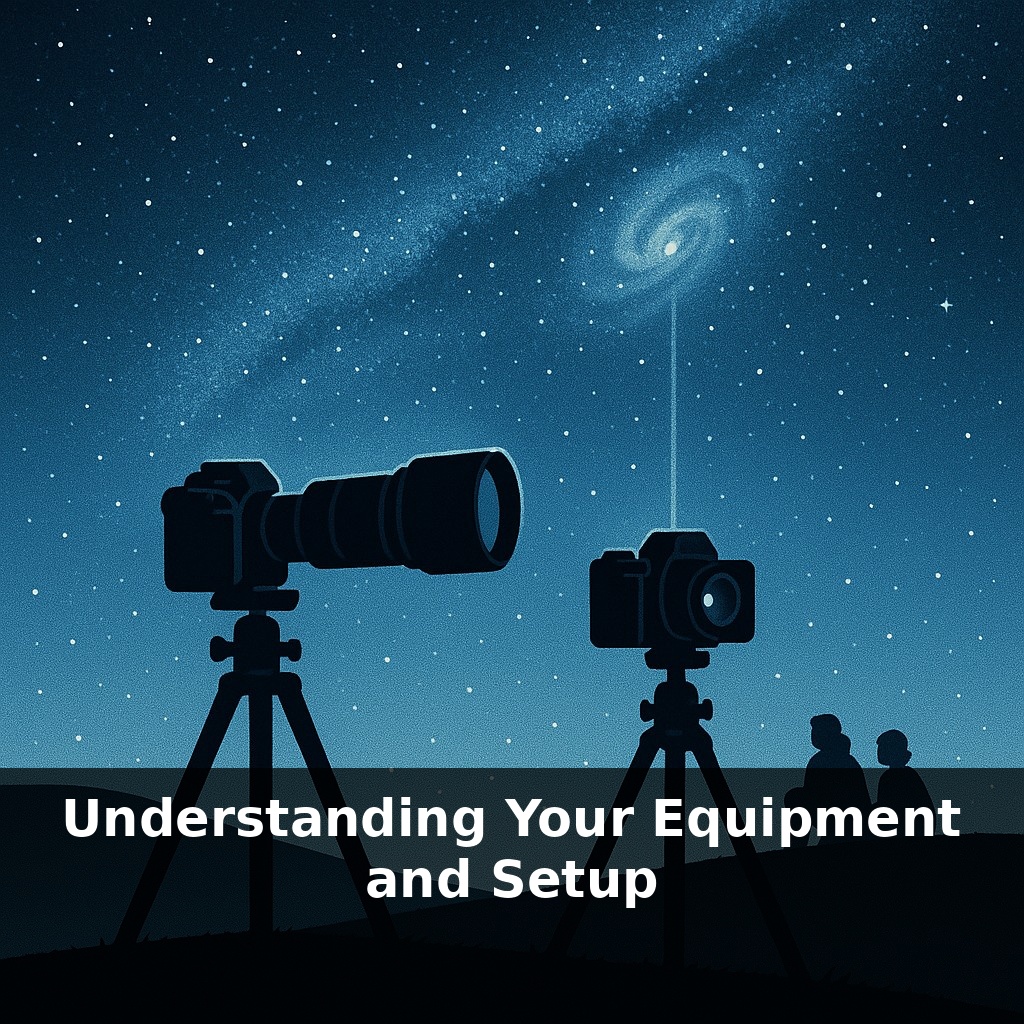
Stars you can’t see with your eyes are already hiding in your camera roll. Out on a dark hill, two friends set up side‑by‑side. One has a pricey lens, the other a basic kit. By midnight, only one has sharp, detailed galaxies—and it’s not the person who spent the most.
Out there between “pressing the shutter” and “seeing a great astro photo” sits a quiet trio doing most of the real work: your camera body, your glass, and whatever is holding them up against the sky. If any one of those three slips, the result isn’t just a little worse—it can fall apart completely. Think less about shopping lists and more about how these pieces cooperate, like players on a team that only scores when everyone hits their mark. One controls how much starlight you can record, one decides how that light is shaped, and one determines whether it all stays perfectly still for seconds or minutes at a time. Tonight, we’re going to map out that team: how sensitive your sensor truly is, why “fast” lenses change what’s possible, and why even a tiny wobble can undo all your careful settings.
Think of tonight as your first real “systems check.” Instead of obsessing over specs, you’ll start seeing your gear as a chain where the weakest link decides your ceiling. This matters because the sky will punish any shortcut: a flimsy clamp, a rushed alignment, a casual tripod leg on soft ground. Entry‑level astrophotography quietly rewards care and planning more than raw budget. Small, smart choices—where you place your tripod, how you balance a tracking mount, how you manage ISO for faint details—compound. You’re not just buying equipment; you’re building a repeatable way to turn clear nights into reliable results.
Start with the part that usually feels most mysterious: the box in your hands. For astro work, what matters isn’t brand prestige, it’s control. You want to be the one deciding how long the shutter stays open, how wide the aperture is, and how much the camera amplifies the signal—without the auto modes second‑guessing you. If your camera lets you lock in manual exposure, shoot RAW, and disable long‑exposure noise reduction (so it doesn’t waste time doing “dark frames” between shots), it’s already a viable tool for the night sky.
Next, match your optics to your targets instead of chasing specs in isolation. Faint Milky Way scenes and big constellations reward short focal lengths and large apertures because they let you use shorter exposures before star trails appear. Tight nebulae and small galaxies demand longer focal lengths, but that extra reach magnifies everything, including tracking errors. A 24 mm prime forgives a lot of slop; a 200 mm setup exposes every tiny mistake in your alignment and balance. That’s why many world‑class astrophotographers still lean on simple wide primes for their most reliable keepers.
Now zoom out—literally—to the support under everything. The “rock‑steady” part isn’t just about having a heavy tripod; it’s about how forces travel through the system. A loose center column, a half‑tight ball head, or a flexy quick‑release plate can each introduce tiny shifts that smear detail across your whole frame. Swapping a wobbly plate for a rigid L‑bracket, hanging a small weight from the tripod, or spreading the legs fully can gain you precious seconds of usable exposure without touching the camera or lens.
When you add a tracking mount to follow the stars, precision alignment suddenly becomes the keystone. You’re no longer fighting just hand shake or wind; you’re trying to cancel Earth’s spin with surprising accuracy. Small alignment errors that seem “close enough” at wide angles turn into obvious streaks as you zoom in or stretch exposures past a minute. Treat the mount like a finely tuned robotic joint: balance the load so the motor doesn’t strain, level the base so adjustments behave predictably, and redo alignment if you bump anything. Subtle discipline here quietly unlocks longer exposures, lower ISO, and finer detail than any single upgrade can buy.
Think of this stage like calibrating a racing drone rather than just upgrading its propellers. Before launch, pilots don’t ask “Which drone is best?” so much as “Does this particular frame, motor, and battery combo behave the way I expect?” Do the same with your astro kit. One evening, work through a simple sequence: fix your settings, then vary only one thing at a time—first exposure length, then ISO, then how firmly everything is clamped. Stack those test frames later and note exactly when stars start to stretch, when noise overwhelms faint structure, and when pressing the shutter introduces blur.
You’ll quickly see patterns: maybe ISO 1600 still looks clean enough to pull hidden clusters out of the background, or a small bump in aperture gives you more depth without sacrificing too much light. Small travel trackers, if you’re using one, reveal their comfort zone too—how much weight they tolerate before guiding slips. This experimental mindset turns random “gear limitations” into a personal map of what your specific setup can reliably do.
Soon your “starter” rig may behave more like a smart co‑pilot than a passive tool. As stacked sensors, cooled travel mounts, and AI stacking apps mature, you’ll spend less effort fighting noise and drift, and more time choosing *what* to explore. Think of it like moving from manual typewriter to collaborative text editor: the basics still matter, but the system quietly corrects small slips, lets you iterate faster, and opens room for creative experiments under any reasonably dark sky.
As you refine this setup, you’re really building a personal “night profile” for your gear: how it behaves in cold air, how wind or passing cars ripple through it, how far you can push exposures before things fall apart. Over time, that profile becomes instinct. You’ll arrive under a new sky, glance up, and already *know* which settings will reveal its secrets.
Try this experiment: Pick one piece of your current setup (like your audio interface or main mic), and record a 60-second clip while changing just ONE variable every 10 seconds—first at your normal gain, then lower gain with you closer to the mic, then higher gain with you farther away, then with a different pickup pattern or input setting. Listen back on headphones and label which 10-second segment sounds clearest, which has the least background noise, and which feels most “like you.” Commit to using those exact settings for your next 3 recordings and notice whether your editing time drops or your sound is more consistent.
From this course
Astrophotography for Beginners
6 episodesUnlock all episodes
Full access to 6 episodes and everything on OwlUp.
Subscribe — $1.99/monthLess than a coffee ☕ · Cancel anytime