Stars streak across your camera screen, but the sky above you looks perfectly still. Your eyes say “nothing’s moving,” yet your sensor insists everything is. In this episode, we’ll step into that gap between what you see and what your camera actually records.
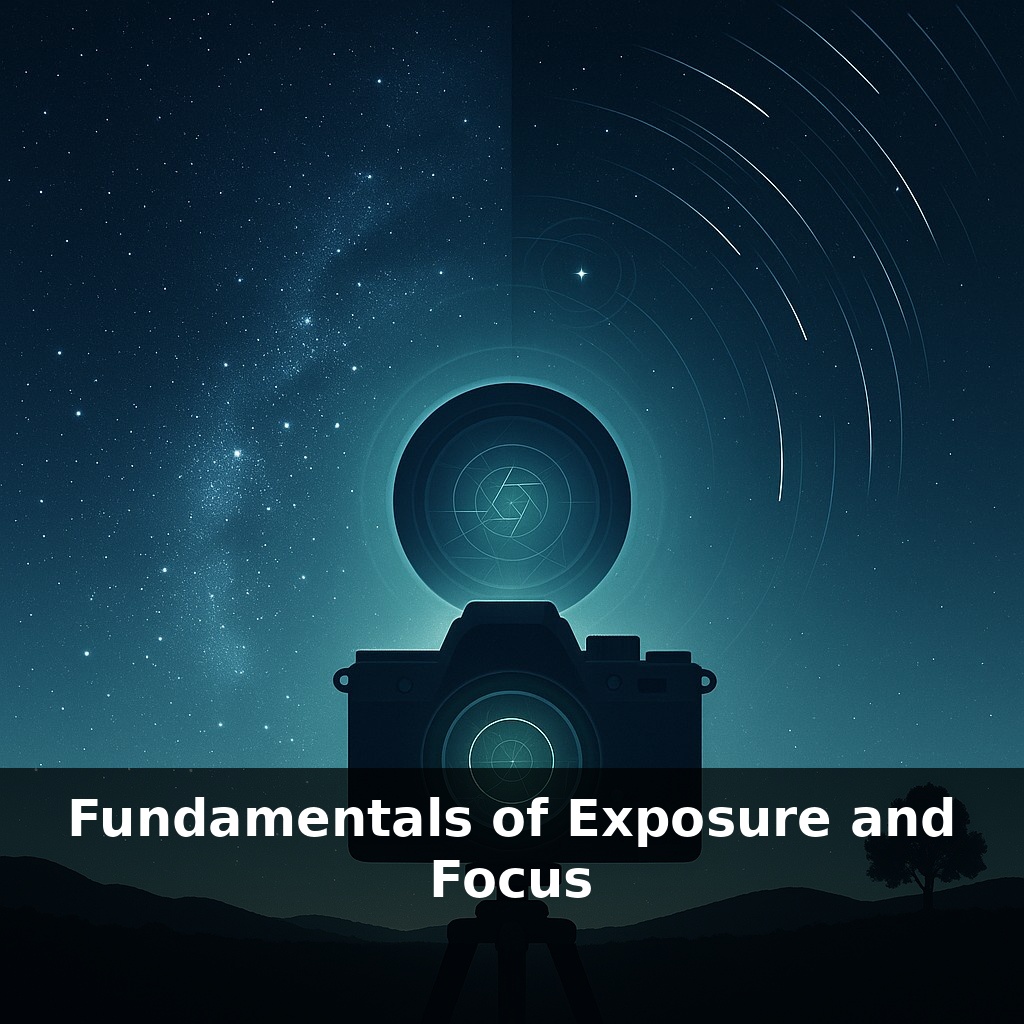
That mismatch between your vision and your camera isn’t a bug in the system; it’s the starting line for doing astrophotography on purpose instead of by accident. To get from “blurry light smears” to crisp Milky Way detail, you need two things working together: enough light, and exact focus. Exposure decides how much faint starlight you manage to gather before the sky turns into a noisy gray soup. Focus decides whether that light becomes sharp points or soft cotton balls scattered across the frame.
Most beginners chase settings they saw in a tutorial and hope for the best. In this series, we’ll treat the night sky more like a technical problem you can solve. We’ll look at how tiny changes in timing, aperture, and ISO shift the balance between detail and noise, and how “infinity focus” is more precise—and less mysterious—than the hard stop on your lens suggests.
Out under a dark sky, your settings aren’t guesses; they’re levers you can nudge to control how the scene unfolds over seconds instead of instants. Shift one, and the others must respond, not just to keep things bright enough, but to keep stars tight while the landscape still feels grounded. This is where simple “recipes” break down and deliberate choices begin. A fast lens might buy you shorter times, but it also shrinks your margin for precise focusing. Push the time longer, and the sky begins to write its own signature into your frame. Tonight, you’ll start learning to steer that trade-off instead of chasing it.
Step into the dark with a plan and a lot of what used to feel like “mystery” starts turning into numbers you can actually use.
Let’s start with motion. The sky isn’t just “moving”; it’s rotating at a very specific rate: 15° per hour. That’s slow to your eyes, but on a wide lens it becomes just fast enough to ruin an exposure if you push it too far. At 24 mm, that works out to an apparent drift that starts to show itself in roughly 20 seconds. Past that, stars don’t just get brighter; they get longer. No slider in your editor can turn a tiny line back into a point.
So instead of asking “how long can I expose?” flip it: “Given my focal length, what’s the longest time before drift becomes a problem?” Those Milky Way recipes you’ve seen—15 to 25 seconds on a 14–24 mm lens—are built around that limit. They’re not magic; they’re just staying ahead of Earth’s spin.
Once that upper bound is set by motion, you’re left with two remaining levers you can actually move freely: how wide the lens opens, and how much amplification you’re willing to tolerate. Opening up buys you time or lower noise, but it also tightens the razor-thin zone where distant stars are crisp. Go too wide and optical flaws creep in at the corners: faint smears, weird wings around bright stars, darkening toward the edges that you’ll have to deal with later.
On the amplification side, modern sensors are far better than their reputation. Current back-illuminated designs can catch well over four out of five photons that hit them, and add less than a single electron’s worth of noise as they read each pixel. That means you can push amplification to 3200 or 6400 without instantly destroying a frame—especially if you plan to stack a series of identical shots. Combine 16 of them and the useful signal grows four times faster than the random noise does, quietly rewriting what “too noisy” used to mean.
The real game is noticing how each small change pushes against the others. Think of it like tuning a racing bike: a lower, faster position makes you quicker, but also twitchier; a slight handlebar adjustment can be the difference between stable and terrifying.
Out in the field, those neat numbers turn into concrete choices. Say you arrive at a dark site with a 20 mm lens and realize the foreground mountain is barely visible. You’ve already pushed your time close to the limit set by the sky’s rotation, so instead of dragging the exposure longer, you might open the lens one stop and bump amplification one stop—keeping brightness steady while buying a cleaner frame to stack later. Another night, thin haze softens everything. Rather than forcing more light, you could shorten time slightly to keep small stars from swelling, then plan on combining a longer series of frames to recover contrast.
This is where “test shots with intent” matter. Take a 10‑second frame, then a 20‑second one, zoom all the way in, and inspect the tiniest stars near the edge. Do they stay round? Does the faint dust lane appear or vanish? Treat each trial like iterating a software build: change one variable, examine the result, and keep the version that survives close scrutiny.
In a few years, dialing in the night sky may feel less like manual flying and more like supervising an autopilot. Cameras are already inching toward “astro modes” that recognize stars as confidently as faces, auto-tuning multiple short frames into one clean result. Curved detectors could pair with compact lenses that stay sharp from center to edge, shrinking gear bags. Meanwhile, smarter firmware may learn to detect and mute satellite streaks the way noise-canceling headphones erase a passing train.
Your challenge this week: head outside after dark and make a mini “exposure lab.” Lock your framing, then capture a short sequence where you nudge one control at a time. Think of each frame as a test tile in a mosaic wall; when you review them later, patterns in sharpness, brightness, and grain start mapping out your personal sweet spot.