Earth spins so fast that in the time it takes to sip your coffee, stars have slid noticeably across the sky. Yet your camera can freeze a galaxy millions of light‑years away. How can something racing overhead become a still portrait? That tension is where deep‑sky magic begins.
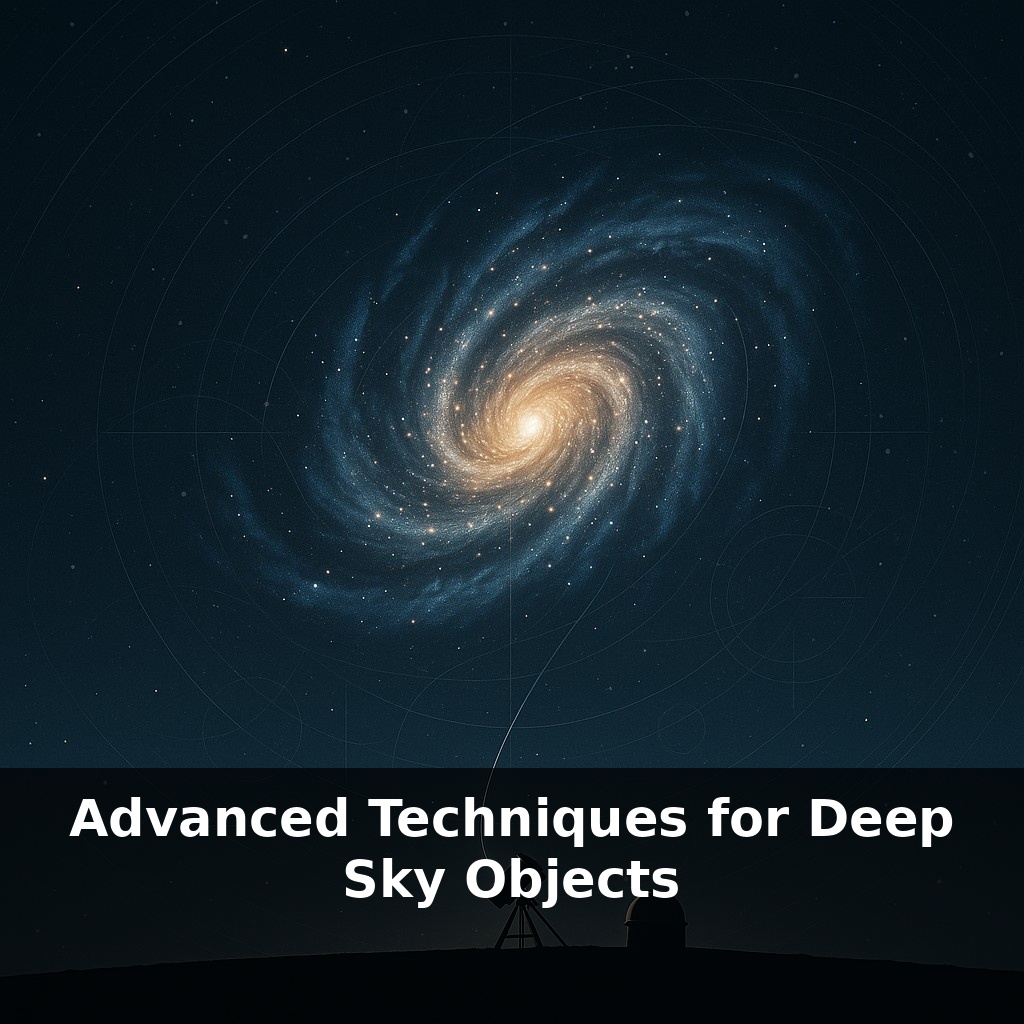
Faint galaxies don’t surrender easily—you have to cheat a little. Not by bigger telescopes or darker skies (though those help), but by bending time, motion, and math to your will. This is where advanced deep‑sky techniques step in: precise tracking that cancels the sky’s drift, exposures long enough to catch photons trickling in, and digital stacking that turns dozens—or hundreds—of noisy frames into one clean image. Together they quietly push your camera far beyond what a single shot can show. Modern gear has made this “cheating” surprisingly accessible: budget equatorial mounts can follow a target for hours, sensitive CMOS sensors drink in weak light, and software aligns and combines everything for you. In this episode, we’ll unpack how those three pillars work together, and what changes most when you move from casual snapshots to serious deep‑sky projects.
Long before hobbyists could do this from their backyards, professional observatories were already pushing these same ideas to extremes. They’d spend whole nights collecting data on a single galaxy, then return to it across seasons, building up integrations that rival a time-lapse of the universe itself. Today, you’re using a leaner version of that workflow at home: planning targets across multiple nights, matching framing so each session lines up, and minding details like focus, temperature, and sky brightness so your data plays nicely together. The mindset shift is key: you’re not shooting photos—you’re accumulating evidence.
Here’s the twist most beginners miss: those three pillars—tracking, exposure, stacking—don’t work in isolation. Each choice you make in one column quietly rewrites the rules for the others.
Start with tracking accuracy. A mid‑range equatorial mount might wander ±5–20 arc‑seconds over its internal worm‑gear cycle. On its own, that’s enough to turn faint stars into tiny dashes. Add an autoguider, and suddenly you can keep stars pinned close to a single pixel for minutes at a time. That extra stability isn’t just “nicer stars”—it lets you *choose* longer sub‑exposures, which changes how efficiently you collect signal compared with read noise from the camera.
Now connect that to stacking. Because SNR scales with the square root of the number of frames, 16 good subs already double your SNR; 100 give you ten times the SNR of a single exposure. But here’s the subtle trade‑off: very short subs mean you need *lots* of them to beat down noise, yet extremely long subs risk losing everything to a sudden gust of wind or a guiding glitch. Modern imagers often sit in a sweet spot: exposures just long enough to push the background sky well above the camera’s read noise, but short enough that a ruined frame doesn’t hurt much. Instead of gambling on one heroic 30‑minute shot, they’ll run, say, 120 shots at 2–3 minutes each and let statistics do the heavy lifting.
This is where integration time becomes your real “aperture.” Four to twenty hours on a target might sound excessive, until you see what stacking does over multiple nights. Wispy outer arms of galaxies, shock fronts in emission nebulae, dark dust lanes—all live buried in the low‑contrast margins of your data. Each additional hour doesn’t transform the picture, but it nudges those subtle structures further above the noise floor. Advanced imagers plan seasons around this: choosing a handful of objects to *go deep* on instead of hopping to a new target every clear night.
Light‑polluted skies complicate things, but they don’t end the game. Narrowband filters carve the spectrum into tight windows, letting you record specific emission lines while most city glow is rejected. That’s why you’ll see backyard images of nebulae with shockingly clean contrast, even under orange domes of skyglow.
Your challenge this week: design one “deep” project. Pick a single nebula or galaxy, then map out how you’d reach 8–12 hours of integration: sub‑exposure length, number of subs per night, how many nights, and whether you’d use broadband or narrowband. Treat it like an observing campaign, not a one‑night stand.
Think of this “go deep” approach less like snapping a photo and more like engineering a long‑term test flight. A spacecraft team doesn’t just launch and hope—they simulate the orbit, budget fuel, script mid‑course corrections, and leave margins for trouble. You can do the same with your target. Start by sketching the *phases* of your project: framing and focus night, data‑gathering nights, and a “cleanup” night to grab missing filters or fix framing. Add concrete constraints: how long your battery lasts, when the target clears local trees, when the Moon washes out broadband work but still allows narrowband. Keep a log of seeing, transparency, and guiding performance, then tag each night’s subs with simple quality flags. Later, when stacking, you can ruthlessly reject outliers instead of guessing. As your total integration grows, you’ll notice something subtle: planning skill starts to matter as much as optical hardware, and the bottleneck becomes clear sky, not your gear.
As these tools evolve, “taking a picture” shifts toward running a tiny observatory. On-sensor guiding and automated trail removal will quietly fix problems in the background, while cloud stacking and AI cleanup turn raw subs into live, shareable views. Citizen networks may watch the sky like a distributed smoke alarm, flagging supernovae or occultations for pros. Your careful project notes and calibration frames could end up as real data points in someone’s paper, not just decoration on your wall.
In the end, you’re not just capturing pretty spirals and glowing clouds—you’re quietly sampling the universe. Treat each long project like curating a library: label, back up, and revisit your data as your skills grow. Old photons become new images with fresh processing, like remastering a classic album when better studio gear finally lands on your desk.
To go deeper, here are 3 next steps: 1) Download and install Stellarium or SkySafari Plus, then use it tonight to plan a 2–3 hour imaging session on one target (like M51 or the Rosette Nebula), checking altitude, transit time, and field of view with your exact scope/camera combo. 2) Grab Charles Bracken’s *The Deep-sky Imaging Primer (3rd Edition)* and read the chapters on sub-exposure length and signal-to-noise, then apply his formula to set specific gain/ISO and exposure times for your own setup before your next clear night. 3) Install the free ASTAP and N.I.N.A. (or refine your existing workflow) and run a test sequence indoors: set up plate solving, autofocus routine, and a basic imaging profile so that when you’re under the stars, you can automate framing, focusing, and sequencing instead of doing it all manually.