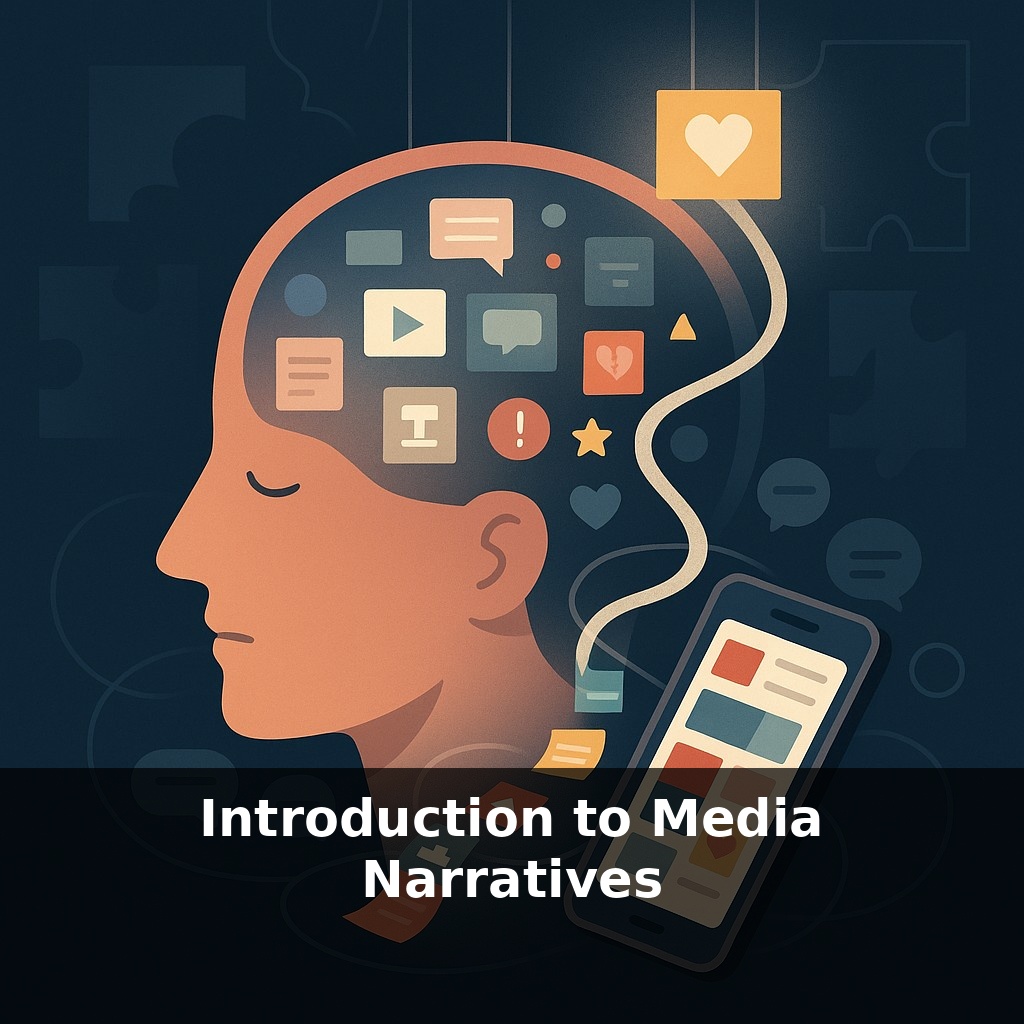
Introduction to Media Narratives
📝 Transcript
Right now, while you’re listening to this, your mind is quietly finishing a story that someone else started. A headline, a clip, a comment thread—each offers only fragments. The real mystery is: who chose those fragments, and what story are they nudging you to believe?
Open your news app, scroll for 60 seconds, and watch what happens: politics, outrage, heartbreak, a feel‑good miracle, a celebrity misstep—then back to outrage. It feels random, but that sequence is produced, not accidental. Editors, algorithms, and platforms constantly decide what appears first, what is buried, and what vanishes. These decisions don’t just inform you; they quietly suggest which stories matter and which don’t. Media narratives are the patterns that emerge from those choices over days, weeks, and months. One outlet highlights victims, another strategy, another economic fallout. Like a curator arranging pieces in a gallery, each reshuffle subtly changes the meaning you walk away with—and the conclusions you think you reached on your own.
Zoom out from a single scroll, and patterns start to appear. Certain villains keep returning, familiar heroes are recycled, and some crises seem to flare up only when cameras arrive. This isn’t just about which stories make it into your feed, but how repeated themes slowly sketch a world map in your head: who is dangerous, who is competent, who is worth caring about. Emotional headlines, share‑friendly clips, and viral outrage aren’t random either; they’re rewarded by clicks and ad dollars. Over time, that reward system can tilt coverage toward drama and simplicity, even when reality is complex and unresolved.
Think about a big, fast‑moving story—the early days of a pandemic, an election night, the first weeks of a war. At first, coverage feels chaotic: numbers, rumors, expert quotes, shaky videos, official briefings. Then, quickly, a few dominant storylines harden: “who is to blame,” “who is winning,” “who is suffering.” That hardening is where narratives really show their power.
Three basic moves drive this.
First, **selection and omission**. Do outlets follow the money, the victims, the diplomacy, or the partisan drama? In Ukraine coverage, some organizations drilled into military logistics; others zeroed in on refugees; others focused on energy prices at home. Each track is factual, but each quietly answers a different question about what matters most.
Second, **framing the central conflict**. Is a protest “chaos in the streets” or “a democratic awakening”? The underlying events can be the same; the cast and moral center shift. Words like “clash,” “riot,” “crackdown,” or “defense” aren’t neutral—they signal who the audience should intuitively side with, even before evidence is weighed.
Third, **repetition until a label sticks**. Once a phrase gains traction—“war crimes,” “fake news,” “border crisis,” “defund” anything—it can become a mental shortcut. The more often it appears, the less we interrogate it. Over time, that label can narrow which solutions seem thinkable. If something is always a “crisis,” compromise starts to look like weakness rather than problem‑solving.
This is where common myths sneak in. Narratives aren’t automatically lies; they’re simplified through‑lines built on selected facts. That’s unavoidable. The ethical fault line is whether counter‑evidence gets a fair showing, and whether uncertainty is acknowledged. Social media didn’t dissolve that line; it relocated it. Editors once filtered themes in newsrooms; now recommendation systems boost content that keeps you engaged, which often means emotionally charged, clear‑cut stories.
Even knowing all this doesn’t put you outside it. Research on the third‑person effect shows we reliably think “others are swayed, I’m just informed.” Meanwhile, the stories that feel most “obvious” to you are often the ones you’ve absorbed most deeply.
Watch how this plays out with a concrete issue like climate coverage. One outlet might zoom in on homeowners rebuilding after fires, another on policymakers arguing over targets, another on tech companies pitching carbon‑capture breakthroughs. Same underlying phenomenon, but you’re being walked through three different “worlds”: personal loss, partisan contest, innovation race. Over a month of casual scrolling, you might start to feel that climate change is mainly about individual lifestyle choices—or, alternatively, that it’s only about elections, or only about future tech magically fixing things. A similar fork appears with crime stories: a local incident can be cast as evidence of neighborhood decay, as a policing failure, or as a symptom of poverty and policy. None has to be fabricated; each uses real details while quietly steering you toward a distinct diagnosis and, later, very different “common‑sense” solutions.
Soon, you won’t just consume narratives—you’ll co‑produce them. Your posts, pauses, and skips will help train systems that forecast which angles spread fastest. As AI tools script clips and comments in seconds, the line between authentic reaction and manufactured chorus blurs. Fact‑checks alone won’t keep up. Think of your attention as a lens: where you focus sharpens certain futures, while neglected angles fade from public view, policy debate, and even historical memory.
Your challenge this week: each time a big story dominates your feed, jot down three missing angles or voices, as if you’re sketching the unseen half of a city skyline. By Friday, compare notes. Are the same groups, regions, or consequences consistently off‑screen? That pattern is your first real glimpse of how narratives contour public reality.
From this course
Behind the Headlines: Unmasking Media Narratives
7 episodesUnlock all episodes
Full access to 7 episodes and everything on OwlUp.
Subscribe — $1.99/monthLess than a coffee ☕ · Cancel anytime