A single word in a headline can quietly shift public opinion as much as a common medical treatment shifts health outcomes. You hear a breaking story on your commute, your friend shares a meme at lunch, a push alert buzzes at night—and each one is quietly framing reality for you.
Think about how differently a story feels when it’s told as a “crime wave” versus a “policy failure,” a “protest” versus an “uprising,” a “leak” versus a “whistleblower revelation.” The facts might line up neatly, yet the story’s center of gravity—who seems responsible, what seems urgent, what seems possible—shifts with each choice. Journalists make dozens of these choices per article, often under deadline, often without fully unpacking their own assumptions. That’s where framing quietly lives: in which expert gets quoted first, which photo becomes the face of an issue, which number is highlighted and which is buried. Like an art curator arranging a gallery wall, the press doesn’t just show us pieces of reality; it arranges them so that some paths through the story feel natural, and others almost never occur to us at all.
So when critics say “the media is biased,” they’re often reacting not just to political lean, but to these quieter curatorial moves. Two outlets might relay the same timeline and quotes, yet one centers economic stakes while the other spotlights individual morality. Over time, those patterns teach us which kinds of harm count, whose voices are “expert,” which problems seem solvable and which feel like background noise. This is where framing becomes more than a storytelling choice; it’s a force that can normalize chronic crises or, suddenly, reclassify them as emergencies demanding action.
When researchers pulled together decades of experiments on framing in 2020, they found something striking: the average impact on people’s views was roughly as strong as many widely prescribed medical treatments. That isn’t about “tricking” people with lies; it’s about how small editorial decisions nudge us toward one storyline instead of another.
Those nudges operate on several layers at once.
There’s the **problem frame**: is climate coverage cast as a story about melting ice, about corporate malpractice, about national security, about consumer choices? Each lens highlights different culprits, victims and solutions. Shift the lens, and suddenly different policies feel “common sense.”
Then there’s the **responsibility frame**: who is portrayed as in control? Crime stories that dwell on individual choices steer attention toward punishment; pieces that foreground housing, schooling and jobs prime us to look for systemic fixes. Neither approach is automatically wrong, but they don’t coexist neutrally—one tends to crowd out the other.
You also see **conflict frames**, which emphasize winners and losers. Election coverage that obsessively tracks “who’s up, who’s down” can drown out questions like: what would this proposal change in an actual classroom, hospital, or neighborhood? Audiences walk away fluent in strategy but foggy on stakes.
Even numbers are framed. Is unemployment “4%” or “6.7 million people without work”? Both are accurate; one feels abstract, the other visceral. Add a comparison—“the lowest in 20 years” versus “double the rate for young Black workers”—and the emotional temperature shifts again.
Crucially, there are also **solution or constructive frames**. Instead of stopping at “here’s what went wrong,” they allocate space to what’s being tried elsewhere, what researchers recommend, where experiments have failed. This doesn’t sugarcoat; it widens the horizon of what feels thinkable.
All of this is why media literacy isn’t just spotting falsehoods; it’s learning to hear the choices humming underneath a story. And in newsrooms, it’s why editors who slow down to ask, “What frame are we defaulting to—and who does it leave out?” are doing more than wordsmithing. They’re deciding which futures their audiences can even see.
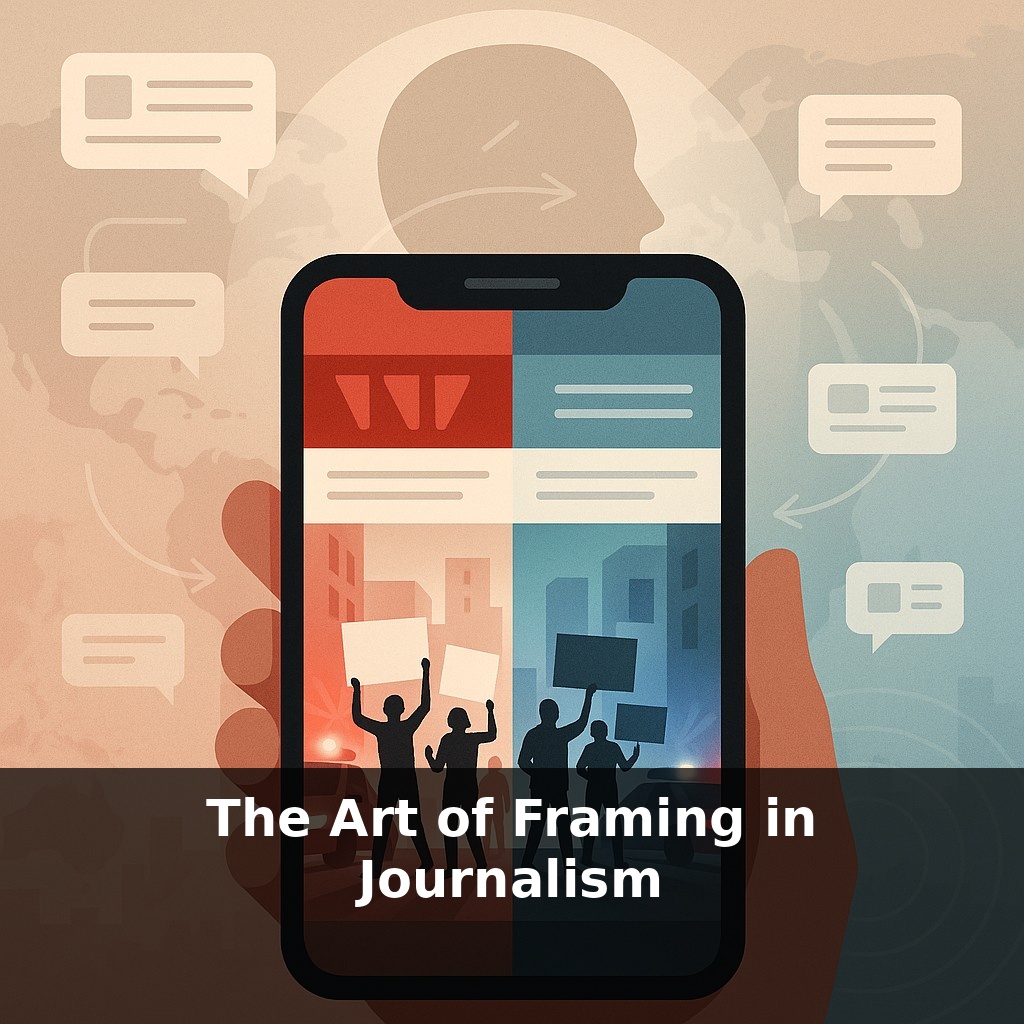
Consider two stories about the same protest: one leads with a photo of broken glass at a storefront, another with a wide shot of a diverse crowd holding homemade signs. Then look at the captions: “riots erupt downtown” versus “thousands rally for safer streets.” You’re primed for disorder in the first, deliberation in the second, before you’ve read a single paragraph. Or think about a wildfire story. One version lingers on heroic rescues and heart-wrenching losses; another foregrounds zoning laws, controlled-burn policies, and insurance lobbying. Both are emotionally potent, but they spotlight different levers for change.
Even the order of quotes matters. If an industry spokesperson speaks first and a local resident last, the resident can sound like a reactive footnote. Reverse the order, and the corporate line feels like a defense against lived experience. In subtle ways, these sequencing decisions sketch an invisible hierarchy of whose reality counts most.
Framing’s future won’t just live in newsrooms; it will sit in your pocket. As feeds learn your habits, they can tune not only which topics you see, but *how* those topics are told, like a playlist that quietly shifts mood without changing the song. Some outlets are experimenting with “frame labels” or side‑by‑side story versions so audiences can compare angles. If those tools spread, the next literacy skill may be less “spot the bias” and more “switch the lens on purpose.”
Noticing frames is only a first step; the next is experimenting with alternatives. Ask: what would this story look like if it started from children, rivers, tenants, nurses? Shift vantage points the way hikers change trails, then compare the views. Over time, you’re not just decoding coverage—you’re quietly editing the mental front page of your own day.
Here’s your challenge this week: Pick one major news story and rewrite its lead three different ways—once as a “conflict” frame, once as a “solutions” frame, and once as a “systems/structural” frame, each under 80 words. Then, show all three versions to two different people and ask them which one makes the issue feel most urgent, most hopeful, and most complex—and note their answers. Finally, compare those reactions and circle one framing choice you’ll consciously avoid or reduce in your own media consumption for the next seven days.