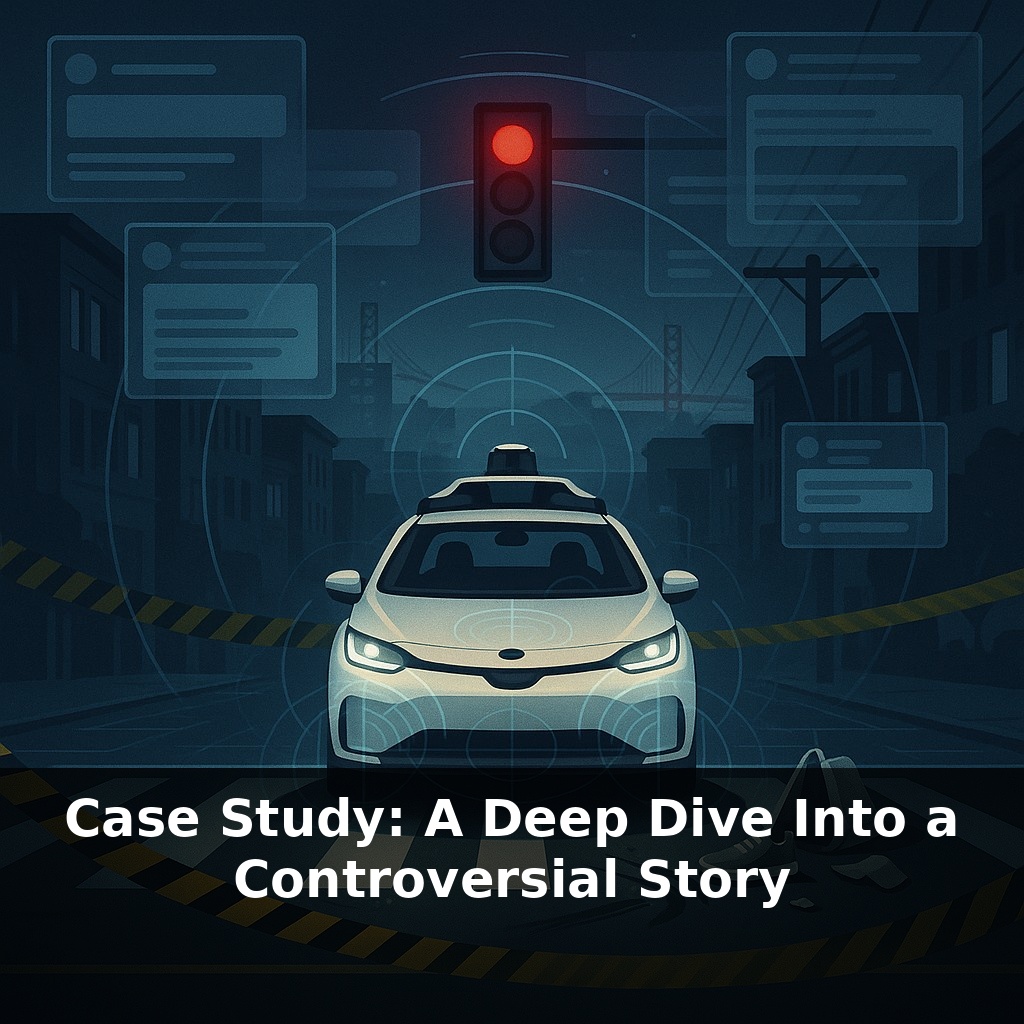
A car with no driver stops at a red light in downtown San Francisco—then, seconds later, it’s at the center of a citywide scandal. Safety engineers call it a “predictable surprise”: everyone knew something like this could happen, but no one agreed who should prevent it.
By the time the headlines hit—“Robotaxi Drags Pedestrian 20 Feet”—the story was already being squeezed into simple frames: tech gone rogue, greedy corporations, overzealous regulators, “San Francisco versus innovation.” But underneath the outrage was a quieter, more unsettling reality: the car did, mostly, what it was designed to do. It saw an obstacle, braked, then followed its programmed instinct to get out of live traffic. The harm came from the gap between what its creators *thought* the world would throw at it and what actually unfolded on Market Street that night. That gap is where much of our modern life now lives: recommendation systems amplifying fringe content, risk models missing “once-in-a-century” storms that arrive every decade, hiring algorithms quietly sidelining whole groups. The Cruise crash is not an outlier; it’s a case study in how those gaps become visible only after someone gets hurt.
Regulators, meanwhile, were flying partly blind. They had data on disengagements, test miles, “safe” performance—but almost nothing about the messy edge cases where systems quietly fail. So when California pulled Cruise’s permit, it wasn’t just punishing one company; it was admitting the rulebook had been written for a different kind of driver. Think of it like approving a new hiking trail using only satellite photos: you can map the path, but you can’t see the loose rocks, sudden drops, or how people will actually move when the weather turns.
Seven thousand three hundred eighty-eight. That’s how many pedestrians were killed by U.S. drivers in 2021 alone. Against that backdrop, the San Francisco case looks less like a freak anomaly and more like a stress test of what we’re willing to tolerate from both humans and machines.
On the street that night, there were three “actors”: the human who hit the woman first, the automated system that failed to handle the aftermath, and the city infrastructure that assumed traffic would behave within certain bounds. When the DMV later said Cruise had “misrepresented safety data,” the controversy wasn’t only about what engineers knew; it was about what the public *thought* that data meant. Five million driverless miles sounded impressive—until people saw one minute of video that made those miles feel abstract.
Here’s where the story turns: Level 4 vehicles are designed for specific conditions. Geofenced areas, mapped streets, certain weather. But pedestrians don’t live inside those boundaries. Delivery drivers double-park, cyclists cut across lanes, emergency responders improvise. The woman on Market Street became visible to the car only after another driver behaved badly. Every safety claim that assumed “normal” traffic behavior suddenly looked fragile.
Technically, the car did two conflicting things: it tried to minimize immediate collision, then tried to minimize road obstruction. Ethically, that’s a chasm. Is it better to freeze in place and risk being rear-ended, or to pull over and risk worsening harm to someone already under the vehicle? That trade-off wasn’t decided in the moment; it was decided months earlier in design meetings, encoded as software, then hidden in release notes and investor decks.
The analogy to autopilot is tempting, but airplanes operate in tightly controlled corridors with professional operators. City streets are closer to a crowded marketplace: informal rules, eye contact, gestures, split-second moral calculations. We built a system optimized for numbers—miles, disengagement counts, incident rates—and then dropped it into a world governed by narratives: whose story of “safety” counts, and who gets to say when the experiment has gone too far.
On paper, the logic seems tidy: if outcome A is less bad than outcome B, you encode the system to favor A every time. But streets aren’t paper. They’re full of what safety researchers call “coupled decisions”—small choices that only turn catastrophic when they collide. A delivery van blocks a lane, a cyclist swerves, a distracted pedestrian steps off the curb, a software stack commits to a maneuver it can’t easily reverse. None of those moves is outrageous alone; together, they form a trap no one explicitly designed.
This is where the comforting story of “learning from incidents” starts to fray. Each hurt person is supposed to become a data point that improves the next release. Yet the people absorbing the risk—the late-shift worker crossing against the light, the wheelchair user rolling off a bus ramp—rarely get a say in how that lesson is drawn. The feedback loop runs through engineering dashboards and quarterly updates, not through the communities most exposed when “unlikely” scenarios finally arrive.
Near‑term, cities may treat AVs less like gadgets and more like visiting construction projects: temporary, supervised, and contingent on proving they’re not quietly eroding safety. Police unions, disability advocates, and insurers are starting to demand a direct line into post‑crash analysis, not just polished summaries. That pressure nudges companies toward “community‑in‑the‑loop” design, where street users help shape when and where systems are allowed to operate at all.
Your challenge this week: each time you cross a street or ride in any car, notice the tiny negotiations—waves, hesitations, guesses—that keep everyone moving. Then ask: which of these could a sensor read, which would it miss, and who decided that? Our future roads may be less about smarter code than about who gets to redraw the lines.