Just after midnight in Berlin, neighbors went to sleep in the same city and woke up in different worlds. One moment, trams crossed streets and friends shared doorways. A few hours later, barbed wire, floodlights, and soldiers turned the heart of a capital into a sudden border.
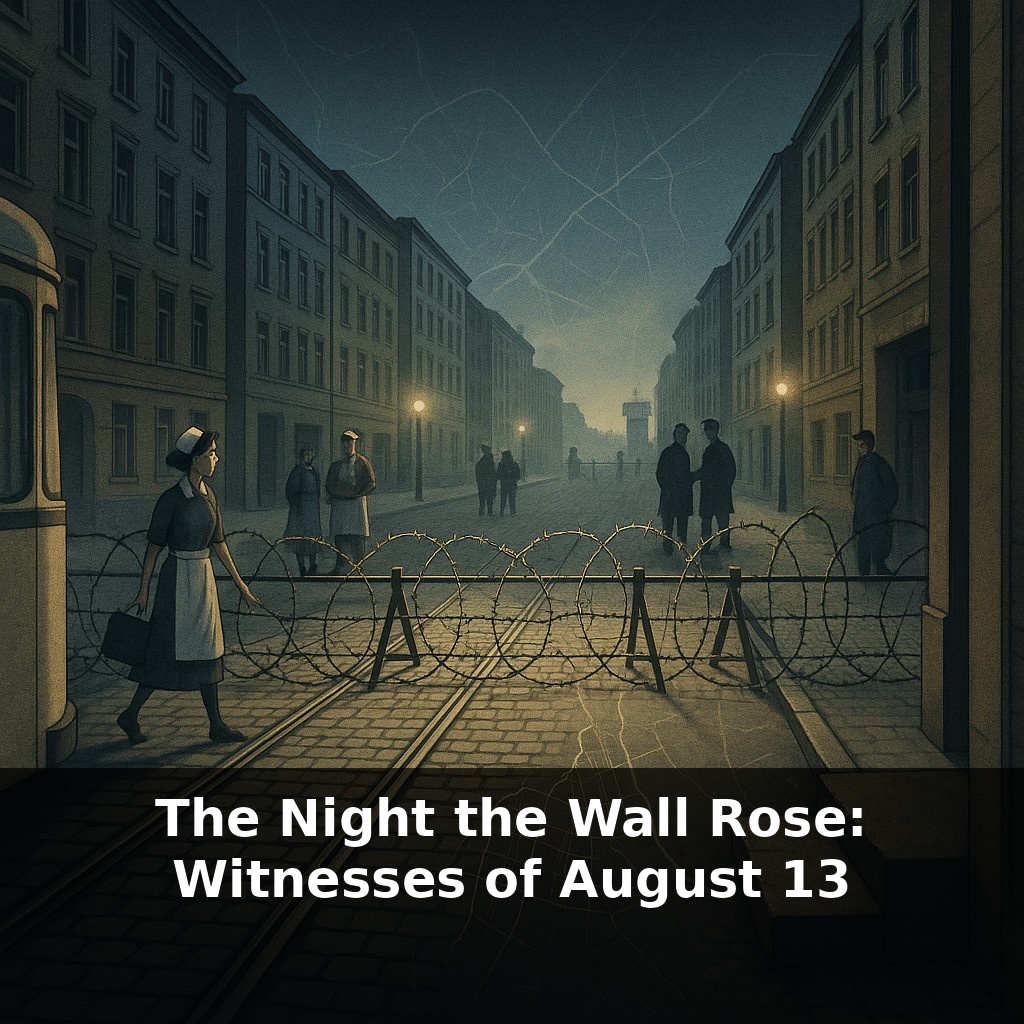
By dawn on 13 August 1961, Berliners stepped out of their front doors into a city that no longer matched the map in their heads. A nurse walked her usual route to the hospital and found her street sliced in two. A baker on one side of town could still smell the morning bread from a rival shop across the way—he just could no longer reach it. Tram lines stopped short like unfinished sentences. On Bernauer Straße, people leaned from upstairs windows, talking down to relatives now stranded on the pavement below, voices crossing a line their bodies could not. Subway cars rolled into sealed stations where platforms stood empty, clocks ticking over a silence no timetable predicted. August 12 had ended like any other Saturday; August 13 began like a citywide misunderstanding that hardened, hour by hour, into a new and unforgiving reality.
By mid-morning, the scale of what had begun became clearer. This was not a local disturbance but a coordinated state operation, rolled out with timetables and troop lists instead of public debate. Around 17,000 uniformed men had moved into position overnight, following sealed orders under the codename “Operation Rose.” Concrete posts, wooden obstacles, and checkpoints appeared in sequence, like notes in a carefully composed score. Western journalists rushed to the scene, filming confused crowds and terse border guards, while East German radio framed the same events as a defensive measure, drawing a firm line through competing narratives.
In the offices of the East German leadership, 13 August was not a rupture but the execution of a long-delayed decision. For years, the German Democratic Republic had been losing people faster than it could build a future: engineers, doctors, students, skilled workers who boarded trains to West Berlin and did not come back. By the summer of 1961, nearly one in six East Germans had left since 1949. The state called it “Republikflucht”—desertion of the republic; in factory canteens and cramped apartments, people called it simply “going over.”
In Moscow, this drain looked like a strategic leak in the Soviet bloc’s defenses. Nikita Khrushchev had watched West Berlin become a showcase—and a pressure point. Every defection was a data point that Western leaders could cite as proof that socialism was failing. Reports flowed upward: hospitals short of staff, research institutes losing senior scientists, construction projects stalled. If a society is a kind of orchestra, East Germany was trying to play an ambitious score while its first violinists quietly packed their cases and slipped out the side door.
By early August, Soviet and East German officials had agreed: the easiest route out had to close. Not with public debate, but with a technical measure—a “regulation of the state border.” The language was bureaucratic, but the logic was stark. Stop the movement, stabilize the workforce, reassert control. Walter Ulbricht, the GDR’s leader, had publicly insisted in June, “Niemand hat die Absicht, eine Mauer zu errichten”—“No one has the intention of building a wall.” The phrase reassured some, but it also signaled nervousness: the issue had become visible enough that it had to be denied.
Western intelligence services picked up hints—unusual troop movements, tightened controls, rumors among border guards. Newspapers in West Berlin printed speculative maps, arrows showing where a barrier might run. Yet timing remained guesswork. Politicians argued over whether the Soviets would risk such a drastic step; diplomats weighed notes and speeches like weather reports, trying to predict a storm.
On the ground, ordinary Berliners heard fragments. A cousin in the people’s police warning, “Don’t travel this weekend.” A co-worker whispering that permits might soon be harder to get. Some rushed to move savings, visit family, or make one last crossing “just in case.” Many assumed the crisis, like earlier ones, would blow over.
It did not blow over. On the night of 12–13 August, the long-theorized “measure” became reality, not in one dramatic structure but in hundreds of small actions carried out street by street, doorway by doorway, each decision made by a specific officer, a specific squad, in a specific place.
Some of the clearest “witnesses” to that first night weren’t politicians or generals, but small, ordinary objects that suddenly gained new meanings. A tram ticket bought on Saturday became useless paper by Sunday, trapped in a wallet on the “wrong” side of town. A house key, once a symbol of security, now fit a door you could no longer approach. Wedding rings that had crossed checkpoints freely during visits now marked couples forced into long-distance marriages measured not in kilometers, but in permissions and stamps.
Listen to the way people from that night describe sound. Dogs barking in courtyards where patrols marched past. Church bells that still rang across the city, their echo briefly knitting together spaces that law had split apart. Radio music drifting from the West into cramped East Berlin bedrooms, like a station that played from a neighboring room you could hear clearly but never enter.
Your challenge this week: treat your own routine paths as a kind of historical laboratory. For three days, pick one everyday route—a walk to work, a bus ride, a shortcut through a park. Each day, notice and note three specific “crossings” you take for granted: a bridge, an intersection, a doorway, a platform edge. On the third day, deliberately reroute yourself so that you avoid one of those habitual crossings entirely and feel how your small map of the city shifts.
Then, in a notebook or notes app, write one short paragraph: If this crossing vanished overnight and never returned, what stories would it suddenly hold—who would be cut off from whom, and which objects in your pockets would quietly lose their meaning?
In the decades since, one lesson keeps resurfacing: drastic change can arrive quietly, under ordinary streetlights and weekend plans. Today, the tools look different—databases instead of watchtowers, algorithms instead of patrol routes—yet they can redraw who may go where, and with whom. Rights can erode not only through loud decrees, but through a series of minor “adjustments” that feel temporary, technical, even helpful, until a city’s freedom has subtly narrowed like a river in drought.
History rarely announces itself with trumpets; it often arrives like fog, changing what’s visible before anyone agrees when it began. The night of 13 August shows how fast “normal” can be edited—street by street, rule by rule. The open question is how we notice such edits in our own time, before they settle like sediment into the riverbed of daily life.
To go deeper, here are 3 next steps: 1) Watch at least one eyewitness account from the Bundesstiftung Aufarbeitung’s “Zeitzeugenportal” (time-witness portal) on August 13, 1961, and compare what you hear with the podcast’s stories of that night. 2) Read the first two chapters of Frederick Taylor’s *The Berlin Wall: A World Divided, 1961–1989* or Hope M. Harrison’s *Driving the Soviets up the Wall* to see how the political decisions behind “the night the Wall rose” line up with the personal memories you just heard. 3) Explore the interactive “Chronik der Mauer” (chronik-der-mauer.de) timeline for 13–15 August 1961, zooming in on the specific border crossings mentioned in the episode (like Bernauer Straße), and use Street View or historical photos to visualize exactly where those witnesses stood.