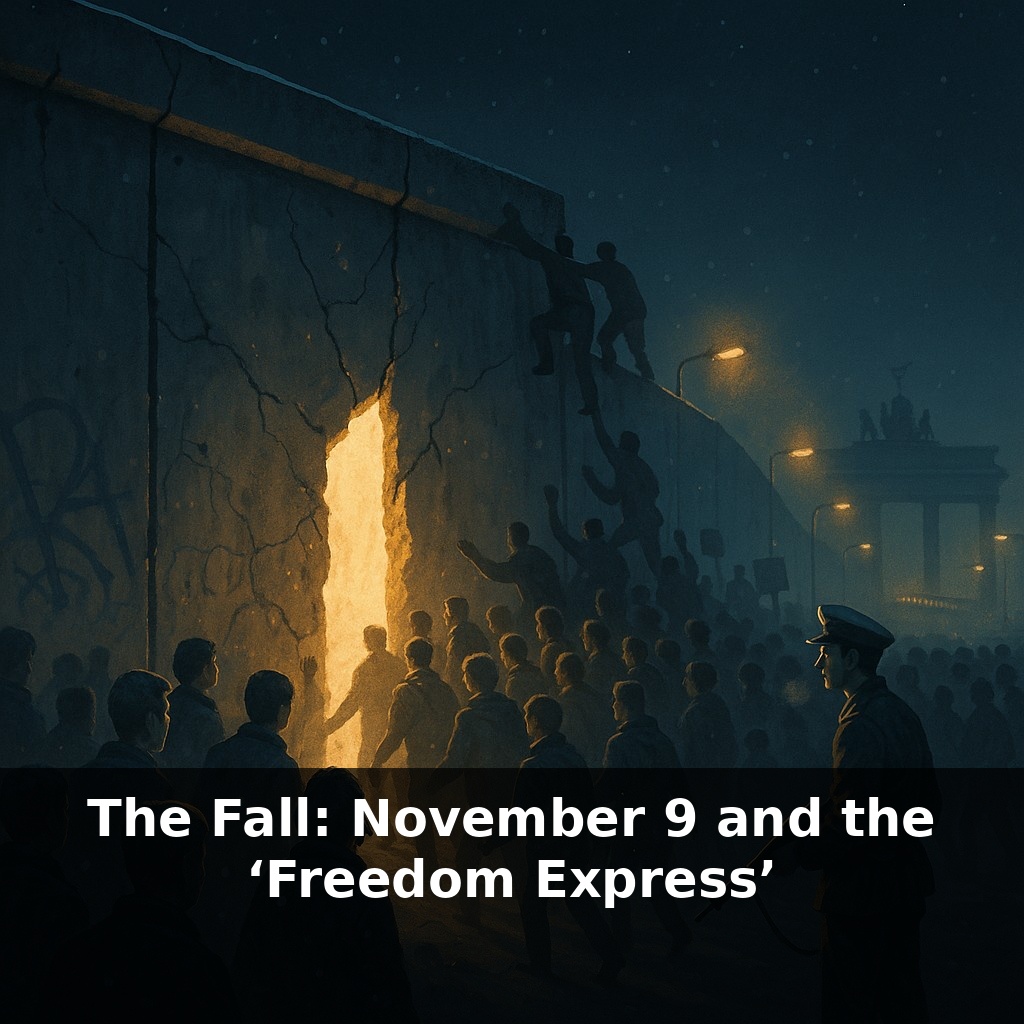
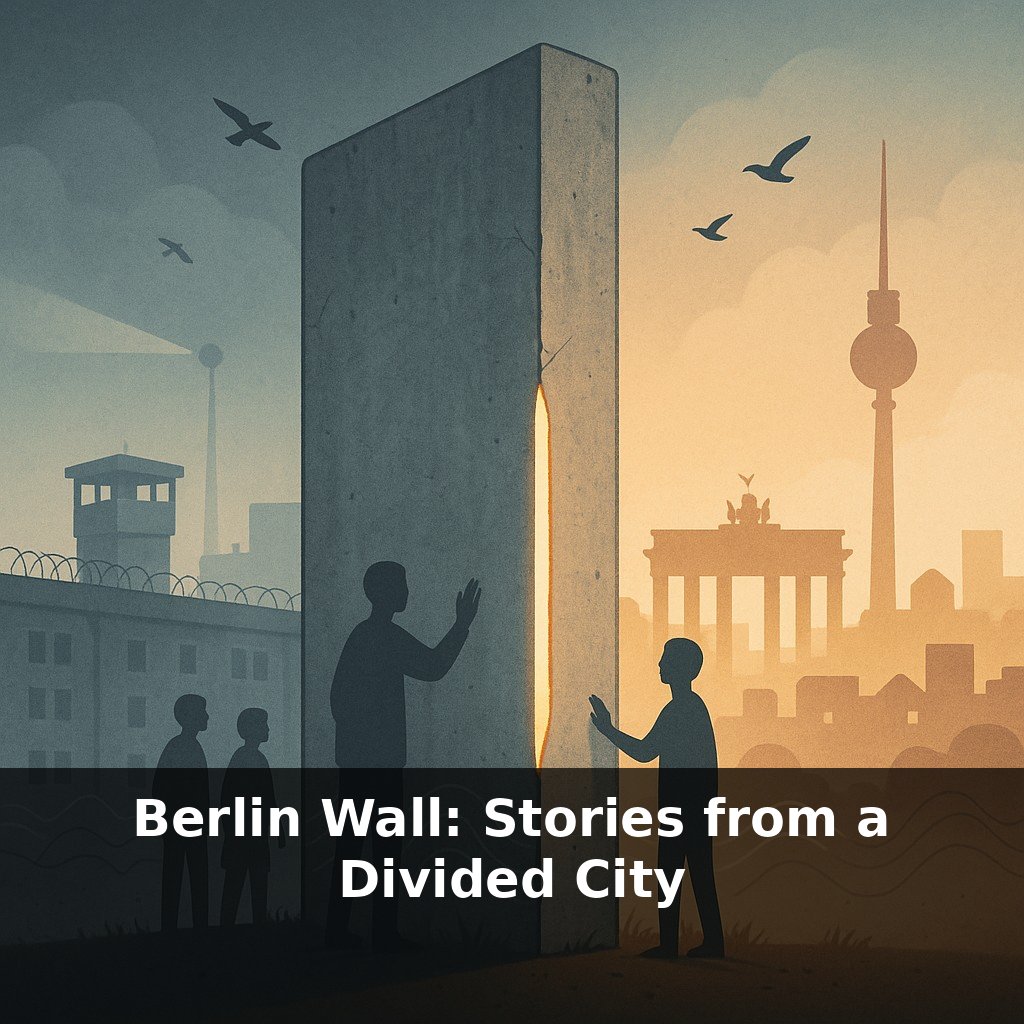
On one cold November night in 1989, border guards in Berlin faced a crowd—and a sentence—they didn’t fully understand. Within hours, a wall built over decades began to fall, not from bombs or tanks, but from a confused announcement and a wave of people who refused to wait.
In the weeks before 9 November, East Germany was already coming apart at the seams. Monday demonstrations filled city squares; chants for “Wir sind das Volk” grew louder than any official slogan. Trains packed with refugees—soon dubbed the “Freedom Express”—rumbled westward through Hungary and Czechoslovakia, each departure quietly draining the regime of both citizens and credibility. Diplomats negotiated, party leaders argued, and state media tried to sound calm while the ground shifted under their feet. The Wall in Berlin still stood, but its purpose was eroding—like a dam whose lake has been quietly emptied upstream. When that muddled announcement finally hit live television, it didn’t create the pressure; it merely cracked the last visible barrier holding everything in place.
In early November 1989, officials were juggling crises on every front. Refugees were streaming out through newly opened routes in Eastern Europe, party hardliners were losing arguments behind closed doors, and foreign leaders were quietly signaling that no Soviet tanks would roll in this time. The Wall’s 43 kilometers through Berlin were suddenly less a symbol of strength than a measurement of vulnerability. Each checkpoint became a stage where exhausted guards, anxious citizens, and bewildered functionaries performed a script no one had fully written—or agreed to follow. Into this confusion stepped one spokesman, one sentence, and live TV.
At 6:53 p.m. on 9 November 1989, a tired party spokesman named Günter Schabowski shuffled his papers at a live press conference in East Berlin. He hadn’t been in the key meeting that afternoon. He had only a memo—dense, bureaucratic, and, crucially, not meant for immediate release. When a reporter asked about new travel rules, Schabowski glanced down, squinted through his glasses, and improvised.
The text in front of him said that, under certain conditions, East Germans would soon be able to apply for permission to travel. It was supposed to start the next day, with procedures, stamps, and forms—everything the system understood. Instead, Schabowski read it clumsily and, pressed to clarify when it would take effect, muttered the three words that detonated the evening: “Sofort, unverzüglich” – “immediately, without delay.”
West German television cut the clip within minutes. On living room screens across East Berlin, his hesitant sentence was replayed, stripped of nuance. Viewers didn’t hear a trial regulation; they heard the word that had never applied to their movement before: immediately. Phone lines lit up. People called friends, family, colleagues: “They’re opening the border.”
The order book on the border guards’ desks still said nothing about any of this. Their superiors had no clarifying fax, no fresh directive. Some commanders phoned party offices and got only busy signals or vague assurances that “details will follow.” Those details never came. Instead came people—first dozens, then hundreds, then thousands—heading for the best-known crossing points: Bornholmer Straße, Checkpoint Charlie, Invalidenstraße.
Many of those walking toward the barriers had, until then, tried to navigate the system cautiously: applying for exit visas, joining waiting lists, staying just on the safe side of trouble. Now they were voting with their feet. The presence of foreign TV cameras added a new calculation; violence would not be easily hidden. For the first time in 28 years, the risk for the men in uniform was no longer just about letting someone slip through, but about how the world would watch whatever they did next.
Your challenge this week: Pick one “rigid rule” in your own environment—a policy at work, a family routine, a school norm—and watch closely what happens at the smallest point where it is actually enforced: the front desk, the form, the conversation. Notice who has to improvise, who hesitates, and where informal decisions quietly reshape what the “rule” really is.
Think of how a weather front moves through a landscape: the forecast gives a rough idea, but the real story shows up in the one valley where wind funnels differently, or the one hill where clouds always snag. In November 1989, that “valley” was the handful of crossings where individual officers, not party planners, had to decide what “immediately” meant in practice. Some stalled, some phoned around, some simply watched the numbers swell and did the math on what force would require. Historians later traced how tiny choices at a few gates redirected millions of lives and, over decades, billions of euros in reunification costs. It’s a reminder that large systems often hinge on the least glamorous points of contact. A receptionist bending a rule, a teacher ignoring an outdated guideline, a junior manager signing off on an exception—these are the places where official policies collide with lived reality and, sometimes, quietly begin to crumble.
The same night borders blurred, other questions hardened: Who pays for decades of neglect? How do you stitch together legal systems, pension schemes, even school curricula that grew apart? Policymakers today study 1989 less for the drama at the crossings than for the slow work that followed—treaties, tax transfers, truth commissions. Like gardeners merging two overgrown plots, they must decide what to prune, what to replant, and how much wildness to tolerate in the new shared space.
In the months after 9 November, new questions replaced old fears: jobs, rents, school places, voting rights. Some friendships frayed; others formed across streets that had once been dead ends. Like rivers after a landslide, lives carved fresh channels, sometimes flooding, sometimes drying up, but gradually finding a new course no planner had fully mapped.
Before next week, ask yourself: 1) “If I had been standing at the Berlin Wall on November 9, 1989, watching people climb onto the ‘Freedom Express,’ what is one barrier in my own life today that would feel just as urgent to tear down—and what’s the first concrete step I could take to ‘cross’ it this week?” 2) “Looking at how ordinary East Berliners spread information and courage through small conversations and gatherings, who in my own circle could I talk to this week about something we both feel boxed in by, so we can encourage each other the way they did?” 3) “When I think about the mix of fear, confusion, and excitement at the border crossings that night, where in my life am I hesitating at a ‘checkpoint,’ and what specific piece of evidence (a fact, a person’s story, or a personal experiment) could I seek out today to give myself permission to move forward?”