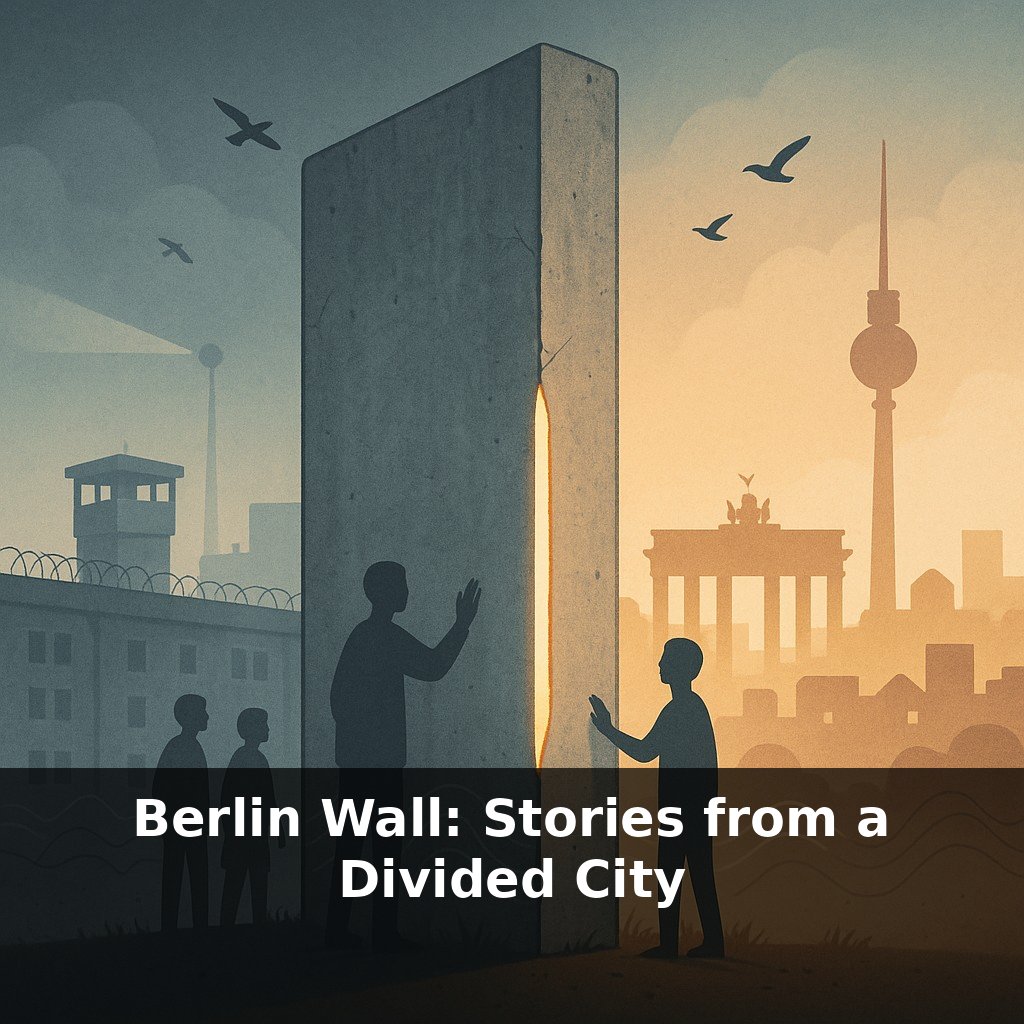
In today’s Berlin, more than two-thirds of young people say the Wall is just “history”—yet the city map still betrays its old fault lines. A higher rent on one street, a different tram line on another. Is this one united city… or two different pasts sharing the same postcode?
Step off the train at Alexanderplatz, then ride a few stops west to Ku’damm, and you’re not just changing neighborhoods—you’re crossing a quiet line in paychecks, voter preferences, and even family stories. An engineer in the west might earn more than a counterpart in the east, though they share the same skyline. Street by street, the city reveals how money from Bonn and Brussels flowed into roads, housing, and glossy office blocks, yet memories and local habits still set the tempo of daily life. Some areas that once emptied out under the GDR now buzz with start-ups and galleries, while others are still catching up, like a choir in which some voices have found the new key faster than others. To understand whether Berlin is truly “healed,” we have to look beyond the vanished border and ask: who gained, who waited, and who is still in transition?
Some of the sharpest contrasts emerged not on maps, but in expectations. After 1990, many in the east hoped prosperity would arrive as quickly as new shop signs; instead, factories shut, careers vanished, and whole professions had to be relearned under different rules. Meanwhile, western taxpayers watched the “solidarity surcharge” nibble at pay slips for decades, told it would speed up levelling that still isn’t finished. Public transport was stitched back together, schools merged, administrations unified—yet trust and confidence adjusted more slowly, like traffic lights reprogrammed long after new roads are already open.
Stand on the Oberbaumbrücke at sunset and you can watch three versions of Berlin glide past at once. On one side, glass offices house venture-capital firms and media start-ups; on the other, 1960s Plattenbau blocks shelter pensioners whose working lives unfolded in a planned economy. Between them float party boats packed with visitors to whom both stories feel remote—a backdrop, not a biography.
Officially, the city speaks of “growing together.” The numbers show how uneven that growth has been. In the 1990s, unemployment in eastern districts often doubled western levels; whole industries—textiles, shipbuilding, electronics—collapsed as they hit the shock of global competition. Many mid‑career specialists saw their qualifications suddenly downgraded or rejected. Some retrained as taxi drivers or security guards, others left for Bavaria or abroad. The east did not just gain new opportunities; it also lost an entire economic script.
Yet the same decades turned former industrial wastelands into laboratories for new lifestyles. Cheap rents in areas like Friedrichshain and Prenzlauer Berg attracted artists, students, and later international migrants. Galleries filled ex-factories, lofts replaced workshops, English appeared on café menus. Where state firms once produced for Comecon, co‑working spaces now export code and design. This influx helped shrink the gap, but it also pushed long‑term residents to the edges, stirring arguments over who the “new Berlin” is really for.
Infrastructure tells another, quieter story of reconnection. Tram tracks laid anew into western streets, S‑Bahn lines re‑linked, and disused freight yards reborn as parks and cultural venues have blurred the physical border. Property investors followed track maps as eagerly as planners, betting that every new station would lift land values one stop further out.
Polls hint at a generational hinge. Many under 35 navigate the city less by its past division than by subcultures: club scenes, activist networks, academic circles. For them, the key divide may be precarity versus security, not east versus west. But listen to older Berliners and you still hear different benchmarks for fairness, different instincts about the state and the market, shaped by whether adulthood began with a party congress or a shareholder meeting.
Tourism adds a final twist. Sites of control and escape now fund souvenir shops, museums, and guided tours in multiple languages. The city’s fractured history has become an economic asset—yet every ticket sold raises the question: whose memory is being packaged, and who gets to decide when the story of division has a happy ending?
Walk a few blocks in Lichtenberg and you’ll see one kind of reunification in practice: a former Stasi office block turned start‑up hub, a Vietnamese grocery next to a craft‑beer bar, kids with Polish and Syrian roots playing in a courtyard once reserved for party officials. Cross to Neukölln, long in the west, and you’ll find the reverse: an area that never knew socialist housing boards now wrestling with tenants’ unions, rent caps, and debates over who owns the street. These micro‑shifts are where “growing together” stops being a slogan and becomes a series of small bargains: whose school closes, which club survives a noise complaint, which mural gets painted over for a new development.
Reunification is like re‑tuning an orchestra midway through a concert: some instruments adapt quickly, others lag, and for a while the melody wobbles—yet over time, new harmonies appear that no single section could have played alone.
Some clues to Berlin’s future lie in how today’s kids move through it. Many cross old borders as casually as changing subway lines, yet they still pass memorials, plaques, and quiet gaps where buildings never returned. Digital projects may become their main “textbook,” layering AR timelines over streets. If that memory work fades, unity risks turning shallow; if it deepens, the city could become a living seminar on how societies repair themselves without erasing their scars.
Berlin’s “healing” may lie less in erasing difference than in how people learn to cross it. New co‑ops, community gardens, and neighborhood festivals pull strangers into the same small routines, like threads tightening a shared net. The experiment isn’t finished; every lease signed, band formed, or friendship begun quietly redraws what reunification means.
Start with this tiny habit: When you pass a place in your city that used to be a boundary—like a bridge, a station, or a street that once divided neighborhoods—whisper one sentence about who might have stood there during the split and what they might feel seeing it today. When you unlock your phone afterward, quickly snap one photo of that spot from your perspective. When you get home tonight, show that single photo to one person and share the one-sentence story you imagined about reunification in that place.