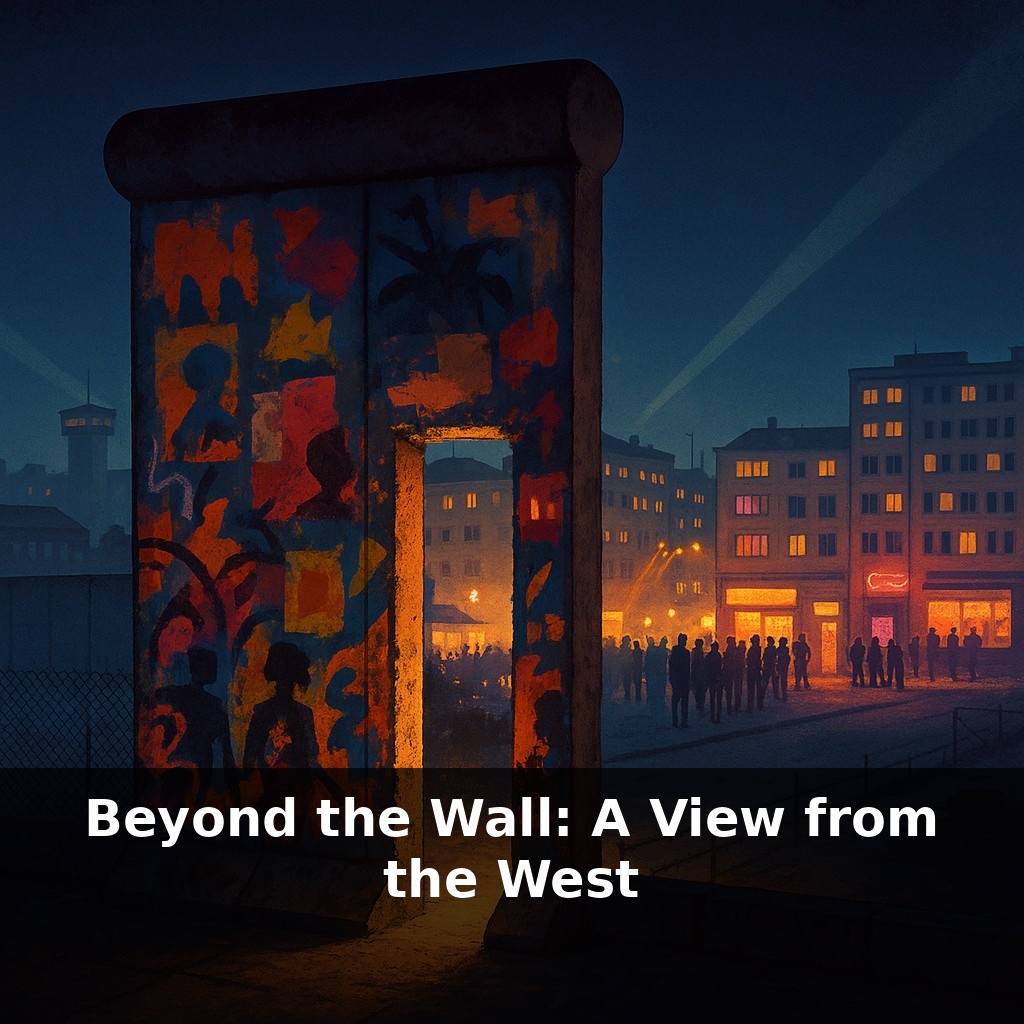
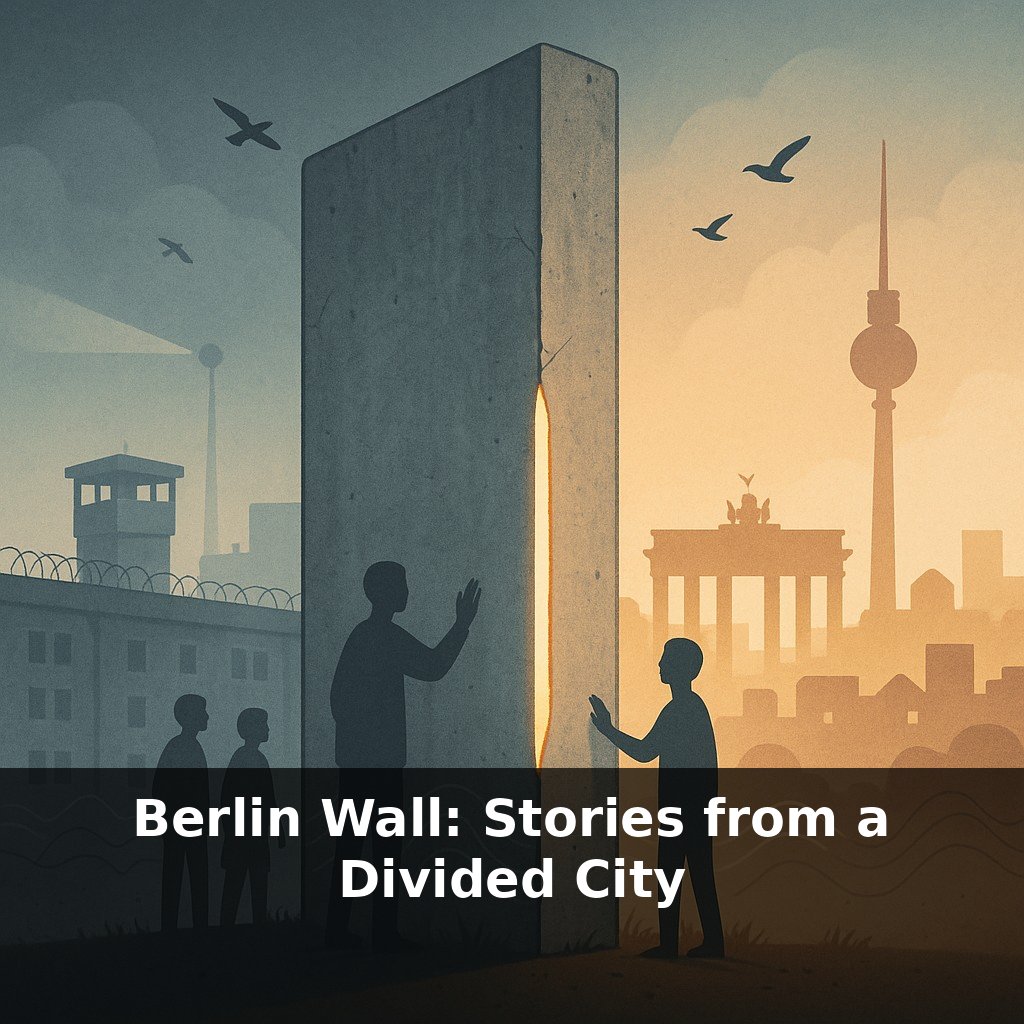
A fully democratic city once survived deep inside communist territory, with nightlife, protest art, and pop concerts unfolding under the watch of foreign tanks. In this episode, we step onto those bright West Berlin streets and ask: what did “freedom” actually feel like there?
By the late 1970s, West Berlin looked less like a besieged outpost and more like a strange, glittering loophole in the Cold War system. Rents were low, conscription rules were looser, and subsidies from Bonn quietly soaked into everyday life—cheaper public transport, dense cultural funding, student support. A student could spend the morning in a heavily subsidized university seminar, cross a U.S. checkpoint on the way home, then end the night in a bar where American GIs, Turkish workers, and avant‑garde artists shared the same smoky air. The Wall was close enough that you could see guard towers from your bedroom window, yet many residents learned to treat it like bad weather: always there, always potentially dangerous, but folded into the background of getting groceries, catching the bus, falling in love, and planning a future that might, at any moment, be interrupted.
On paper, West Berlin’s status was a legal labyrinth: not a federal state, not fully part of the FRG, and officially still under Allied occupation. In practice, that abstraction translated into everyday quirks. You paid with the same currency as in Hamburg, watched the same TV shows, but stepped past British or American soldiers on your way to the bakery. Draft‑dodging West German men flocked here, filling shared flats and seminar rooms, while Turkish families, guest workers turned residents, opened cafés and grocery shops that stitched new routines into streets once defined by ruins. The city felt provisional yet strangely permanent, like a long‑running “temporary” exhibition.
The numbers behind that “loophole city” were staggering. By the 1980s, Bonn was transferring around 8.6 billion Deutschmarks a year to keep West Berlin running—money that underwrote everything from housing programs to theaters. Converted into today’s money, that’s several billion euros annually for just over two million people, a level of per‑capita support that would make many modern capitals envious. Officially, it was compensation for the city’s exposed position. Unofficially, it was hazard pay for choosing to live at the fault line of the Cold War.
You could see that money on the streets, but not in the way of flashy luxury. It showed up as unusually cheap rents for big, slightly crumbling Altbau apartments, student cafés that somehow survived on endless refills, and a dense patchwork of cinemas, galleries, and clubs squeezed into basements and abandoned factory spaces. A Berlin address carried a quiet promise: life here might be materially modest, but the city would pick up enough of the tab that you could spend your time on music, activism, or art instead of pure survival.
The Wall’s 155‑kilometer loop set hard physical limits, yet within that ring the city felt oddly expansive. Car ownership and television sets per household were higher than in many West German regions, and West‑side department stores competed to display the latest consumer gadgets, implicitly advertising what the East was supposed to be missing. On Saturday afternoons, families strolled along Kurfürstendamm under bright shop windows, while only a few hundred meters away concrete, floodlights, and watchtowers marked the edge of their world.
That edge was never abstract. Around 5,000 people tried to get across from East to West through the urban section of the border; at least 140 died on the western side’s strip alone. Their names slowly accumulated on memorial plaques that Berliners might pass daily on their way to work. The city learned to live with this dual register: exuberant consumption and cultural experiment on one level, a persistent awareness of risk just below it, like a low frequency hum you only noticed when everything else went quiet.
On a Tuesday afternoon you might see schoolchildren on a class trip to the Reichstag’s ruined shell, their teacher pointing to bullet holes, then walk ten minutes and step into KaDeWe’s food hall where you could buy Chilean wine and tropical fruit in mid‑winter. History and high‑end groceries shared the same tram stop. A few streets away, American soldiers browsed German record shops, picking up Bowie or Nena singles before heading back through the gates of McNair Barracks. For local kids, the sight barely registered; the uniforms were as ordinary as postmen.
West Berlin’s airport, Tempelhof, worked like a pressure valve. Charter flights carried residents out over East German territory to vacation beaches they could never have reached by car. Summer photos showed smiling faces in Spain or Greece, but the flight path always led back into the walled circle. The city’s soundscape captured that paradox: punk bands rehearsed in damp basements, while across town church bells marked the hours, as if both defiance and routine needed equal airtime.
West Berlin’s story hints at how fragile openness can be supported without smothering it. Today’s isolated democracies and censored online spaces face similar pressures: stay attractive enough that people want to remain, yet resilient enough to survive shocks. The city’s later pivot into a startup and culture magnet suggests that frontier zones can become laboratories for renewal, like burned forest clearings where new species appear—if they’re given time, oxygen, and room to grow.
After 1989, that enclosed city didn’t simply vanish; its habits leaked into unified Berlin like ink in water. Former border zones became bike paths and art spaces, and the old fault line turned into a kind of urban scar tissue—tender, but flexible. Memory here behaves like Berlin’s weather: shifting fast, rarely settled, always forcing you to pack for two seasons at once.
Before next week, ask yourself: 1) When I hear Western commentators talk about Gaza or the West Bank, which specific phrases or assumptions do I now notice as “invisible walls,” and how do they shape what I’m willing to question out loud in my own circles? 2) Looking at the news sources, podcasts, or accounts I follow, whose voices from *inside* Palestine (writers, journalists, families) are missing, and what’s one concrete change I can make today—like swapping one usual outlet for a Palestinian-led one—to rebalance that? 3) The next time someone casually repeats a simplified “good vs. bad” narrative about Israel–Palestine, what’s one curious, non-argumentative question I can ask—based on what I learned in this episode—to gently open up the conversation rather than shut it down?