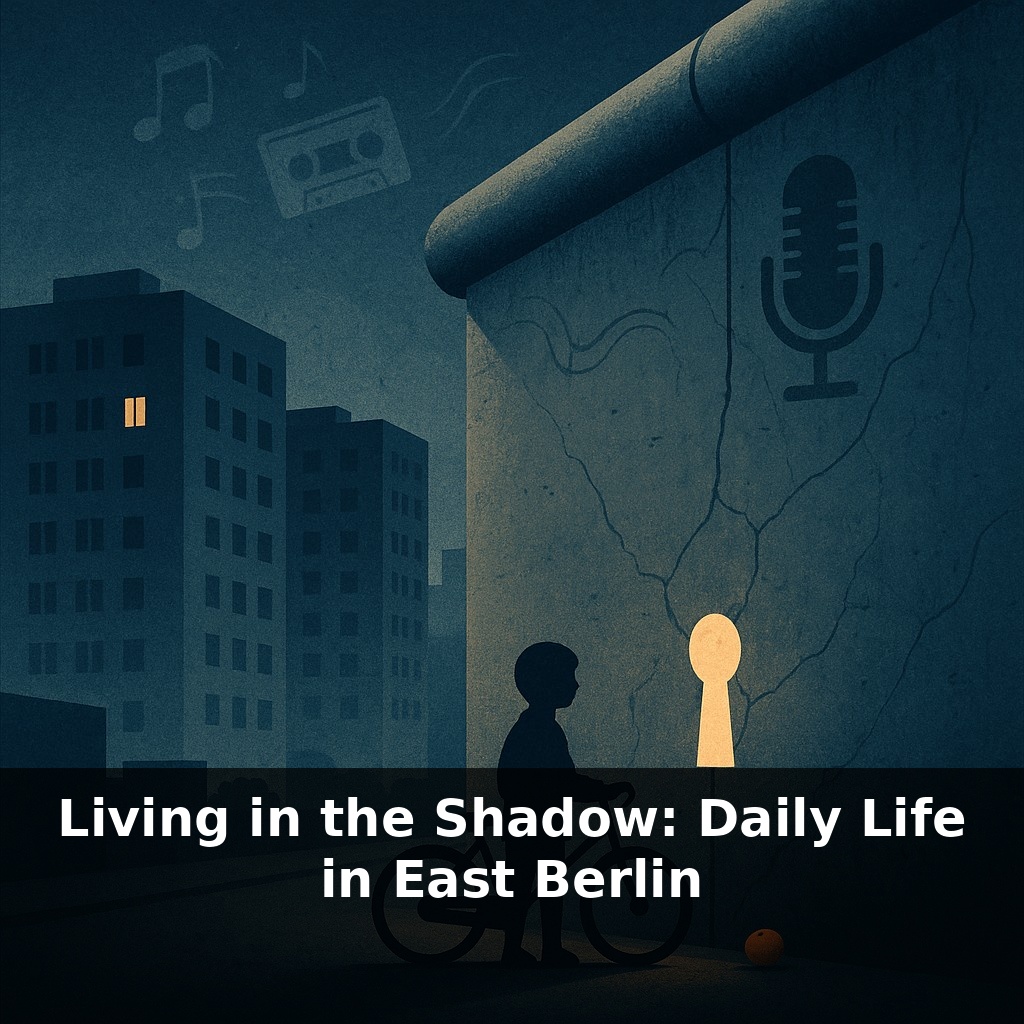
A city sealed by nearly a hundred miles of concrete—but inside, kids still rode bikes, bands played forbidden songs, and neighbors whispered over thin walls. In this episode, we step into East Berlin kitchens, queues, and quiet rebellions, and ask: how do you live in a cage?
Mornings often began not with an alarm clock, but with a calculation: how early to join the queue. Was the rumor about oranges true today, or would the shelves be as bare as yesterday? In East Berlin, time itself became a kind of currency—spent waiting for meat, for news, for a chance that something rare might appear. Kitchens doubled as strategy rooms, where families quietly traded tips on which shop had flour, which neighbor had a cousin in the West who might send coffee. Daily life ran on two parallel tracks: the official schedule of work, school, and party slogans, and the unofficial schedule of favors, barters, and whispered updates that spread through stairwells like the smell of soup. Children absorbed these unwritten rules early, learning which questions to ask at home, and which never to voice on the street. Survival was practical, careful, and endlessly improvised.
At work, the day unfolded under slogans and portraits, but most people focused less on ideology than on getting through their shift and home on time. Offices, factories, and schools followed strict routines, yet everyone knew which rules were iron and which were quietly bent. After hours, the city shifted: church basements hosted poetry readings, smoky apartments turned into jazz clubs, and youth clubs doubled as safe spaces to swap banned cassettes. Television antennas pointed west like metal sunflowers, catching signals that carried other lives, other colors, into cramped living rooms. Even leisure needed caution; a careless joke could linger longer than any echo.
In the cramped apartments that lined Stalinallee or the prefab blocks in Marzahn, comfort was measured less in square meters than in small victories. A new curtain from a West package. Real coffee shared on a Sunday. A record player repaired with a part “organized” from a friend of a friend. The shortages outsiders read about translated into a constant background puzzle: how to stretch butter, how to replace missing screws, how to turn state-issued sameness into something that felt like home.
Queues weren’t just about scarcity; they were a source of information. If you joined a line without knowing what it was for, odds were good it would still be worth it. While bodies shuffled forward, voices traded rumors: whose relative had finally gotten a Trabant after twelve years, which office might have a free slot for a telephone application, whose neighbor had been quietly “transferred” after a late-night visit from plainclothes men. People learned to talk in layers—surface chatter for anyone listening, coded meaning for those they trusted.
Trust itself was a fragile currency. With nearly one in three hundred residents working for the secret police in some capacity, every friendship carried a question mark. Some couples later discovered that their spouse’s “extra shifts” had been reports filed on their own living room. Yet genuine solidarity persisted. Parents watched each other’s children while doing shifts at the factory. Entire stairwells would conspire to “lose” an official letter no one wanted to receive.
Women’s lives carried a particular weight. Nearly half the workforce was female, so a typical day might mean a full shift at a chemical plant or office, followed by another at home—cooking with whatever could be found, sewing children’s clothes from old curtains, queuing again for kindergarten places or extra ration cards. State propaganda celebrated them as “heroines of labor,” but the gap between posters and exhaustion was wide.
Despite the pressure, culture threaded through daily routines. Amateur theater groups rehearsed in school halls after hours. Painters exhibited in tiny church galleries where the walls smelled of damp hymnals. In Prenzlauer Berg, writers read texts that would never see official print, their words passed hand to hand in carbon-copied manuscripts that smudged fingers black. The city’s nights were not loud, but they were dense—thick with shared secrets, cautious laughter, and the sense that history was something pressing in from the edges, not yet visible, but already there.
Clocks and calendars carried a different weight when planning years ahead for something as simple as mobility. Applying for a car felt less like shopping and more like planting a slow-growing tree whose fruit your children might taste first. Some families pinned the expected delivery year of a Trabant on the wall, marking school milestones beside it: first day of class, youth group membership, then—maybe—keys arriving in a plain envelope. A telephone line turned into a family heirloom in advance, its eventual dial tone imagined at every holiday. Parents would joke that their toddlers should start thinking now about who they’d like to call in fifteen years.
Housing followed its own long arc. Newlyweds might spend their early married life sharing a room with in-laws, writing polite but urgent letters to housing authorities, collecting stamps and signatures the way others collected postcards. Promotions at work were not only about career pride; sometimes they nudged you slightly higher on the apartment list, a quiet trade of conformity for a few more square meters and your own front doorbell.
Surveillance then relied on neighbors’ ears and opened letters; now it’s algorithms sifting messages at scale. Supply shocks today show how fragile “normal” is when shelves empty or energy costs spike. Your challenge this week: each time a digital service “recommends” something—news, a route, a purchase—pause and ask: whose interest does this serve? Note the moments you quietly resist the suggestion. Those tiny choices are where modern micro‑resistance starts.
In the end, what lingers from those years is less the slogans than the muscle memory of adaptation: how people learned to bend rules without breaking, to store hope the way others stockpile jars in a cellar. History often zooms in on border crossings and speeches, but the ground really shifted in kitchens, courtyards, and tired hands quietly refusing to give in.
Here’s your challenge this week: For one day, live under your own “mini Stasi” by banning all unplanned internet searches, social media, and GPS—plan your movements and tasks on paper the night before and stick to them exactly. Pick one ordinary routine (like your commute or grocery shopping) and do it as if you were in East Berlin: limited choices, no online price checks, and only what’s available in the first place you go. That evening, record a 3–5 minute voice memo describing how the lack of freedom and constant “self-surveillance” changed your mood, decisions, and sense of trust in your surroundings.