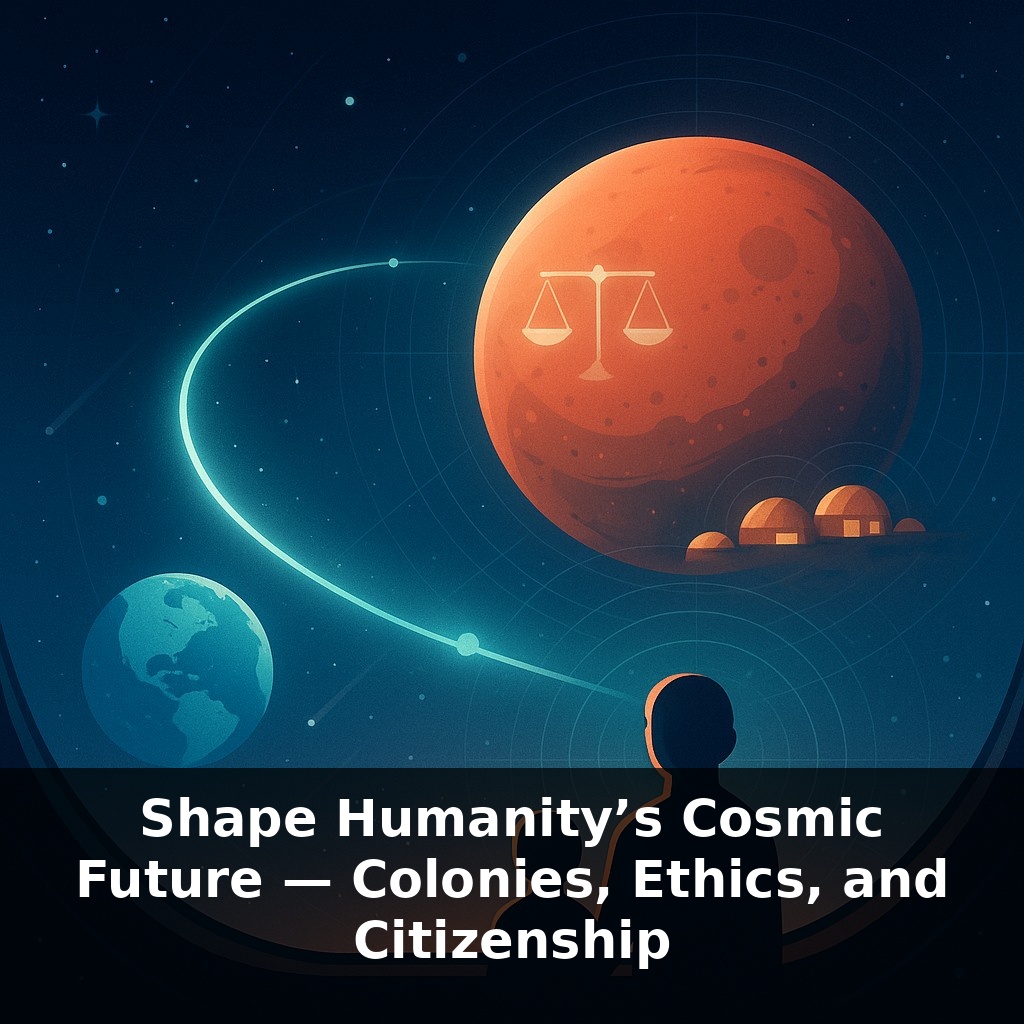
“Earth is already part of space,” wrote Carl Sagan—yet our laws mostly stop at the atmosphere. A child born in the first Mars habitat could live and die under rules no one has written yet. In this episode, we’ll explore who gets a say in shaping those rules—and who gets left out.
Radiation on Mars can hit about 0.66 millisieverts a day—roughly twenty times what you’re soaking up on Earth. That’s not just a medical statistic; it’s a political one. Who decides what dose is “acceptable” for workers, settlers, or children born off‑world—and who carries the risk if that judgment is wrong?
As we move from brief missions to permanent outposts, technical checklists quietly turn into constitutions. Life‑support failures, AI misbehavior, resource shortages, and even who controls the airlock all become questions of power and rights. The Outer Space Treaty and Artemis Accords sketch the outline, but they don’t say who gets to draw the details once people actually live there.
Think of every hatch, habitat module, and rover contract as a small vote about the kind of civilization we export. In this episode, we’ll follow those “votes” into the future and ask: what does fair cosmic citizenship really look like?
Early space law grew out of the Cold War and rocket tests; today it has to cope with biotech labs on the Moon, corporate fleets heading outward, and settlers who may never see Earth. The Outer Space Treaty banned national ownership of celestial bodies, but it never imagined private insurance disputes over a Martian nursery or a workers’ union in a rotating habitat. As launch costs plunge, the gap widens between “first movers” and everyone else. Rules set now can either become a tollbooth that locks in advantage, or a commons that invites many cultures to plant roots among the stars.
main_explanation: Space settlements will sit at the intersection of three negotiations: survival, sovereignty, and story.
Survival comes first. Off‑world communities will depend on fragile loops of water, air, food, energy, and data. Whoever runs those loops—state agency, company, cooperative—effectively controls life itself. We already see hints of this in how access to satellites shapes who gets internet or climate data on Earth. Translate that outward: if a corporation owns the only power reactor in a lunar crater, can it shut off electricity to a protest movement? Can it charge more for “premium” oxygen, arguing that it invested in the reactors?
Sovereignty is next. Under today’s rules, people and hardware in orbit or on another world still fall under some country’s jurisdiction. That works when crews rotate home, but not when generations grow up who feel more loyalty to their habitat than to a distant capital. Do they get automatic “dual citizenship”—of their birth nation and their settlement? Could a future Mars town declare political autonomy without starting a legal war back on Earth? The Antarctic Treaty and the ISS agreement show that shared spaces can be managed cooperatively, yet they also rely on Earth‑based courts that settlers might see as out of touch with daily realities in low gravity.
Then comes story: who we think we are out there. If the dominant narrative is “frontier,” history suggests patterns of exclusion and extractive economics. If it’s “research outpost,” residents may be treated as expendable field staff. A different framing—say, “laboratory of new social contracts”—invites experiments: citizens’ assemblies deciding habitat rules, rotating leadership chosen by lottery, or charters that bake in rights to air, communications, and due process as non‑negotiable.
Terraforming debates sharpen all three tensions. Before we alter a planet’s climate or import engineered microbes, we’ll need something like a planetary ethics review board, with seats not just for scientists and investors but for Indigenous leaders, philosophers, and representatives from countries that are not launching rockets. Without that, decisions about reshaping alien landscapes will be made by a narrow slice of humanity while claiming to speak for everyone.
Your challenge this week: sketch a one‑page “bill of rights” for a small off‑world settlement—no more than 200 people. Force yourself to choose just 10 rights. Then ask: who in today’s world would be most likely to see their needs ignored by your list, and how could you rewrite it to include them before we leave the planet?
On a rotating space habitat, the person who tends the algae tanks might quietly hold more power than a mayor. In a closed loop, the ones who manage light, nutrients, and filters decide how much oxygen reaches every cabin. That’s why early governance models can’t just copy terrestrial parliaments; they’ll need roles akin to “chief ecologist” or “systems ombudsperson” with authority independent of any one company or flag. Think of it less like a single government and more like a mesh of overlapping guarantees: labor rights embedded in work contracts, safety rules tied to docking permissions, and data transparency as a precondition for linking into shared navigation networks. A lunar settlement that publishes real‑time environmental and health metrics, for example, invites outside watchdogs and citizen‑scientists to spot abuses or failures early. Over time, these practices could harden into norms: no habitat gets certified as “safe” without democratic oversight of its life‑support and AI control systems.
A quiet risk is that “cosmic citizenship” becomes a luxury brand, not a shared identity. Insurance markets, for instance, might decide who’s “fit” to live off‑world, much as credit scores gate access to housing. Data trails from training sims, health implants, even VR classrooms could feed opaque ranking systems that shape who gets a launch seat. If so, the first real constitutional crisis in space may center on algorithmic exile rather than a flag or frontier.
Spacefaring societies may emerge not as copies of nations, but as shifting constellations of crews, co-ops, and networks that update their charters like open‑source code. The deepest question isn’t who plants a flag; it’s who gets to revise the rules when oxygen, labor, and knowledge flow through new hands far from any familiar sky.
Start with this tiny habit: When you catch a headline about space, whisper to yourself one ethical question it raises—like “Who gets to decide who goes to Mars?” or “How will we treat Martian resources fairly?” Then, before you scroll away, spend 10 seconds imagining one concrete rule you’d want in a Mars colony charter (for example, “no one can own more air than anyone else”). If you’re feeling it, jot that one rule as a single sentence in the notes app on your phone so your personal “space citizenship code” slowly grows over time.