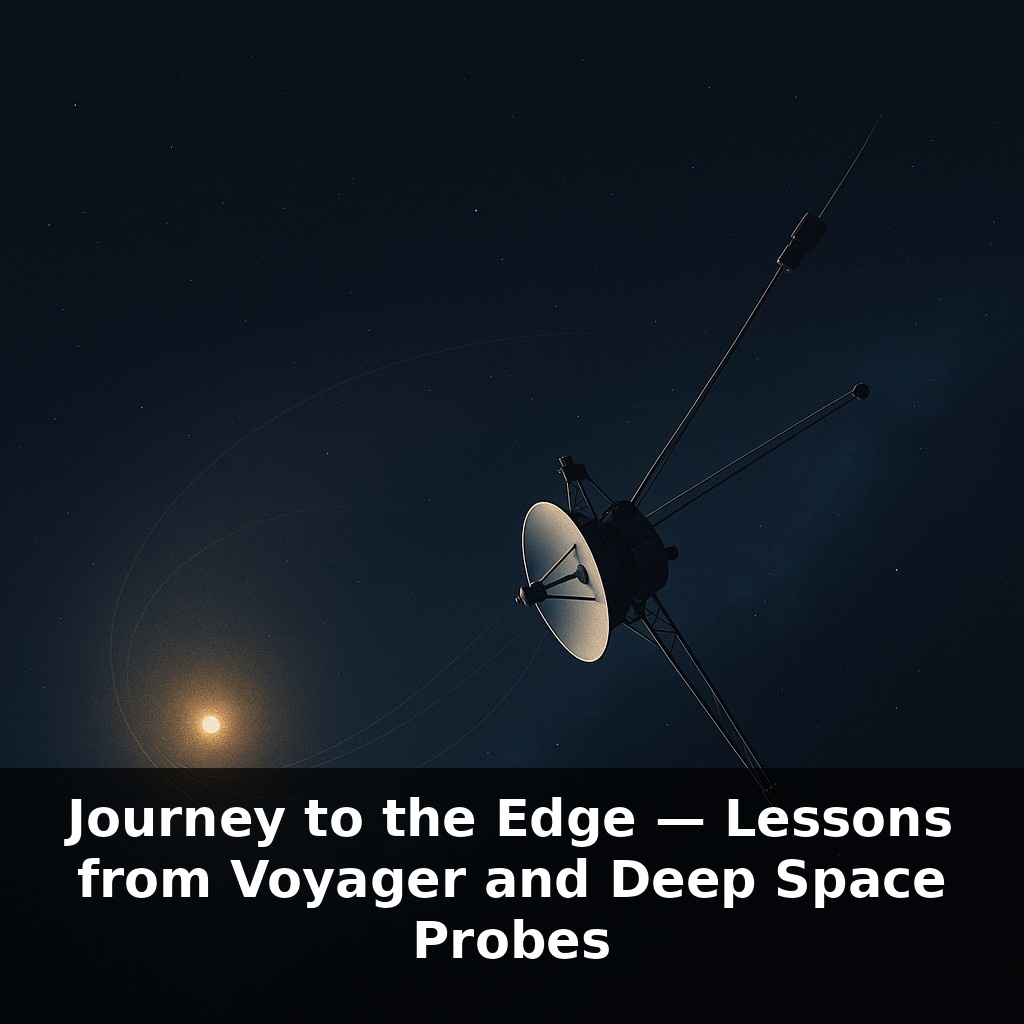
Voyager 1 is so far from Earth that its radio whisper takes almost a full day to arrive—yet engineers still talk to it. In this episode, we’ll follow our oldest robotic explorers as they slip beyond the Sun’s influence and test how long human craft can truly endure.
By the time New Horizons swept past Pluto in 2015, it was flying a route first proven by two elderly pathfinders launched in 1977. Those twin spacecraft, and the mission architects behind them, quietly rewrote our rulebook for how to cross the Solar System: use planets not as destinations, but as stepping stones.
In this episode, we’ll zoom out from surfaces and orbits to trace a different kind of frontier—the invisible boundary where the solar wind thins and interstellar space begins. We’ll see how carefully timed fly-bys at Jupiter and beyond let probes “trade” momentum with giant worlds, cutting decades off their journeys. And we’ll dig into an underappreciated achievement: designing hardware and software that must keep working not just years, but generations, from home. As we follow these outbound missions, we’re really asking how far foresight—and curiosity—can carry a civilization.
As our probes press outward, the map beneath them keeps changing. When Voyager 2 skimmed past Neptune, it revealed winds faster than Earth’s most violent storms and a moon, Triton, geysering nitrogen into space. Years later, New Horizons showed Pluto wasn’t a frozen fossil but a world with blue skies and glaciers of exotic ice. Each fly-by forces us to redraw what “edge of the Solar System” even means: not a clean line, but a shifting weather front where charged particles, magnetic fields, and lonely worlds all negotiate the reach of our star.
When mission planners first traced Voyager’s path in the early 1970s, they were racing an invisible clock. A rare alignment of the outer planets—Jupiter, Saturn, Uranus, Neptune—wouldn’t repeat for another 176 years. If they missed that window, no simple sequence of fly-bys could sling a probe past all four giants in a single grand tour.
They launched not one craft, but two, with deliberately different fates. Voyager 1 took a steeper, quicker route, diving past Jupiter and Saturn and then turning upward out of the planetary plane. Voyager 2 followed a more patient arc, visiting all four giants before angling toward the southern skies. Those diverging paths gave us something priceless: two sampling points plunging through the outer regions in different directions, letting scientists compare conditions above and below the flattened disk where most planets reside.
As the Voyagers retreated, their cameras fell silent, but other senses took over. Instruments that sniffed particles and fields began reporting a slow transformation: fewer of the Sun’s energetic particles, more from distant cosmic events; a shifting orientation in the surrounding magnetic environment; a subtle rise in background radiation. Crossing into interstellar space turned out not to be a sharp border, but a layered shoreline with tides and storms of its own.
That shoreline forces engineers into ruthless choices. With power fading from their nuclear batteries, controllers reprogrammed the craft to operate on a budget of just a handful of watts—less than a modern LED bulb. Heaters for some components were switched off entirely, forcing electronics to work at temperatures they were never tested to endure. Every year or two, another instrument goes quiet so that a few core sensors and the transmitter can stay alive.
New Horizons inherited those lessons. Its route past Jupiter and toward Pluto was timed to harvest a similar boost, trimming years off its cruise. But its mission design assumed a different tempo: hibernate for long stretches, then awaken for intensive observation campaigns. Beyond Pluto, it hunted down a small Kuiper Belt object, Arrokoth, showing that Voyager-style exploration could evolve into targeted reconnaissance of specific relics of planet formation.
Together, these probes are revealing not just where our neighborhood ends, but how to keep a fragile machine thinking clearly at the cold edge of a star’s domain.
Think about the way a long-distance hiker plans resupply stops. Voyager’s designers did something similar with science: not every instrument had to run all the time, only when the “trail” offered something new. As the probes moved outward, teams scheduled observation campaigns around rare alignments, solar storms, or crossings of little-studied regions, then powered down again to stretch the “food” of their RTGs.
The same discipline shows up in New Horizons’ extended mission. After Pluto, its team used surveys from Hubble and ground-based telescopes to locate Arrokoth, then fine‑tuned the trajectory with tiny course corrections—like a sailor adjusting sails to catch a distant, moving beacon. This approach is now central to concepts for a future Interstellar Probe: launch fast, skim past a giant planet once, then commit to a decades-long cruise.
Even the data return strategy has evolved. Engineers are testing smarter compression and adaptive schedules so that, despite glacial bitrates, the most scientifically rich measurements always get a ride home first.
Future probes will lean on lasers instead of weak radio links, aiming to stream data like high‑speed fiber across light‑days of emptiness. Concepts on the drawing board would sprint far beyond Voyager, sampling the hydrogen “weather” between stars and treating Kuiper Belt objects as waystations. Think of it as shifting from tossing bottles into the cosmic ocean to building a thin, bright telegraph line across the dark, one ambitious mission at a time.
As new probes race outward, each becomes a moving weather station on the galaxy’s outskirts, logging conditions we’ve never endured. One day, star‑bound crews may read those logs like mountaineers study old route notes, trusting distant robots to mark safe passages, hidden hazards, and the thin, shifting edges of home.
Try this experiment: Pretend you're mission control for your own “Voyager probe” today. Pick one goal at the very edge of your comfort zone (your personal “interstellar space”), and define just three “instruments” you’ll use to explore it—e.g., one conversation, one skill to practice, and one environment to step into. Then set a tiny, fixed “power budget” like Voyager’s RTG: give yourself exactly 30 focused minutes to run those three “instruments,” no more, no less. At the end of the day, notice what unexpected “data” came back—surprises, reactions, or ideas you didn’t anticipate—and decide which “instrument” you’ll keep powered on tomorrow and which one you’ll shut down.