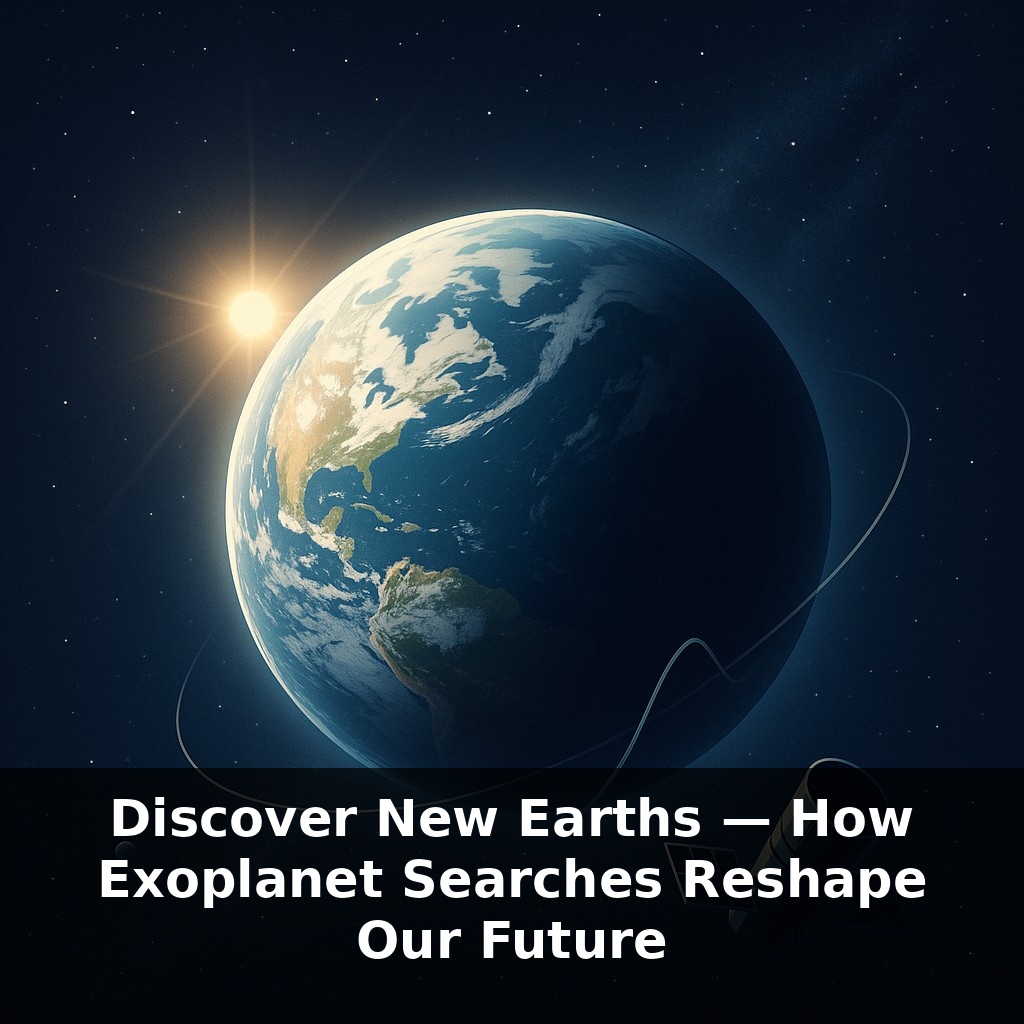
Right now, astronomers have logged thousands of worlds beyond our Solar System—yet we’ve never seen even one of them as a clear disk. In this episode, we’ll chase those hidden planets and ask: when we finally spot a true “other Earth,” what changes back here at home?
We’ve crossed an invisible frontier. A few decades ago, “planets” meant the familiar handful circling our Sun. Now, we’ve cataloged more than 5,500 worlds, and the list grows every week. Kepler showed us that planets are not rare jewels but common coins scattered through the galaxy—especially those roughly Earth-sized, in orbits where water could stay liquid. That realization quietly rewires the stakes of everything from biology to long‑term space policy.
Instead of asking, “Are there other places like home?” the sharper question becomes, “What will we do once we find them?” Will they stay distant dots for philosophers and poets, or targets for future explorers and engineers? In earlier episodes we talked about returning to the Moon, stepping onto Mars, and mining asteroids; exoplanets stretch that arc from nearby neighborhoods to truly interstellar horizons. Today, we’ll follow how that shift may reshape our future plans.
Instead of sketching distant blue marbles in our imagination, we now map real addresses in the galaxy: TRAPPIST‑1e, Kepler‑452b, Kepler‑16b and thousands more, each with measured sizes, years, and stellar weather reports. We’re learning which stars are stable landlords and which flare like faulty wiring. Astronomers sift starlight for hints of clouds, oceans, even chemistry that might betray life. Bit by bit, this turns “someday” questions into spreadsheets and mission drafts, the way vague dreams of sailing once hardened into shipping routes, ports, and shipyard blueprints.
The next step isn’t just counting distant worlds; it’s sorting them. With thousands of entries in the catalog, astronomers are building shortlists: places we might actually study in detail with the next generation of telescopes. Space observatories like JWST and the upcoming Roman Space Telescope target especially promising systems—compact families of planets around dim, cool stars, where repeated passes give us more chances to catch those tiny, regular dips in brightness and tease out atmospheric clues.
Those dips, plus small stellar wobbles, give surprisingly rich dossiers: size, mass, density, rough climate hints. Put together, they reveal a cosmic census wildly unlike our own backyard. Nearly a third of known worlds land between Earth and Neptune in size, a regime our Solar System skipped. That forces theorists to remodel their ideas of how systems grow: maybe migrating giants reshuffle inner real estate, or thick gaseous envelopes puff up rocky cores into mini‑Neptunes. Each new outlier—like Kepler‑16b looping a double star—adds another constraint on these formation stories.
For habitability, the game is shifting from “Is it the right distance?” to “What’s the environment actually like?” Spectrographs dissect starlight that has filtered through a planet’s skies, searching for water vapor, carbon dioxide, methane, and eventually subtle patterns of gases that, together, might hint at biology. A single molecule won’t be enough; instead, teams are designing “biosignature packages,” combinations of atmospheric ingredients that are hard to sustain without some active process at the surface.
This is where the work loops back to our own world. To interpret those packages, researchers are building detailed climate and chemistry models of Earth across deep time—iceball epochs, hothouse stretches, oxygen‑poor eras—then asking which signatures would have been visible from light‑years away. In a sense, Earth becomes our calibration target, the control case against which strange spectra from TRAPPIST‑1e or future finds will be compared, much like a doctor learns to read rare symptoms only by first mastering healthy baselines across many patients.
Instead of staring at a star catalog like a phone book, mission planners now treat it like a travel guide. They flag “must‑visit” systems where multiple worlds line up just right for detailed follow‑up, the way an experienced traveler picks cities where trains, weather, and budgets all cooperate. Around TRAPPIST‑1, for instance, several targets can be probed with the same observing setup, turning one distant red sun into an entire comparative‑climate laboratory.
Future space telescopes extend this logic. Designs on the drawing board, like Habitable Worlds Observatory concepts, pair huge mirrors with star‑shading devices that block glare and isolate faint planetary light. With those tools, astronomers hope to move from rough atmospheric sketches to something closer to weather reports and seasonal maps.
On the ground, dedicated arrays and precision spectrographs refine masses and temperatures, building the reference set engineers will lean on when choosing where a first interstellar probe—likely robotic and tiny—should someday aim.
Some of the most radical shifts may happen on the ground. As cheap photonic chips turn backyard rigs into serious instruments, sky surveys could resemble crowdsourced weather apps, with classrooms in Nairobi or Lima logging dips in distant suns. If future spectra hint at biology, debates now reserved for philosophy seminars might move into parliaments and city councils, shaping ethics codes, school curricula, even how we justify sending tiny probes toward a chosen “next address” among the stars.
Instead of treating “new Earths” as postcards we’ll never visit, we can let them steer choices we make now: what technologies we fund, how we manage our own climate, which stories we teach children about belonging. Like hikers spotting distant ridgelines, we may never reach every summit, but their silhouettes can still guide our path forward.
Try this experiment: Tonight, use an online exoplanet catalog (like NASA’s Exoplanet Archive or Eyes on Exoplanets) to pick one real exoplanet that fascinates you—maybe a hot Jupiter, a super-Earth, or something in a habitable zone. Look up its key data (orbital period, distance from its star, discovery method like transit or radial velocity), then step outside after dark and point in the rough direction of its constellation using a stargazing app. For one week, track that same exoplanet each night: log how your sense of “distance,” habitability, and what “another Earth” could be like changes as you repeatedly reconnect with that invisible world orbiting a real star in our sky.