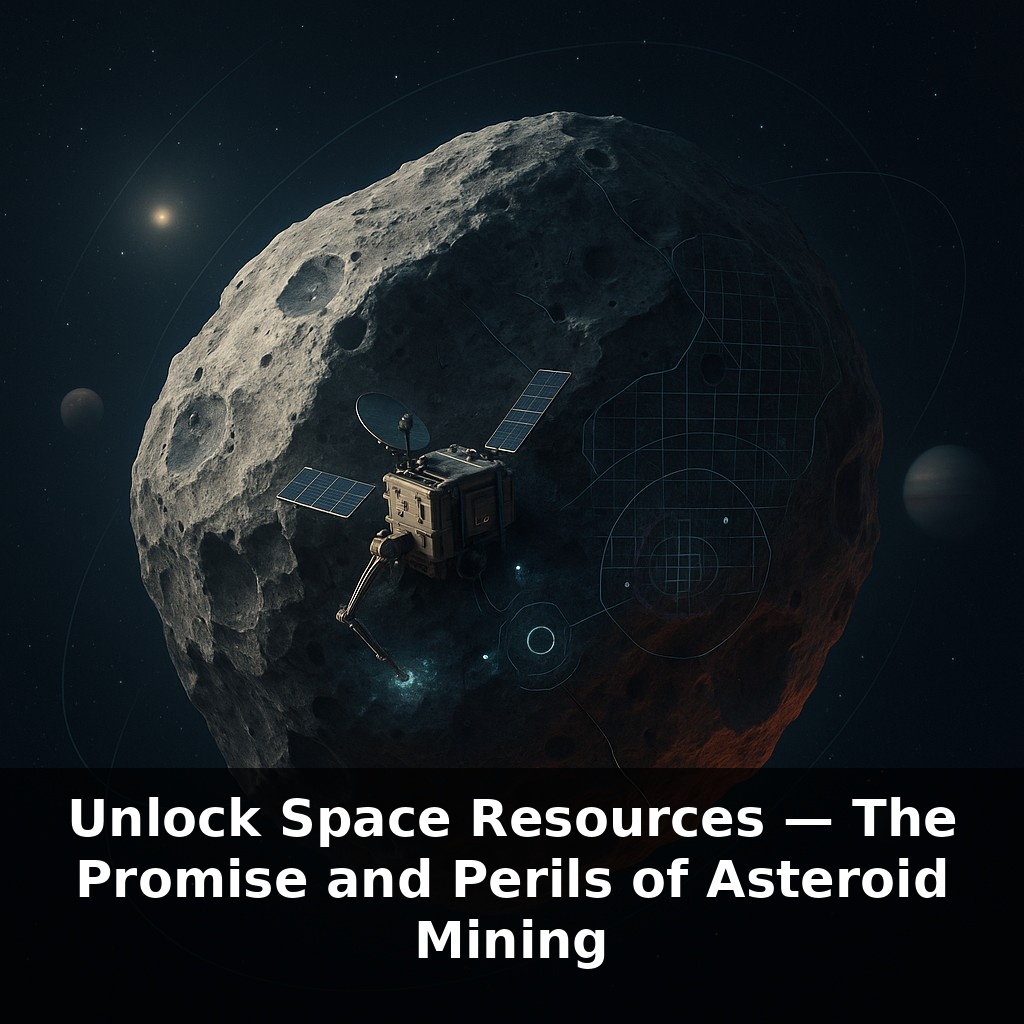
Somewhere between Mars and Jupiter, a rock the size of a city holds more metal than humans have ever mined on Earth. Now jump forward a few decades: a tugboat–sized robot clamps onto that rock, drills in, and turns it into the gas station that makes deep‑space travel routine.
By the time OSIRIS‑REx and Hayabusa2 dipped down to kiss their target asteroids, something subtle but historic had changed: we’d stopped treating these rocks as distant curiosities and started treating them as survey sites. Not for tourists, but for industry. Each sample canister that parachuted back to Earth was more than a science time capsule; it was a preliminary assay report, like the first drill core from a remote Arctic claim. And while we’ve talked about metals and refueling in orbit, the real twist is how messy, dusty, and politically tangled this could get. Nations are quietly drafting ownership rules. Start‑ups pitch trillion‑dollar markets. Yet no one has actually dug, processed, and sold a single kilogram from space.
Now we’re edging into the awkward middle phase: between bold PowerPoint visions and an actual supply chain in orbit. Engineers quietly ask unglamorous questions—how do you anchor to a spinning rubble pile that’s barely holding itself together? What happens when you blast it with thrusters or drills; does it crumble like dry snow or clump like wet clay? Lawyers, meanwhile, are probing gaps in century‑old space treaties, testing where salvage rights end and sovereign claims begin. And financiers are running spreadsheets, wondering who pays if the first “ore body” turns out to be a cosmic dud.
Even with promising survey data, the first big question isn’t “where’s the gold?” but “where’s the water?” The most valuable cargo, at least early on, is likely to be ice and hydrated minerals in carbon‑rich C‑type asteroids. Melted, filtered, and split by electricity, that water becomes oxygen and hydrogen—air to breathe, radiation shielding, and high‑performance rocket propellant. The same tanker that tops up a satellite in geostationary orbit could later refill a ship heading for Mars.
Not every rock is worth the trip. Mission planners obsess over delta‑V budgets and light‑time delays, sorting targets into a bizarre kind of real‑estate listing: composition, spin rate, orbit, thermal environment, and how hard it is to get there and back from low Earth orbit. An asteroid that’s metal‑rich but energetically expensive to reach may be less attractive than a “modest” water source in an easy orbit that passes near Earth every few years.
Then there’s the extraction itself. Unlike mines on Earth, you don’t get gravity for free. Regolith floats, dust sticks electrostatically to everything, and any force you apply can send tools skittering away. Concepts range from giant bags that envelop a small asteroid, to slow “percolator” drills that heat rock and capture the vapor, to microwave ovens that bake boulders from the inside. In situ processing plants would likely start tiny—kilowatt‑scale, refrigerator‑sized chemistry labs—turning grams into proof‑of‑concept kilograms before anyone dares scale up.
Legally, we’re in early “homestead” territory. The Outer Space Treaty bans sovereign ownership of celestial bodies, but recent national laws in places like the United States and Luxembourg assert that companies may own what they extract. That tension hasn’t been tested in court—or in orbit. If two actors show up at the same promising Near‑Earth object, who gets priority? Space agencies talk about “safety zones” and coordination, but there’s no universally accepted rulebook yet.
Financially, the near term looks less like a gold rush and more like a series of slow, expensive prototypes. Early customers probably won’t be jewelry markets on Earth, but space agencies and satellite operators buying propellant, water, and construction feedstock off‑planet. Only once those in‑space markets mature will bulk metals for terrestrial use even start to be plausible.
For a hint of how this could play out, look at how offshore drilling and Antarctic research evolved. First came publicly funded expeditions, then specialized ships and rigs, then whole service ecosystems no one initially predicted—divers, surveyors, data firms. In orbit, a similar cast may appear: prospectors mapping Near‑Earth objects for hire, “tow truck” operators nudging small bodies into more convenient orbits, refineries that lease time on their processing lines the way cloud platforms rent server space. Some concepts stay deliberately modest: strip only enough water to fill a depot, then move on, like selective logging rather than clear‑cutting a forest. Others flirt with planetary‑scale engineering, such as redirecting metallic fragments into cislunar space for slow, continuous processing. Between those extremes lies the real frontier: figuring out how much we can take without turning useful resources into hazardous debris fields.
A world with routine asteroid mining might feel oddly familiar: boomtown dynamics without a frontier sheriff. Insurance actuaries could treat failed captures like shipwrecks, pricing in “space storm” risks. Commodity traders might watch ephemeris charts the way farmers track rainfall. Environmentalists, too, would face a twist: arguing not just to protect distant rocks, but to prefer off‑world metals over new open‑pit scars at home—a debate less about can we mine, and more about where we should.
In the end, unlocking space resources isn’t just a treasure hunt; it’s a rehearsal for how we’ll behave in a larger cosmos. If treaties, tech, and business plans can evolve together, we may swap some earthly mines for silent quarries in orbit. Your challenge this week: sketch a simple “code of conduct” you’d demand from the first real asteroid miner.