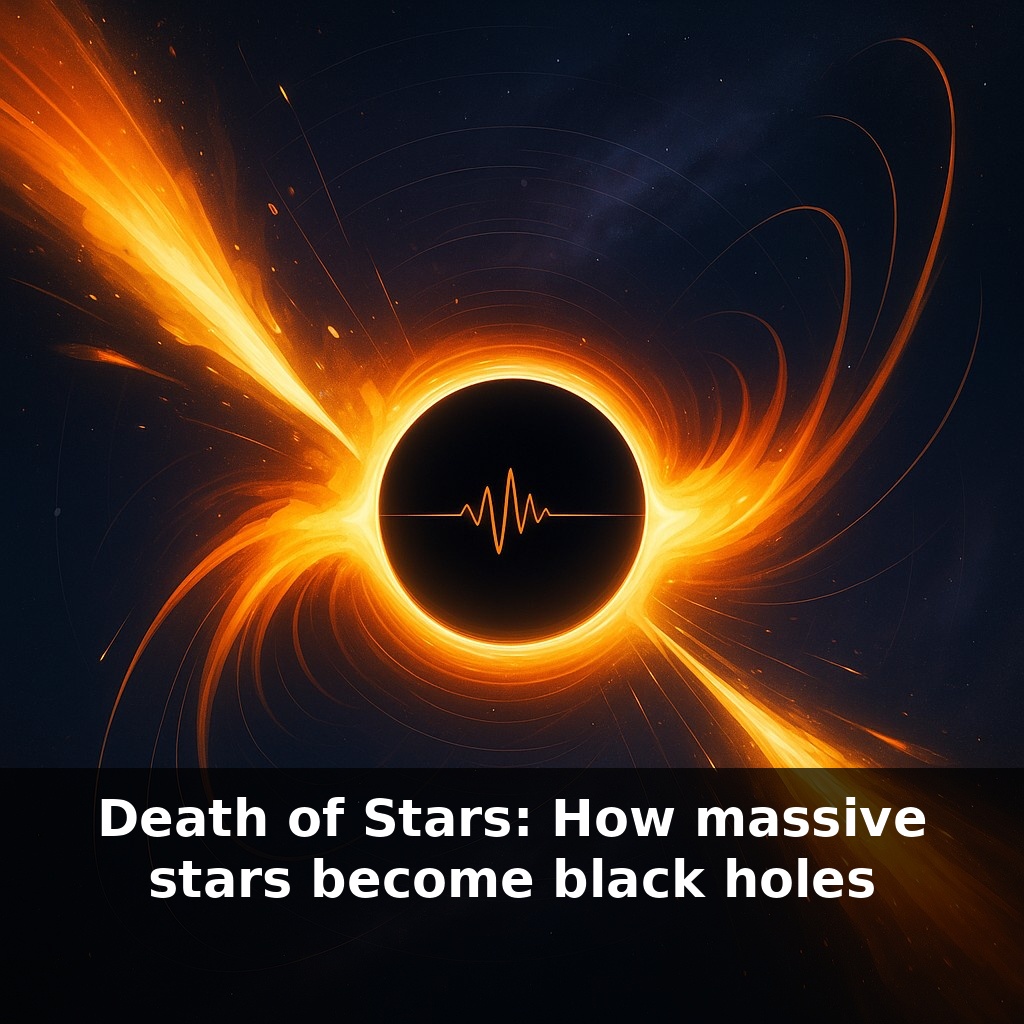
Death of Stars: How massive stars become black holes
📝 Transcript
A single dying star can briefly shine brighter than every other star in its galaxy. In this episode, we drop into the final heartbeat of such a giant—when light, matter, and even time itself face a question with no escape: what happens after the last burst of fusion?
In that final instant after a massive star’s core gives way, the universe runs a kind of high‑stakes audit. Every particle, every bit of energy, every fragment of the star’s history has to “decide” where it goes: flung outward into space, locked into an ultradense remnant, or lost behind an event horizon. The result isn’t predetermined; it depends delicately on the star’s mass, rotation, and internal structure at the moment of collapse. Some stars leave behind neutron stars—atomic nuclei scaled up to city size—while the most extreme cases cross the line into black holes. Astronomers read the outcome not by watching the core itself, but by decoding fleeting signals: a flash of gamma rays, a fading supernova afterglow, a storm of escaping neutrinos, and long‑afterward, ripples in spacetime from black‑hole mergers.
Astronomers rarely witness this drama in real time; instead, they reconstruct it from remnants scattered across millions of years. Supernova shockwaves compress nearby gas, seeding future generations of stars and planets, while the densest leftovers orbit quietly in binary systems, betraying themselves only through X‑ray outbursts or gravitational waves. In this episode, we’ll zoom out from the collapsing core to its wider ecosystem: how a single death event reshapes its stellar neighborhood, and how black holes emerging from these ruins connect to the mergers LIGO detects today.
Far from the collapsing core, the star’s outer layers are still “following orders” from a past that no longer exists. For a brief moment, gravity is pulling them inward toward a core that has already transformed, while an outbound shockwave races upward to unbind the star. Whether that shock actually succeeds is the first big fork in the road between a visible supernova and a quiet, almost invisible birth of a black hole.
If the shock stalls, the star can undergo “fallback”: some of the material that started to escape loses momentum and rains back down. That returning mass can push a borderline neutron star over the Tolman–Oppenheimer–Volkoff limit, turning a near‑miss into a black hole seconds or minutes after the initial collapse. Astronomers suspect that some dim, “failed” supernovae—where a massive, bright star simply winks out over a few months—are signatures of this gentle‑looking but lethal outcome.
Rotation and magnetic fields add more branches to the story. A rapidly spinning core can flatten into a disk feeding the newborn black hole. Under the right conditions, that disk focuses a pair of ultra‑relativistic jets that punch through the star and power long gamma‑ray bursts. These events are so luminous that we can detect them from billions of light‑years away, yet the central engine can shut off in less than a minute.
Most massive stars don’t live or die alone. In close binaries, one star may already have become a compact object when its partner collapses. Mass transfer before the explosion can strip off the outer envelope, altering how much material is left to form the remnant. Afterward, the kick from the explosion can either disrupt the system entirely or tighten it into a doomed black‑hole–black‑hole pair. Over millions to billions of years, gravitational radiation robs such binaries of orbital energy until they finally merge, producing the spacetime ripples that LIGO detects.
Across a galaxy, thousands of these individual fates add up. Each death event enriches interstellar gas with heavy elements, shapes new star‑forming regions, and quietly seeds the population of stellar‑mass black holes that future observatories will map in detail.
Your challenge this week: treat every news item or image about a “massive star” or “supernova” as a branching decision tree. Ask: did the shock win or stall, was there fallback, and could this be the origin story of a future black‑hole merger?
In hospitals, a patient’s chart can branch into ICU recovery, long-term rehab, or a final, flat line—depending on a few key vitals. Massive stars have similar “care pathways,” but their metrics are mass, spin, and chemical makeup. A star born with just a bit more mass than its neighbor might end in quiet collapse with almost no fireworks, while the lighter sibling erupts in a vivid, widely photographed supernova. Metal-rich stars—those formed from already-processed gas—tend to shed more of their outer layers through stellar winds, trimming down the mass that can feed a future black hole. Metal-poor stars, especially in the early universe, may keep their bulk and collapse more directly. In dense star clusters, close encounters can swap partners in binary systems, pairing black holes that never formed together. Each tweak—a faster spin here, a stripped envelope there—rearranges the routes that lead from solitary giants to the merging black holes we detect billions of years later.
Soon, black‑hole births may feel less like rare fireworks and more like a constant, low drumbeat in our data. Collapses across cosmic time will sketch a kind of “population census” of gravity’s most extreme offsprings. Patterns in their spins and masses could expose how often stars share partners, trade mass, or die alone. Like tracing family traits through generations, we’ll follow how each collapse subtly reshapes galaxies, star by star, until the sky looks more like a living family tree than a static map.
Across billions of years, these endings quietly rewrite the universe’s “playlist,” adding heavier elements that later become planets, oceans, machines, and us. The next black‑hole birth you read about isn’t just distant fireworks; it’s an upstream note in the chain of events that eventually makes technology—and curiosity about this story—possible.
Here’s your challenge this week: one evening after dark, go outside and use a stargazing app (like Stellarium or Sky Guide) to locate at least one star that’s more massive than the Sun (for example, Betelgeuse or Rigel in Orion), then look up its estimated mass and fate (neutron star or black hole candidate). Sketch a simple “life timeline” for that exact star: birth in a nebula, main sequence, red supergiant, supernova, then black hole (or not), with rough timescales in years. Finally, explain its whole death journey aloud—in your own words—as if you’re narrating the star’s path to becoming a black hole for a curious friend standing next to you.
From this course
Black Holes Explained
7 episodesUnlock all episodes
Full access to 7 episodes and everything on OwlUp.
Subscribe — $1.99/monthLess than a coffee ☕ · Cancel anytime

