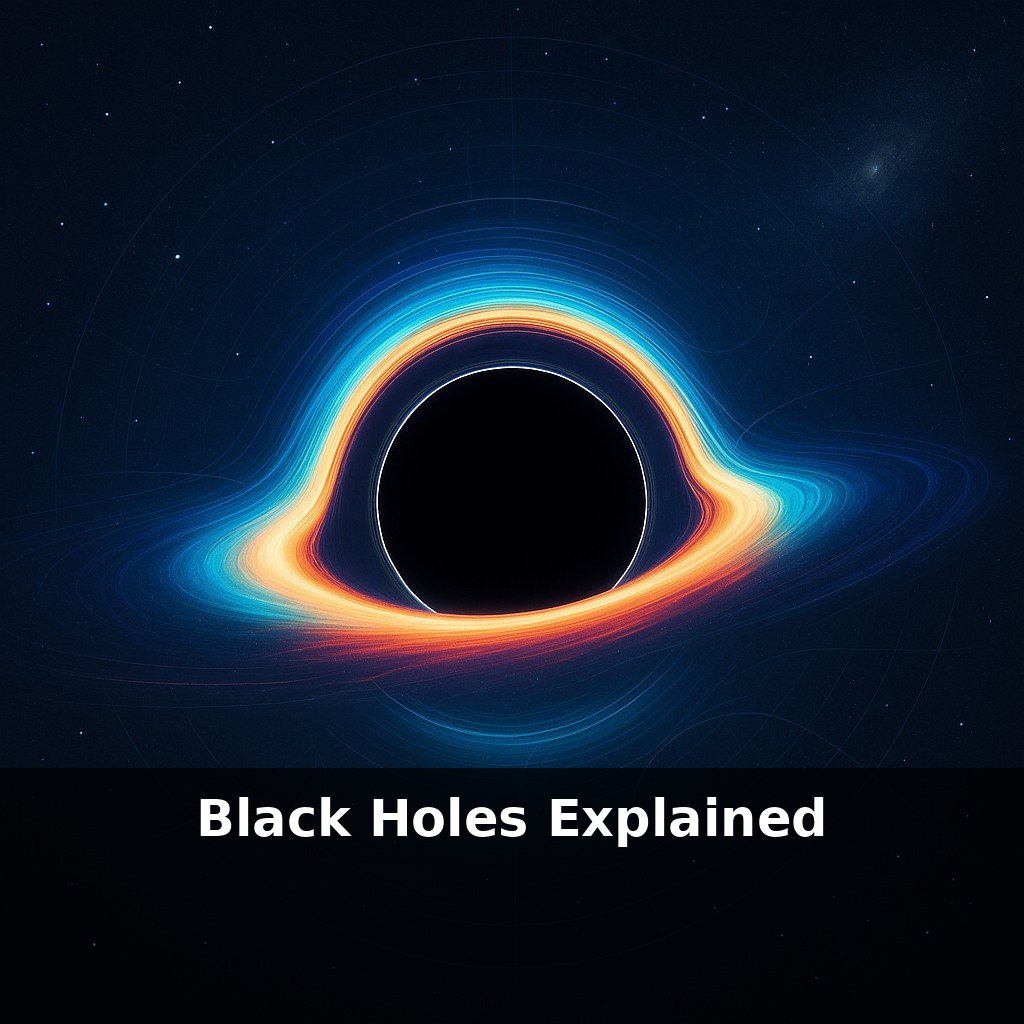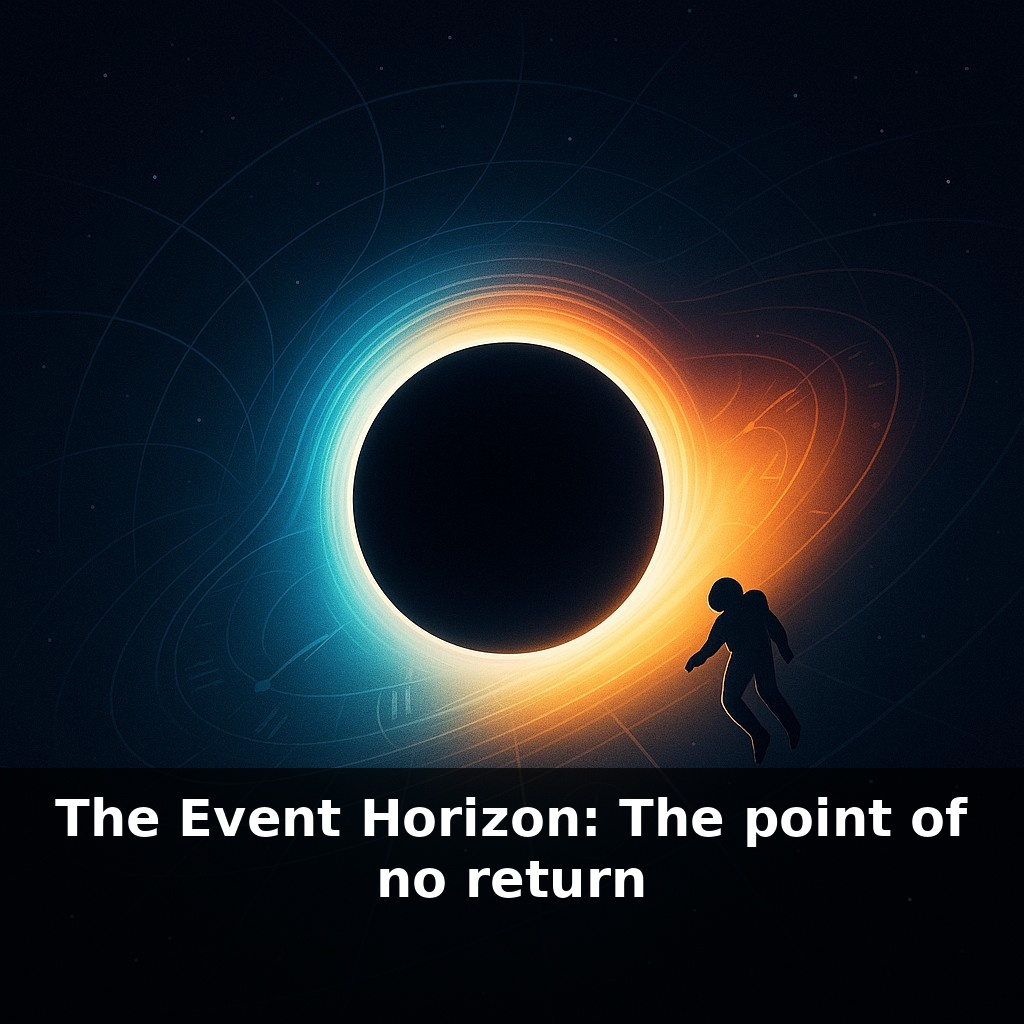
A place can exist in the universe where “inside” and “outside” stop meaning anything. An astronaut’s clocks slow almost to a halt, yet, from their point of view, nothing special happens. In this episode, we’ll walk right up to that invisible boundary—and lean over the edge.
At this boundary, physics keeps its promises but breaks your intuition. The event horizon is less a wall and more a line in the universe’s bookkeeping: cross it, and your future light cones all tilt inward, forcing every possible path deeper toward the singularity. From far away, telescopes never quite see anything cross this line; infalling matter appears to freeze and fade, its light stretched to darkness by extreme redshift. Yet from the falling object’s own perspective, the journey continues smoothly. This mismatch isn’t a glitch—it’s exactly what general relativity predicts in strong gravity. In the coming sections, we’ll connect that prediction to real observations: the orbits of stars whipping around Sagittarius A*, the ringlike “shadows” captured by the Event Horizon Telescope, and the tiny ripples in spacetime recorded by LIGO as black holes collide. Then we’ll push further, into thermodynamics, Hawking radiation, and information.
To really see what’s at stake at this “point of no return,” we need to think like experimentalists, not just storytellers. We’ll treat the event horizon as a kind of cosmic protocol: a rule about which signals can ever be exchanged between regions of the universe. That rule shapes everything from how black holes grow to how galaxies evolve. In this episode, we’ll zoom in on concrete evidence—stellar motions, radio images, and gravitational-wave patterns—and then ask what they imply about causality, energy, and information when nature pushes technology, and theory, to their limits.
Stand next to a black hole—at a safe distance—and its weirdest features start looking surprisingly ordinary. Gravity there just acts like any other mass of the same size. Replace the Sun with a black hole of one solar mass and Earth’s orbit barely notices. Planets keep circling; comets still swing in and out. The drama only escalates as you shrink the radius containing that mass, tightening space around it until, at a specific size, the escape speed from that surface matches light itself.
That specific size is encoded in the Schwarzschild radius: make the mass bigger, and the radius grows in direct proportion. Sagittarius A* is millions of times heavier than the Sun, so its critical radius stretches to millions of kilometers. Paradoxically, that enormity makes the local environment gentler. Near a stellar-mass hole, tidal forces close to this radius are violent enough to rip a spacecraft apart; near a supermassive one, the same crossing could be physically uneventful for both ship and crew.
Yet “uneventful” doesn’t mean observationally irrelevant. From far away, you never see matter finish its fall, but you do see where the geometry begins to dominate. For a non-rotating hole, there’s a radius just outside the critical boundary where even light can only orbit in precarious loops. Slight disturbances send photons either inward forever or outward to infinity. That precarious region sculpts the dark “shadow” and bright ring the Event Horizon Telescope reconstructed: radio waves skimming near this orbit before escaping carry the imprint of the spacetime they threaded.
Gravitational waves add another test. When two holes merge, the newborn object “rings” like a struck bell. The pattern and fading of that ringing depend sensitively on having an actual one-way boundary instead of a material surface. A surface would reflect infalling energy and generate telltale echoes; current observations find no such signatures, tightening constraints on any alternatives to a genuine no-return region.
Quantum fields push the story further. Close to the boundary, the distinction between modes that escape and those that plunge underlies the tiny, frigid glow encoded in Hawking’s formula. For stellar remnants, that glow is utterly swamped by the cosmic microwave background, but its very existence ties together gravity, temperature, and information in a way no other known system does.
Think of a touring musician stepping from a quiet green room onto a massive festival stage. Backstage, they can chat, rehearse, tweak the set list. Once they step across a certain line—the moment the spotlights hit and the mics go live—everything they do is effectively “published” to thousands of phones, recordings, and memories. There’s no pulling notes back into silence, only adding more sound on top. Crossing that threshold doesn’t change the laws of acoustics; it changes which actions can still be edited and which are now locked into everyone else’s future.
Around real black holes, we see something similar in how matter and information seem to “go live.” Gas spiraling in forms hot, bright disks; magnetic fields twist; jets fire for light-years. Tiny fluctuations in how material piles up just outside the boundary can imprint the timing of X‑ray flashes, radio flickers, and even the last cycles of gravitational waves. In practice, astronomers read those rhythms the way audio engineers read waveforms, pulling out details about spin, mass, and geometry that would otherwise stay hidden.
Einstein joked that theory decides what we can observe; horizons push that to the limit. As telescopes sync like a global orchestra, we’re starting to “hear” subtle off‑notes: polarization twists, delayed flickers, oddly shaped flares. These may flag quantum structure where we expected smoothness. Your challenge this week: follow one new black‑hole result (from LIGO, EHT, or LISA previews) and ask, “What would have to change in physics for this to look different?”
In the end, horizons are less a finish line than a research playlist queueing up harder tracks. Next come questions about quantum “remixes”: do microscopic fluctuations near that boundary subtly alter the cosmic soundtrack, or does classical geometry hold the beat perfectly? As detectors sharpen, each new signal is a test of how far that rhythm can bend.
To go deeper, here are 3 next steps:
1) Watch NASA’s “Exploring Black Holes: The Event Horizon Telescope” mini‑docs on YouTube and pause to compare their visuals with the episode’s description of spaghettification and the point of no return. 2) Open the free interactive tool at https://stellarium-web.org and simulate the region around Sagittarius A* while re-listening to the segment about our galaxy’s central black hole, so you can literally “locate” where that event horizon would sit in the night sky. 3) Grab Kip Thorne’s *Black Holes and Time Warps* (library/Kindle sample) and read the chapter on horizons while you sketch the three zones the episode talked about—safe orbit, unstable orbit, and beyond the event horizon—labeling what can/can’t escape in each.