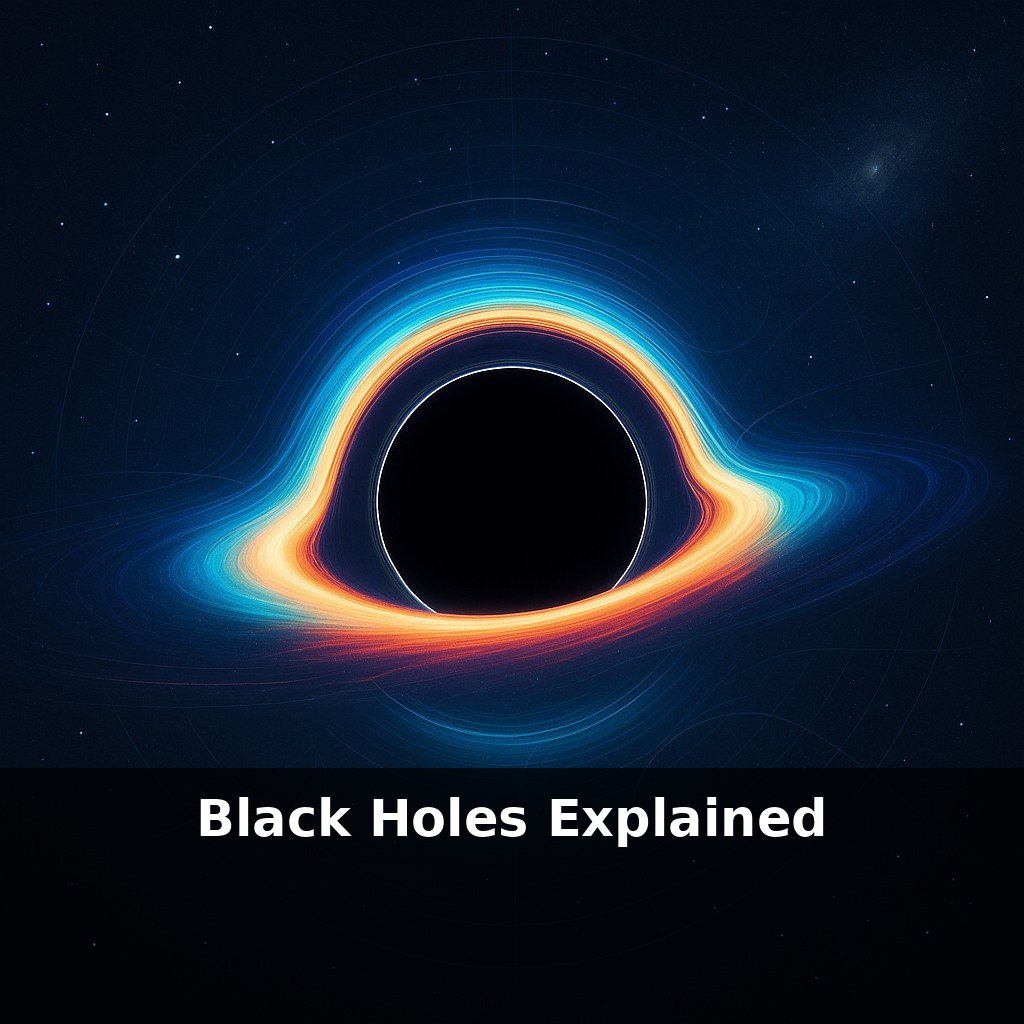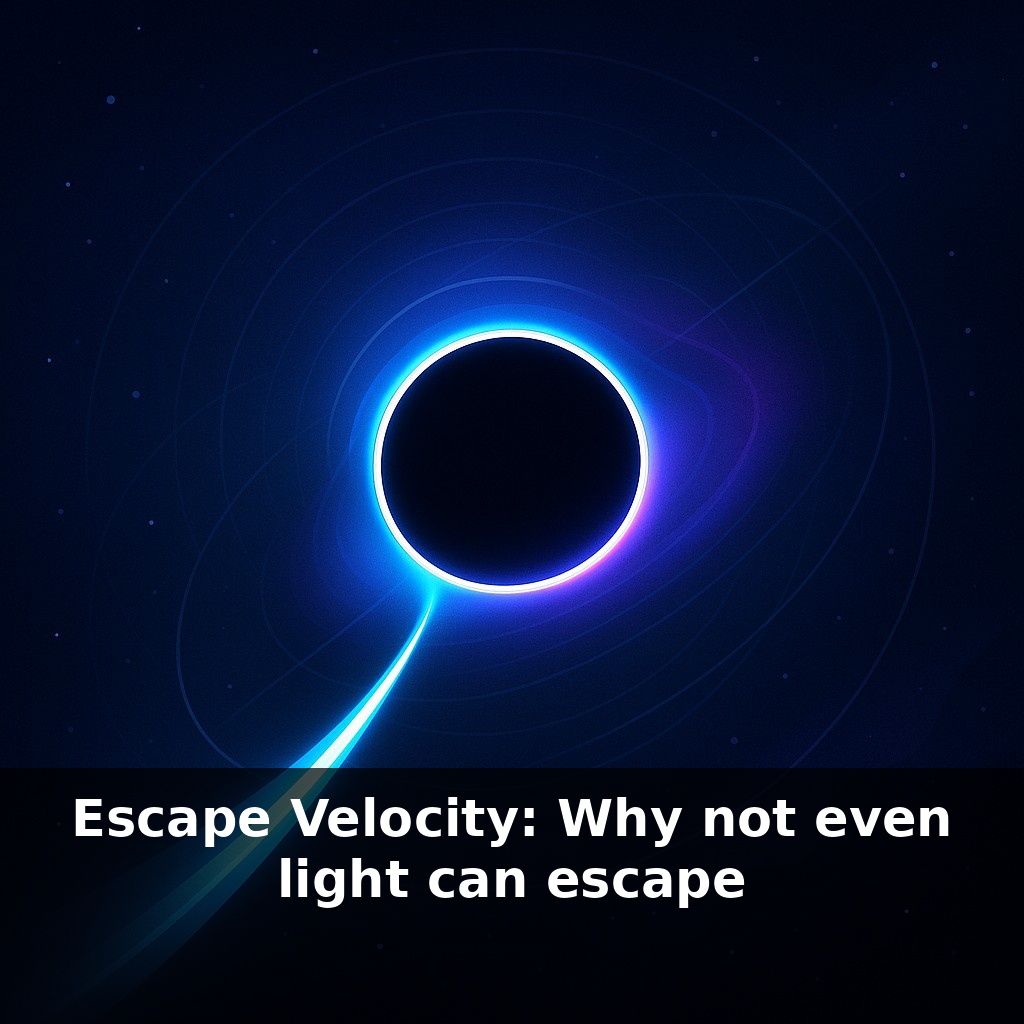
Light is the universe’s ultimate speed limit—yet there are places where even light loses the race. A beam fires outward, doing everything “right,” and still curves back in. How can something moving as fast as physics allows end up trapped, with no way to turn around?
In this episode, we’ll zoom in on the quiet boundary that makes black holes so extreme: the point where escape velocity and the speed of light collide. Out in space, you can always, in principle, fire your rockets harder and climb away from a planet or star. Near a black hole, that “in principle” disappears. There’s a precise radius where any outward attempt—no matter how perfectly aimed or how powerful—stops being a path to freedom and becomes just another route deeper in. That radius defines the event horizon. We’ll see how a simple-looking formula connects mass, distance, and the limit set by light, why Earth and the Sun are nowhere near forming such a boundary, and why even advanced technology can’t “hack” its way out once you cross that invisible threshold.
So what changes as you move closer to one of these extreme objects? First, gravity stops feeling like a simple “pull” and starts acting more like a rulebook for how space and time themselves are allowed to behave. Your options for where you can go, and how fast, get edited in real time. Second, clocks don’t agree anymore: one hovering far away and one dropped toward the hole will tick at different rates, disagreeing about how long any journey takes. Finally, light becomes a kind of negotiator between these viewpoints, tracing out the only possible “escape routes” the universe still permits—and then, eventually, finding there are none.
At first glance, the escape-velocity formula,
vₑ = √(2GM/r),
looks like something you’d use only for planets and rockets. But push it far enough, and it quietly predicts the condition for a black hole.
Take that expression and ask a very specific question: “For a given mass M, at what radius r would the required escape speed equal c?” You’re not redefining any laws—just turning the formula around. Set vₑ = c and solve for r:
r = 2GM / c².
That radius is what we call the Schwarzschild radius. Put the same mass inside any smaller sphere, and you’ve gone past the point where outward motion can still connect to the wider universe. You can pile mass up by crushing an object, or by adding more and more stuff; in either case, once the mass-to-radius ratio crosses this threshold, an event horizon forms.
Real astrophysical black holes don’t get made by literally “packing” matter by hand. They form when massive stars run out of nuclear fuel and can’t support their own weight, or when many black holes and dense remnants merge. In each route, the collapsing material overshoots any stable configuration and drives the radius of the final object below 2GM / c². From the outside, all those complicated details disappear. What remains is astonishingly simple: mass, spin, and (usually negligible) charge.
Notice what this does *not* do. It doesn’t turn the black hole into a super-gravity monster at large distances. Far away, only M matters; swap the Sun for a one-solar-mass black hole in the same orbit, and Earth keeps circling almost exactly as before. The weirdness is localized close in, where the allowed paths through spacetime get drastically edited.
Closer than a certain radius, even light that tries to skim past is forced into a doomed orbit or inward plunge. Closer still, no stable orbit exists at all. For matter, this boundary decides whether you can form an accretion disk that glows fiercely as it spirals in, or whether infall becomes a near-radial dive.
A composer might think of it like tightening a musical phrase around a central note: as you remove more and more options, every melody you write is driven, inevitably, toward the same final tone. Near and inside the horizon, spacetime’s “composition rules” narrow until every possible future line ends at the singularity.
Think about what happens *around* these objects, where signals can still get out. Astronomers treat black hole systems less like isolated beasts and more like high-energy laboratories. For instance, the hot plasma spiraling in doesn’t just glow; it flickers in precise patterns. Those flickers—quasi-periodic oscillations—encode how fast matter orbits in the warped geometry nearby. Measuring them lets researchers back out the mass and spin, the same way a sound engineer can infer an instrument’s size and tension from its overtones.
In X-ray binaries, where a black hole feeds from a companion star, the infalling gas can be redirected into narrow, relativistic jets that shoot thousands of light-years into space. We can’t see past the horizon, but we *can* map how close material gets before it vanishes, by tracking how spectra harden, how polarization rotates, and where radio emission abruptly cuts off. Each of these is a different “dial” on the spacetime environment—giving us a practical toolkit for probing conditions just shy of no-return.
Black holes push physics to its edge, but they’re also practical tools. By timing ripples detected by LIGO and Virgo, or mapping shadows with the Event Horizon Telescope, we can “audit” gravity where it’s most extreme. Future missions like LISA and Lynx will act more like diagnostic scans, tracing how matter and radiation behave right outside the point of no return, and hinting whether spacetime itself has fine print our current theories still miss.
Crossing that boundary doesn’t just erase routes outward; it edits reality’s script for cause and effect. Signals can still crowd right up to the brink, carrying stories about disks, jets, and merging giants like notes in a distant radio song. Your challenge this week: pick one black hole image or dataset and ask, “What hidden rules of spacetime is this whispering about?”