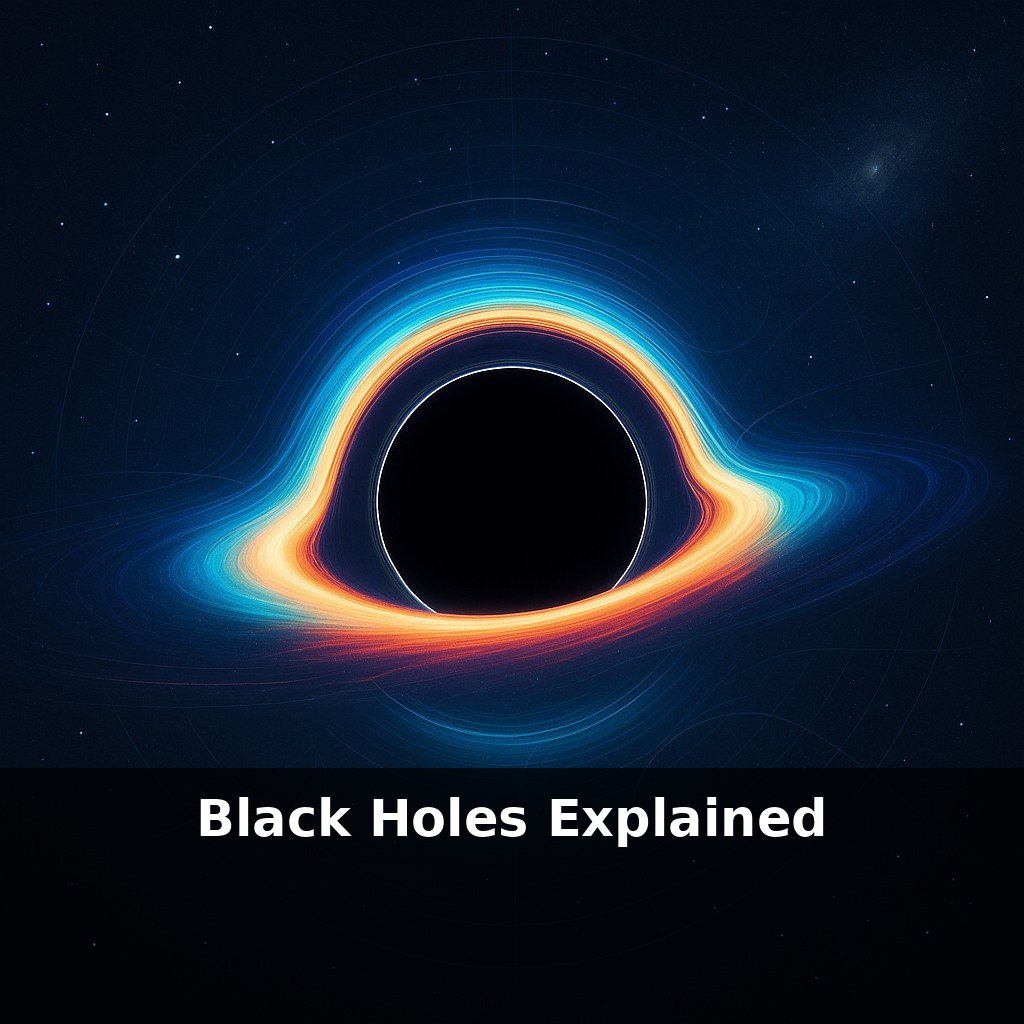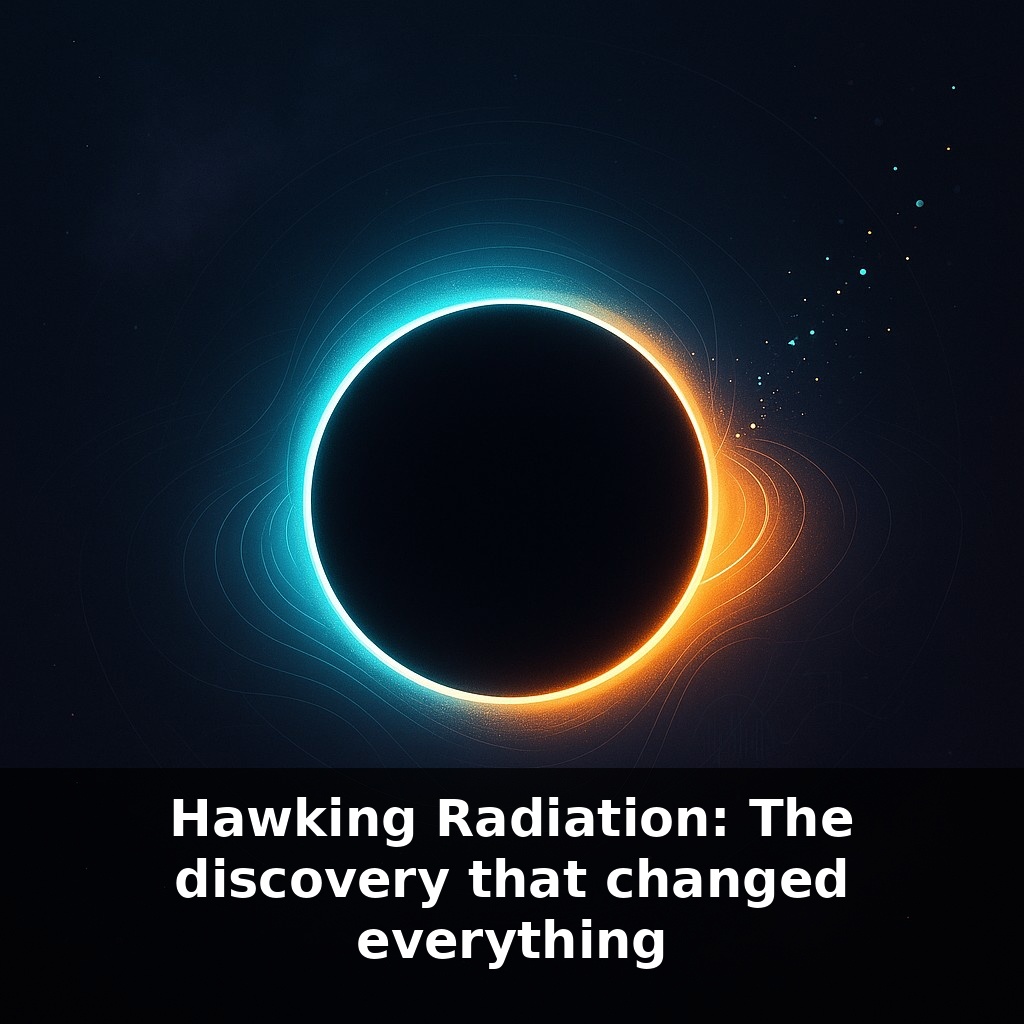
One of the coldest things in the universe might secretly be glowing. A black hole, famous for swallowing light, can slowly leak energy instead. Today, we step right up to the edge of the darkness and ask a risky question: what if “nothing escapes” was never quite true?
Stephen Hawking’s big leap was to ask: what does a black hole look like to the *laws* of physics, not just to telescopes? Classically, it’s a one-way door. But in 1974, combining quantum fields with curved spacetime, he found something outrageous: that door glows with a precise, thermal spectrum.
This wasn’t just “a new effect.” It forced three pillars of physics into the same room: general relativity shaping spacetime, quantum fields bubbling everywhere, and thermodynamics counting invisible bits of information. Suddenly, a black hole wasn’t only about gravity—it had a temperature, an entropy, even a lifetime. A small one would blaze hotter than any star; a huge one would barely whisper. In this episode, we’ll follow how a purely theoretical calculation ended up rewriting what “nothing escapes” can mean in our universe.
Physicists didn’t reach Hawking radiation by staring at the sky—they got there by refusing to let their own theories disagree. On one side: gravity, insisting that crossing the horizon is final. On the other: quantum theory, insisting that empty space is never truly empty. When Hawking forced these views to coexist near a horizon, the equations produced a shock: a precise glow, with a temperature tied to the black hole’s mass. Suddenly, horizons behaved less like absolute walls and more like very cold, very slow-burning coals, quietly reshaping ideas about information and the fate of collapsed matter.
The strange part is *where* Hawking radiation comes from. Not deep inside the hole, but in the restless region just outside the horizon, where quantum fluctuations constantly create particle–antiparticle pairs. In calm, empty space, these pairs annihilate almost instantly and “give the energy back.” Near a horizon, the bookkeeping can go differently: one partner falls in, the other escapes, and the escaping one shows up to a distant observer as real radiation.
From the outside, it looks as if the black hole has paid the energy bill. The escaping particle carries positive energy away; the partner that falls in effectively reduces the hole’s mass. That’s the key shift: the horizon is no longer just a boundary in space; it becomes a kind of one-way energy exchange surface. What looked eternal now has a lifetime.
The math makes this precise. The temperature Hawking derived scales like 1/M, where M is the mass. So as a black hole radiates and shrinks, it heats up, radiates faster, and shrinks even more. This creates a feedback loop: extremely slow at first for big holes, then rapidly accelerating in the final stages. A stellar-mass hole barely cools your detector; a tiny primordial remnant, if it exists, could end its life in a violent flash of high-energy particles.
That inverse scaling also explains why we’ve never directly seen the effect. Astrophysical giants are *too* cold; their glow is drowned in the cosmic microwave background’s 2.7 K bath. Detectors on Earth would need to pick out a feeble, broadband whisper against overwhelming noise. So instead of watching real black holes evaporate, physicists build “analogue horizons” in the lab—using flowing fluids, optical fibers, or ultra-cold atoms—to mimic the same kind of trapping surface and look for Hawking-like emission there.
What makes Hawking’s result so disruptive is that its formula braids together G, ℏ, c, and k_B in one expression. It’s as if gravity, quantum theory, relativity, and statistical mechanics all signed the same contract. That contract doesn’t just say black holes glow; it hints that any complete theory of nature has to explain why horizons know about all four at once—and what really happens to the information they seem to swallow.
Hawking’s formula does something rare in physics: it draws a straight line from the most extreme objects in the cosmos to actual technology on a lab bench. When IBM researchers cool superconducting qubits to millikelvin temperatures, they’re operating in a regime where vacuum fluctuations matter in a way that rhymes with the horizon story. Ultra-cold atom experiments go further: by tuning how sound moves through a Bose–Einstein condensate, teams have built “sonic horizons” and seen phonons emitted with a spectrum that looks strikingly Hawking-like. It’s not a stunt; it’s a stress test of the same mathematics in a system we can poke, tune, and repeat. Astronomers push from the opposite side, using gamma-ray telescopes like Fermi-LAT to hunt for bursts that could betray the last instants of tiny evaporating remnants. So far: silence. But that silence is itself data, shaving away options for what dark matter and the early universe could have been.
Hawking’s insight turns horizons into research tools. If they can glow, they can also store and transform information in ways we don’t yet grasp—like a cosmic hard drive with undocumented firmware. That puzzle drives quantum gravity programs and shapes how we design quantum computers that must cope with loss and decoherence. On a cosmic scale, evaporation sketches a distant era where only faint relic light remains, guiding simulations of how structure, matter, and even time’s arrow might fade.
Hawking radiation turns the universe into a question, not a completed theory. Next steps reach beyond black holes: could any horizon—cosmic, artificial, even in exotic materials—have its own “glow” and bookkeeping of information? Like jazz musicians trading riffs, theorists and experimentalists now improvise around Hawking’s theme, searching for the deeper score.
Start with this tiny habit: When you look up at the night sky (or even just see a picture of space on your phone), whisper to yourself, “Even black holes glow a little”—and take 5 seconds to imagine Hawking radiation slowly leaking out. Next time you pass a light switch, pause for one breath and picture virtual particle pairs popping in and out of existence the way Hawking described near a black hole’s horizon. When you plug in your phone to charge, quickly google one concrete number—like the temperature of a stellar-mass black hole—and just notice how absurdly tiny it is.