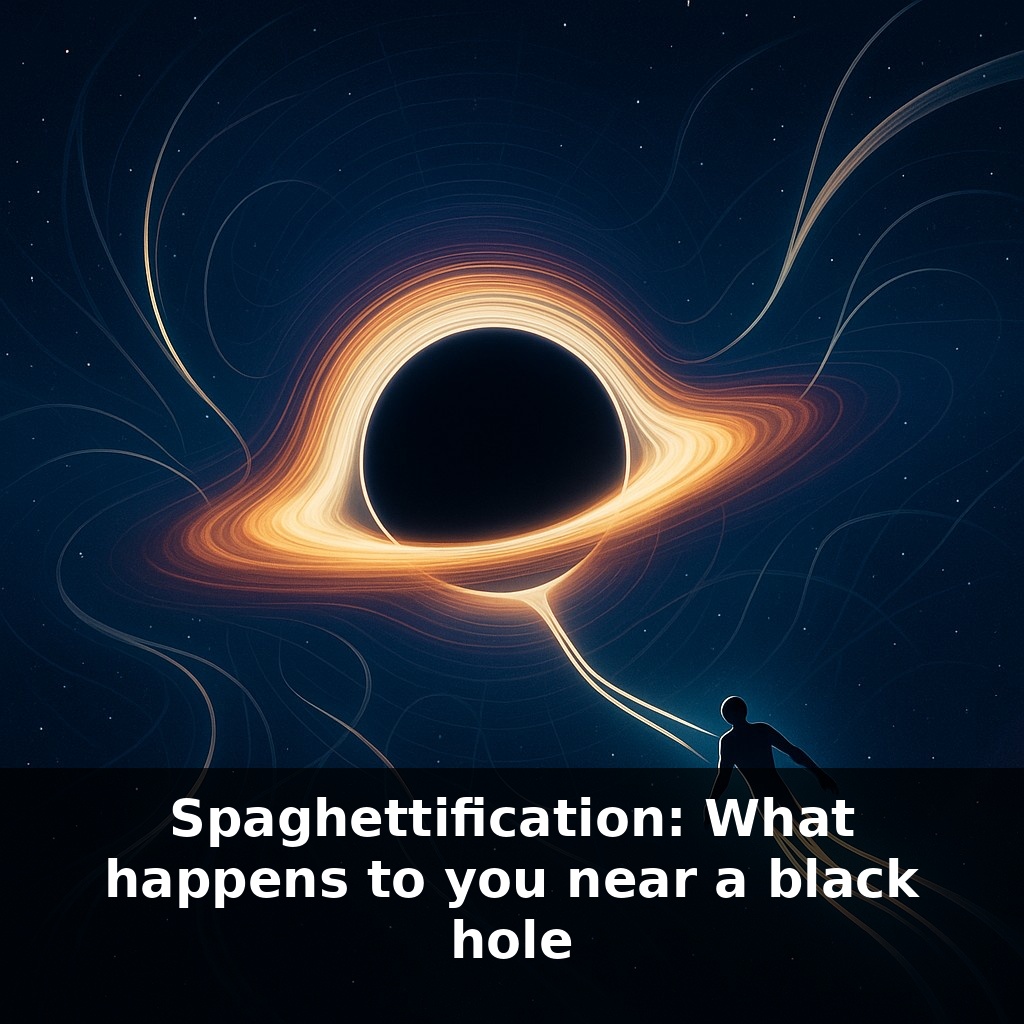
Astronomers have watched whole stars torn into glowing noodles by invisible monsters. In one such event, a single black hole outshone its entire galaxy for weeks. Today, we drop you right next to one and ask: what happens to *you* when spacetime itself starts pulling you apart?
By the time a star gets turned into luminous strands, the real horror has already happened on much smaller scales. That same destructive finesse applies to you, molecule by molecule. This episode isn’t just about “falling in”; it’s about how different parts of you fall *differently*. Your body becomes a measuring device for just how violently the universe can change over a few dozen centimeters.
We’ll zoom in on what each region of your body experiences as you descend: why your feet and head effectively live in different worlds, why no material—biological or engineered—can keep you in one piece, and why the size of the black hole decides whether you notice anything at all before it’s too late. Along the way, we’ll connect this personal disassembly to real tidal disruption events astronomers have recorded across the cosmos, turning individual deaths into galactic-scale fireworks.
On Earth, gravity’s grip feels boringly uniform; a dropped mug doesn’t stretch into a strand before it shatters. Near a black hole, that changes so violently that your height matters as much as your mass. Each extra centimeter closer ramps up the tidal stress, because those forces scale faster than ordinary gravity does. This isn’t just a matter of falling—it’s a matter of how quickly the *difference* in pull grows as you move. To unpack what that means, we’ll track your descent in stages, treating your body like a stack of checkpoints marking how brutal the gradient has become.
At first, you wouldn’t feel “pulled apart” so much as subtly misaligned. Your inner ear says you’re in free fall, but your joints start to protest in strange, asymmetric ways. Knees and hips carry a load that doesn’t quite match what your spine reports. This mismatch grows faster than your fall speed does; with every kilometer closer, the strain ramps up disproportionately.
Zoom into your bloodstream. The pressure difference between the vessels in your feet and those in your chest quietly increases. Blood prefers the lower regions, pooling not just because you’re “downward,” but because the local rules for what counts as “down” change more sharply over your height than your circulation is designed to handle. Capillaries in your legs are asked to endure stress they were never built for, while those near your heart momentarily lag behind in this brutal negotiation.
Nerves get dragged into a geometry they can’t interpret cleanly. Signals from your lower limbs take slightly different paths through the distorted region than those from your upper body. The timings skew by microseconds, then milliseconds—tiny, but your brain evolved in a world where such delays track distance, not warped geometry. Pain, pressure, and balance messages arrive desynchronized, and your sense of “where your body is” starts to glitch.
Muscle fibers become unwilling mediators. Fibers aligned with the fall direction are stretched, while neighboring fibers oriented diagonally are twisted. The biochemical machinery still tries to contract in unison, but the mechanical environment refuses to cooperate. Micro-tears appear long before any dramatic visible elongation, like hairline fractures spidering through concrete just before a bridge fails.
On the structural level, bones experience a stress pattern unlike any load on Earth: not a clean bend or compression, but a gradient that gets measurably stronger from one vertebra to the next. Even before outright fracture, their elastic response subtly changes your posture against your will, locking joints, hunching shoulders, and curling toes as your skeleton searches for a configuration that spreads the impossible load.
One way to picture this escalating mismatch is like a symphony in which every instrument’s tempo is tied to its seat number: violins in the front rows are forced to accelerate faster than those in the back. For a few bars, the piece still sounds coherent. Then, abruptly, coordination collapses—not because any musician failed, but because the score itself demanded incompatible rhythms across the orchestra.
By the time your body’s “orchestra” reaches that point, the failure isn’t just painful; it’s systemic. Circulation, posture, and sensory integration stop agreeing on a shared reality, and the breakdown doesn’t proceed limb by limb, but as a cascade through all the interconnected control loops that usually keep you feeling like one continuous, unified object.
Engineers quietly steal ideas from this kind of violent astronomy. When they design satellites skimming close to planets, or gravitational-wave detectors stretching laser beams over kilometers, they budget for tiny versions of the same misalignments that would shred you near a hole. The math is identical; only the stakes differ. Get those gradients wrong and your billion‑dollar instrument “detunes” itself just as your body would.
Doctors, too, have an odd brush with the concept. In microgravity, astronaut bodies subtly “de-integrate”: fluids shift, bones unload, balance systems lose their calibration. It’s a tame cousin of the breakdown we’ve been tracing, useful as a lab for how complex systems fail when every component experiences slightly different rules.
Your challenge this week: treat your own body like a sensor array. When you accelerate in a car, ride an elevator, or step off a curb, notice which parts disagree first—stomach, vision, balance, joints—and how long it takes for them to resynchronize.
Spaghettification isn’t just a cosmic horror scene; it’s a precision stress‑test of physics. As telescopes and detectors sharpen, those “last screams” of matter become data about how nature handles extremes no lab can copy. X‑ray polarimetry can sketch magnetic fields as they twist apart, while future gravitational‑wave maps might read out a doomed star’s inner structure the way doctors read an EKG, exposing subtle flaws in our best theories—or hinting at new ones.
In that sense, spaghettification turns you into a probe, like a disposable test strip dipped into an acid you can’t bottle. Each torn layer—skin, atoms, nuclei—would “report back” through light, jets, and ripples in gravity. We can’t send volunteers, but we *can* read those reports, slowly converting distant, silent deaths into a user manual for the extreme universe.
To go deeper, here are 3 next steps: 1) Watch the black-hole–spaghettification segments in NASA’s “Imagining the Death of a Star” and “Black Hole 101” videos on YouTube to see visualizations of tidal forces stretching matter. 2) Read the spaghettification sections in *Black Holes & Time Warps* by Kip Thorne or *Black Holes: The Reith Lectures* by Stephen Hawking, and pause to sketch (even roughly) how gravity changes from your head to your feet as you cross the event horizon. 3) Explore the interactive “Journey into a Schwarzschild Black Hole” simulator on the ESA or PhET-style physics sites, tweaking mass and distance to watch how tidal forces ramp up and noting the point where a human body would realistically be torn apart.