The Productivity Illusion: Fact or Fiction?
📝 Transcript
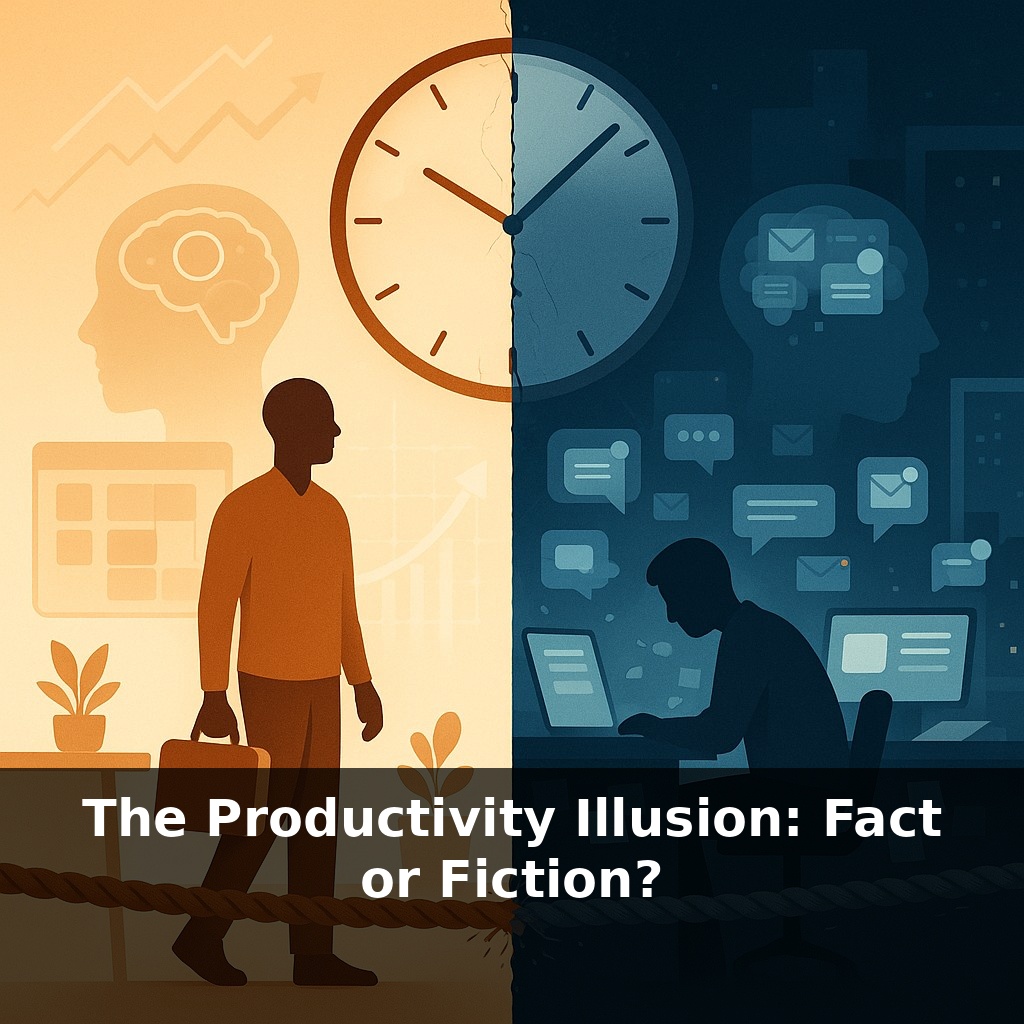
Your boss praises the teammate who leaves at five… while you’re still answering emails at nine—and they get more done. Microsoft found that cutting the workweek actually made people far more productive. How can doing less lead to better results? Let’s pull on that thread.
You’ve probably felt the tug-of-war yourself: a calendar packed with back-to-back meetings, a browser full of tabs, and a brain quietly begging for a breather. Yet the cultural script still whispers, “Busy means valuable.” The data says otherwise. Researchers watching real office workers found they switched tasks every few minutes, bleeding focus all day long. Other studies show that once we push past a certain number of hours, our brain stops giving us its best work and starts quietly sabotaging our efforts. Our problem isn’t a lack of effort; it’s the invisible tax we pay for constant context switching and chronic overextension. In this episode, we’ll examine how attention, rest, and deliberate constraint can turn a seemingly “average” day into one that actually moves the needle—without you living in your inbox or your office chair.
So here’s the twist: the people who look “less committed” on the surface often have something you don’t see—a quiet system. They’ve decided ahead of time which projects get their best energy, which meetings they’ll decline, and when they’ll shut the laptop no matter what’s still unfinished. Instead of cramming more into each hour, they protect a few blocks where nothing is allowed to intrude. Think of it as building a secure server room in the middle of an open office: not everything gets access. In this episode, we’ll unpack how those invisible boundaries reshape what a “full” workday really is.
The illusion shows up most clearly when you look at *where* effort goes, not just *how much* you give. Consider three invisible drains that masquerade as hard work:
First, “micro-responsiveness.” Every ping feels minor, but treating them all as emergencies wires your day around other people’s priorities. Studies on interruptions don’t just show slower progress; they show more mistakes and more stress. That stress nudges your brain toward short-term, easy tasks—exactly the opposite of what your most important work needs. Over time, you become excellent at clearing small items and terrible at moving big ones.
Second, “performative busyness.” Calendar Tetris, instant replies, and visible late nights function as a kind of armor: proof that you care. Yet organizations that have measured output versus time-on-display often find a mismatch. Microsoft Japan’s experiment didn’t work because people magically became more disciplined; it forced teams to redesign **how** they worked. Meetings got shorter or vanished, decisions moved faster, and low-value rituals were quietly retired. The constraint exposed which activities were theater and which actually moved projects forward.
Third, “cognitive debt.” Those extra hours you squeeze in at the edges don’t stay neatly contained. When research shows performance dropping hard after a certain weekly threshold, it isn’t just about fatigue in the moment. It’s the carryover: slower thinking the next morning, reduced creativity later in the week, and a shrinking tolerance for ambiguity and disagreement. That matters because the tasks that truly change your trajectory—strategy, deep problem-solving, influence—live in the land of ambiguity and disagreement.
Notice what all three have in common: they reward visible activity and penalize quiet, high-leverage thinking. The illusion is that you can add those visible behaviors on top of an already-full plate without cost. Like a software system running too many background processes, you start burning CPU on maintenance instead of the applications that actually serve the user. The fix isn’t heroic effort; it’s designing your default day so that focused stretches and recovery are structurally easier than frenetic reaction.
Think about two colleagues starting Monday with the same to‑do list. One opens everything at once—Slack, email, docs, dashboards—and “samples” each task all morning. The other picks one gnarly item, closes the rest, and doesn’t surface until it’s shipped. By lunch, the sampler has touched ten things and finished nothing; the finisher has one real win and a calmer nervous system. Their calendars look equally “full,” yet one has actually reduced tomorrow’s load.
You can see this difference in how teams use tools, too. Some treat every shared doc and chat channel as a live broadcast, responding in real time. Others explicitly label channels: “slow lane” for thoughtful decisions, “fast lane” for true urgencies. The second group often looks less frantic from the outside but hits deadlines more reliably.
Sports science shows the same pattern. Elite runners don’t sprint every session; they alternate hard intervals with easy miles so race day can be genuinely maximal. They’re not less driven—they’re disciplined about *when* to push and when to coast so the peaks actually count.
Leaders now face a fork in the road: double down on visible hustle, or redesign work so thinking has room to breathe. As AI takes over routine tasks, the premium shifts to skills that don’t thrive on constant pressure: pattern‑spotting, negotiation, judgment. Teams that treat calendars like city plans—zoning areas for deep work, collaboration, and recovery—create neighborhoods where ideas can actually collide and grow, instead of just building more traffic lanes for shallow tasks.
So the real shift isn’t squeezing more into your day; it’s deciding what’s allowed in at all. Treat your calendar less like open seating and more like a guest list: a few VIP tasks, limited plus‑ones, and a hard cap on capacity. Your challenge this week: guard one 45‑minute block daily as “no‑entry” time—and notice which “urgent” things survive the wait.
From this course
Breaking Down Productivity Myths
5 episodesUnlock all episodes
Full access to 5 episodes and everything on OwlUp.
Subscribe — $1.99/monthLess than a coffee ☕ · Cancel anytime