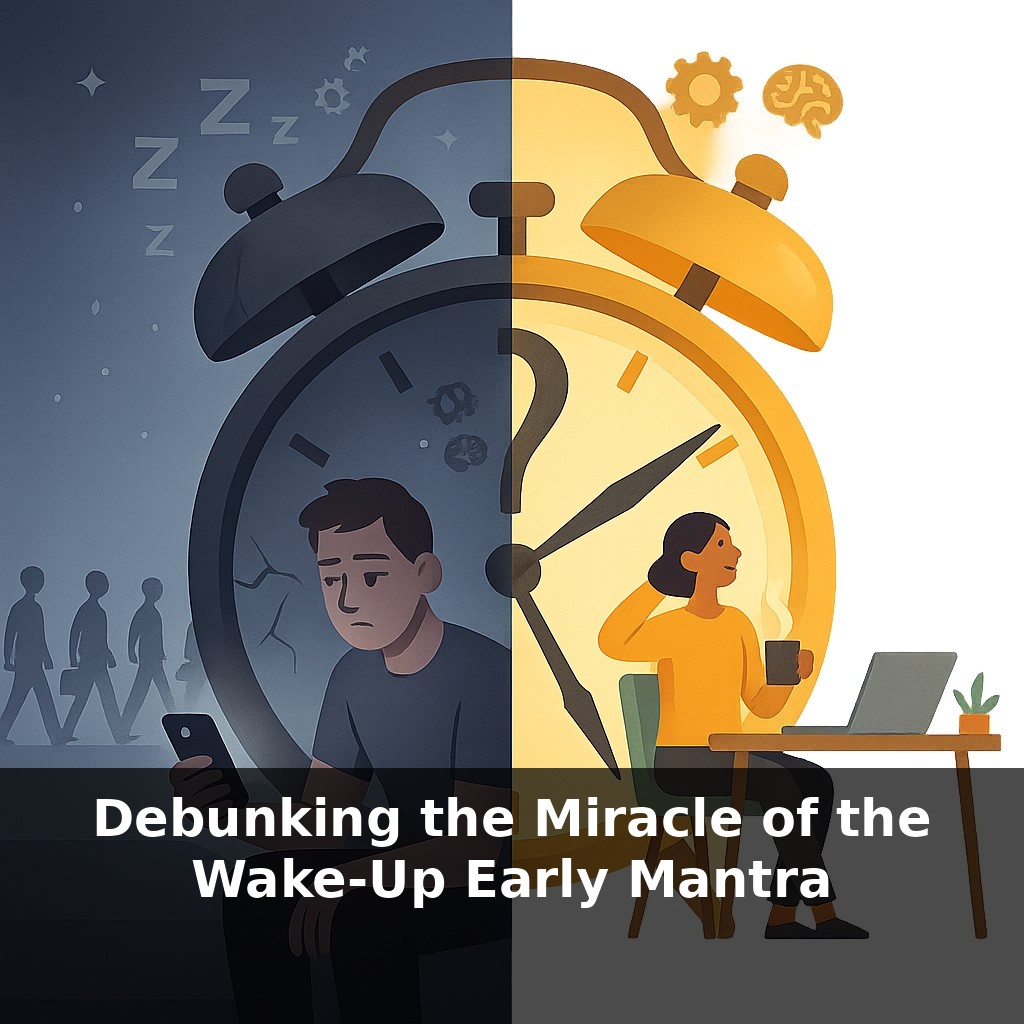
About half of adults are biologically wired *not* to be morning people—yet the loudest success stories all seem to brag about 4 a.m. alarms. You’re exhausted, scrolling past these routines, and wondering: are they disciplined…or just completely out of sync with their own brains?
So here’s the twist the hustle-culture posts usually skip: those glorified crack-of-dawn routines often *work* for their owners not because of the hour on the clock, but because they’ve accidentally built a system around their own natural peaks. For you, copying that schedule might be like installing someone else’s custom keyboard shortcuts on your laptop—technically functional, but constantly fighting your muscle memory.
What actually moves the needle is when your sleep, your energy curve, and your most demanding tasks line up on purpose. That quiet, focused groove you sometimes hit at 10 a.m. or 9 p.m.? That’s not a fluke; it’s a hint. In this episode, we’re going to zoom out from “wake up earlier” and dig into a better question: “When does *your* brain want to do its best work—and how do you build a day around that without blowing up your job, family, or ambitions?”
Here’s where science quietly crashes the “rise and grind” party. Large-scale sleep studies show that *when* you wake up matters far less than *how* your sleep fits together: total hours, regular timing, and whether your schedule respects your internal clock. Think of your day like a well-designed city grid: if traffic lights (meetings, deep work, rest) are synced, everything flows; if they’re random, even a 5 a.m. start just creates earlier traffic jams. Instead of forcing yourself into a heroic wake-up time, we’ll look at how to redesign the “roads” of your day so your real high-output windows aren’t wasted on email and busywork.
Here’s where things get interesting once you stop chasing “early” and start optimizing for “effective.”
First, not everyone has the same *type* of day, even with the same number of hours. Chronobiology research shows three big levers you can actually work with:
1. **Chronotype-aware scheduling.** If you’re a later type forced into a conventional schedule, you don’t have to overhaul your life to see gains. You can quietly reshuffle what happens *within* your required hours: - Block your sharpest 90–120 minutes (whenever they naturally fall) for deep work: coding, writing, strategy. - Push autopilot tasks—status updates, routine forms, low-stakes replies—toward your sluggish zones. - If your job is rigid, even shifting *one* demanding task out of your worst time can make the day feel completely different.
2. **Consistency as a performance tool, not a moral virtue.** In the data, irregular sleep-wake patterns hurt reaction time, mood, and decision quality *even when total sleep is similar*. Your brain likes predictability: it can pre-load hormones, body temperature, and alertness *if* it knows when you’ll ask it to show up. That’s why shifting your schedule by two hours every weekend often feels worse than one very late night: you’re asking your system to constantly re-negotiate what “morning” means.
3. **Cost of misalignment, not laziness.** “Social jet lag” is what researchers call the gap between when your body would choose to sleep and when your life makes you. It’s not just grogginess; those heart and behavior risks stack up over years. The paradox: many people try to “be more productive” by widening that gap—waking earlier, staying up to catch up, running on fumes—then blame themselves for the resulting brain fog.
So instead of idolizing a particular wake-up time, you’re better off running a small, ongoing experiment: - Notice when complex thinking feels almost frictionless. - Guard that slice of the day like a meeting with your future self. - Let less critical work fill the edges, not the center.
That’s the quiet pattern behind many high performers who look “disciplined”: they’re not just awake earlier; they’ve stopped wasting their prime bandwidth on low-value obligations.
Think about two colleagues with the same role and the same 8–9 hours in their day. One quietly rearranges their calendar so the hardest work happens when their brain naturally “comes online”; the other keeps accepting default meeting times and answering messages whenever they pop up. After a month, they’ve both “worked hard,” but only one has built a system that repeatedly turns effort into outcomes.
You see this in real teams: a designer who does concept work late morning and moves pixel tweaks to mid-afternoon; a sales lead who schedules discovery calls when they’re naturally more social and saves CRM admin for low-motivation stretches. Same job description, different internal architecture.
A practical way to start: instead of asking, “How early did I get up?” ask, “Which tasks today truly deserved my clearest attention—and did they get it?” Over time, that single question reshapes your schedule far more effectively than another motivational alarm tone.
“Early riser = future CEO” might make a good headline, but it doesn’t survive contact with data. As wearables quietly map when you’re actually sharp, a different future comes into view: teams built like balanced sports rosters, where not everyone plays the same position at 9 a.m. sharp. If companies start staffing projects by *when* people think clearly, not just *where* they sit, promotion paths and even “ideal worker” images could shift in surprising ways.
Your challenge this week: Use your phone or a simple note to mark three things each day for 7 days: 1) the time you *start* to feel mentally “switched on”; 2) a 60–120 minute window when hard tasks feel easiest; 3) when you predictably fade.
At week’s end, pick just one high‑stakes task and deliberately schedule it into that strong window. Notice whether the work *feels* different—not just whether you finished it.
Treat this like debugging a program: you’re tracing where your mental “lag” actually comes from. As you collect data, you may notice certain people, places, or habits reliably sharpen or dull you, independent of the clock. That’s the real leverage point—once you see which inputs change your output, you can redesign your day with intent, not guilt.
Try this experiment: For the next 5 days, keep your *current* wake-up time, but deliberately shift **one demanding task you normally “save for the morning”** (like deep work, workouts, or planning) into your natural peak-energy window—mid-morning, afternoon, or evening—based on when you actually feel most alert. Before you move it, rate yesterday’s version of that task (done at your usual time) on a 1–10 scale for focus and ease, then rate it again after doing it in your new time slot. Keep everything else the same—same caffeine, same workspace, same task length—so the only variable is *when* you do it. At the end of 5 days, compare your scores and decide whether you truly need to wake up earlier, or just need to line up important work with your real energy rhythm.