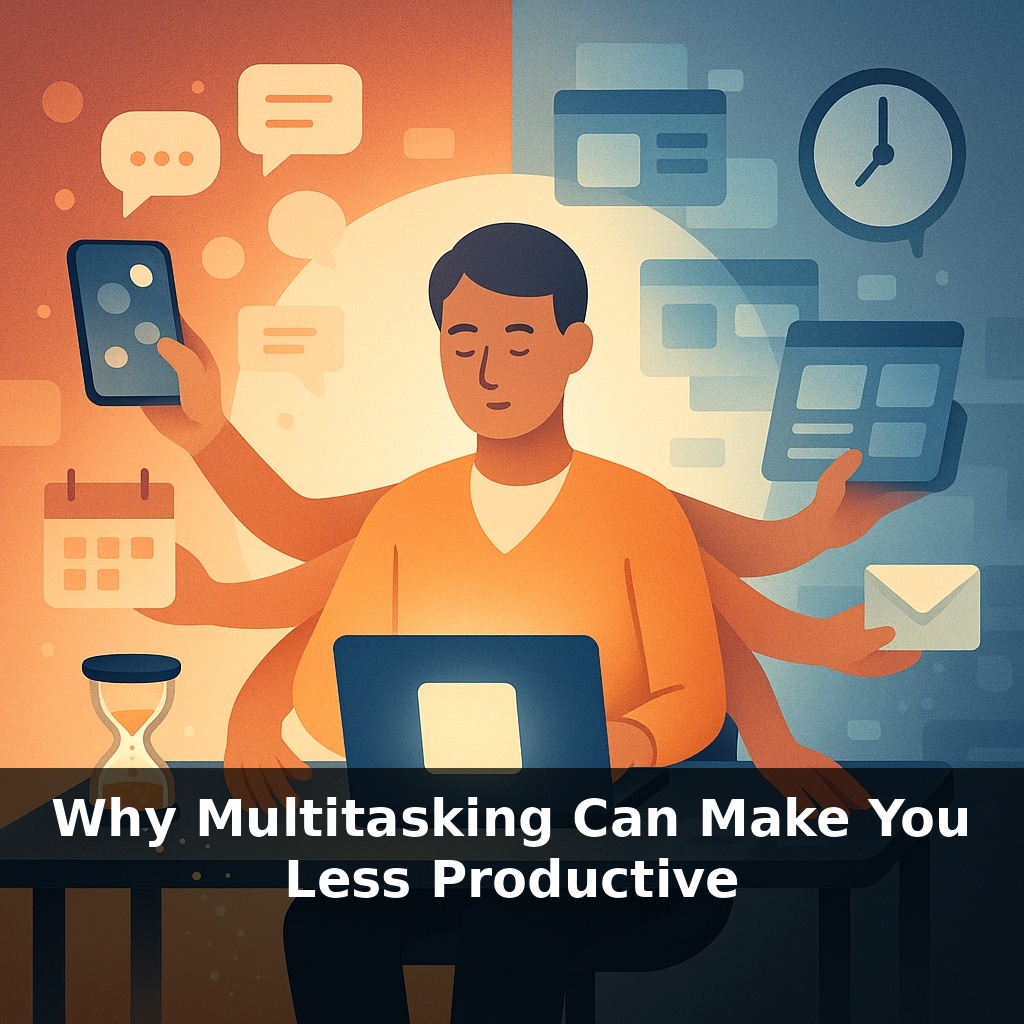
Right now, as you listen, your brain is probably already trying to do something else. A message. A tab. A tiny “check” you promise will only take a second. Here’s the twist: the more you juggle, the more time quietly leaks away—and most of us don’t even feel it happening.
You probably know the obvious interruptions: the ping of a notification, a coworker tapping you on the shoulder, your name lighting up in a group chat. Those are easy to blame. But the more dangerous interruptions are the invisible ones—the tiny choices your brain makes every few minutes: “Should I check email? Maybe I’ll just skim that doc. Wait, I should respond to that message first.” Each micro-decision quietly diverts your attention, not just from what you were doing, but from how deeply you were thinking. Over time, your day stops being a clear path and starts to resemble a maze you’re mapping in real time. You still move, you still work, yet your progress feels oddly fragile—easily knocked off course by the slightest mental nudge or new piece of information. This is where productivity erodes, even when you feel “busy” all day.
At a brain level, those tiny shifts aren’t free—they trigger a full reconfiguration of what your mind is holding ready: goals, rules, priorities, even the “map” of what you were about to do next. Neuroscientists call this executive control kicking in, and every time it does, there’s a brief slowdown and spike in effort, even if you only hopped over to a new tab for 15 seconds. Now stretch that out across your workday: email, chat, slide deck, code editor, calendar, back to chat. Each switch feels trivial, but together they form a kind of “mental tax” that you pay over and over without ever seeing the invoice.
Here’s the strange part: from the inside, multitasking often *feels* fast. Your day is full of motion—replying, skimming, reacting—so your brain gets this constant hit of “I’m doing a lot.” But when researchers actually measure performance, a different story shows up.
When psychologists track people shifting between tasks, they see a consistent pattern: performance drops, even though participants *believe* they’re doing fine. In one classic set of studies, people who *identified* as “great multitaskers” were usually the ones who performed the worst on tests of focus, memory, and task-switching. Confidence was high; results were not.
Part of the trap is that the penalty shows up in places we don’t immediately link to multitasking. It’s not just that everything takes a bit longer. It’s that your brain has less bandwidth for holding context: what you’ve already decided, what still matters, what needs checking. That’s why heavy media multitaskers in the Stanford research didn’t just get slower—they mixed up information, missed details, and were more distractible even when the test itself was simple.
Now put this into a normal workday. You’re drafting a proposal, your calendar reminder fires, you glance at chat, you flick to your inbox “just to clear a few things.” Each move is tiny, but that 23–25 minute recovery time after an interruption doesn’t only apply to someone tapping you on the shoulder. It also applies when *you* voluntarily hop away from what you were doing. You might return to the doc in 90 seconds, yet the deeper layer of thinking you were in—the part that combines ideas, sees patterns, or spots risks—often doesn’t snap back with you.
There’s also a hidden emotional cost. When your tools report that you’ve switched windows hundreds of times in a day, that means your mind keeps having to re-open “mental files” you just closed. Over hours, this creates a subtle sense of being behind, even when you’re technically keeping up. You feel scattered, so you try to work faster, which usually means…more switching.
Think of elite athletes between plays: they use micro-pauses to reset, not to start a different sport. In knowledge work, we often do the opposite—using every gap to start something new, then wondering why deep work feels so rare and so tiring.
Think about the last time you tried to “just answer a quick message” while working on something that actually mattered. You probably didn’t feel a big shift—yet watch what happens if you zoom out. That quick reply turns into checking one more channel, then following a link, then skimming a comment thread. By the time you return, the original work feels colder, like walking back into a conversation you stepped out of ten minutes ago.
One way to see this more clearly is to look at people whose output *depends* on uninterrupted thought. Many developers block off entire mornings for coding and refuse to open communication tools; designers often batch feedback into specific windows so they don’t keep reopening the same file with a different mindset. Writers draft in offline modes, then come online later to research and edit. They’re not being dramatic—they’ve learned that repeatedly reopening a problem from scratch is more draining than staying with it a bit longer, even through mild discomfort or boredom. Over weeks, that difference compounds into whether big projects cross the finish line or keep stalling at “almost done.”
If attention becomes the real bottleneck, careers may start to reward “focus engineering” as much as technical skill. Teams could plan work like architects: load-bearing tasks get quiet, protected space; lighter items fill the gaps. Hiring managers might ask not “Can you handle chaos?” but “How do you protect depth?” Students could train on focus drills the way athletes run sprints—short, intense blocks that grow longer as their cognitive stamina improves.
Treat this less like fixing a bad habit and more like tuning an instrument. Small tweaks—muting one noisy app, giving a single project “prime time,” leaving tiny buffer zones between meetings—change how clearly you can think. Your challenge this week: notice when work feels like a flickering cursor versus a steady beam, and bias toward the beam.