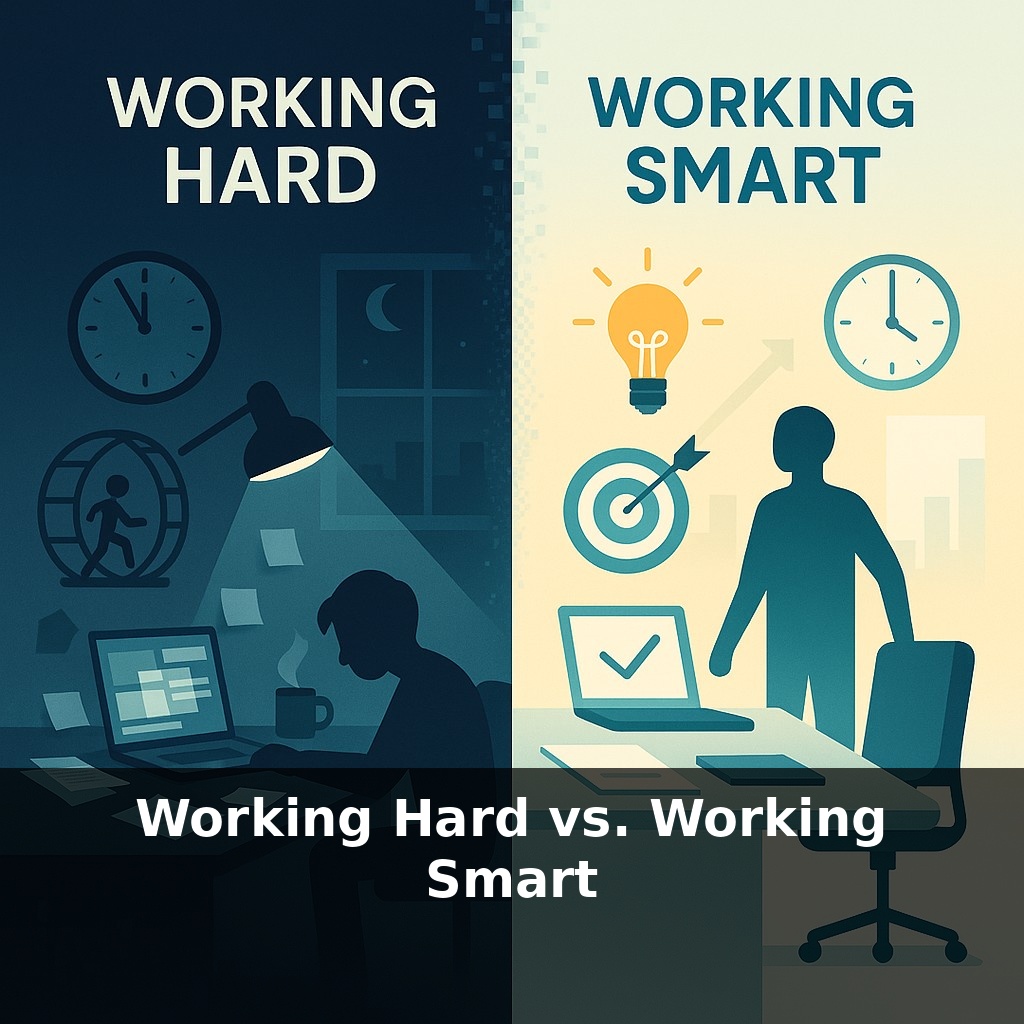
Stanford found productivity flat‑lines once you work past roughly fifty hours a week—yet the people staying latest are often praised the loudest. In your office, who gets promoted: the one online at midnight, or the one who quietly ships big results by four?
A 40% jump in productivity from cutting a full day of work sounds like a glitch in the matrix, not a policy change—yet that’s exactly what happened in Microsoft Japan’s trial. So if more time at your desk isn’t the lever, what is? This is where “working hard” and “working smart” quietly part ways. One burns extra fuel in the same old engine; the other upgrades the engine first. Working smart shows up in small, unglamorous choices: scheduling deep-focus tasks when your brain is actually awake, refusing to babysit low-impact work, and turning tools into teammates instead of digital clutter. It’s less about intensity and more about precision. Over this episode, we’ll zoom in on how top performers redesign their day so each hour does the heavy lifting—without them having to.
The trap is that “doing more” feels productive in the moment: your calendar is packed, inbox buzzing, chat windows blinking. It’s easy to mistake that noise for progress. But when researchers track how knowledge workers actually spend their days, a different picture shows up: tiny fragments of focus scattered between notifications, status meetings, and routine updates that could be automated or skipped. The highest performers don’t necessarily care more; they design their week so that distractions have to fight to get in. Instead of stuffing in extra tasks, they start questioning why a task exists at all.
Most people try to solve overload by cramming more into the same structure: another late night, another tab, another “quick” meeting. But the studies behind “work smart” point in a different direction: change the structure first, then the effort starts to count.
One of the biggest structural leaks is *when* and *how* you use your brain. Cognitive research shows your mental energy isn’t a flat line; you cycle through peaks and troughs over the day. Instead of forcing yourself to grind through everything in the same way, high performers match the task to the state. Creative problem‑solving or strategy when they’re fresh; shallow admin when their attention is naturally lower. The same sixty minutes produces very different outcomes depending on whether you spend it in a peak or a slump.
Then there’s the hidden tax of constant switching. UC Irvine’s work on task‑switching shows that every “I’ll just check Slack” can turn into twenty minutes before your brain is fully back. The myth is that hopping between tasks keeps things moving; the reality is you’re repeatedly paying a restart cost. People who “work smart” guard blocks of single‑task time, then batch tiny items—messages, approvals, quick reviews—into specific windows so they don’t perforate the entire day.
Another shift: instead of asking “How do I get this done faster?” they ask “Why does this keep landing on my plate at all?” That’s where process and technology come in. Think of a developer writing a small script to clean a report that used to take an hour every Friday, or a manager replacing three status meetings with one dashboard everyone checks asynchronously. The Kaizen work at Toyota is an extreme example, but the principle scales down: remove friction once, benefit every time.
Working smart also means redefining “hard work” as outcomes, not visible struggle. In teams, that looks like clarifying what actually moves the needle this week, saying no to requests that don’t, and being transparent about trade‑offs. Over time, your reputation shifts: not as the person who’s always “busy,” but as the one who consistently delivers the right things, with less chaos attached.
A senior engineer I coached used to stay late firefighting bugs. Instead of adding more hours, she ran a quiet experiment: every time a bug hit, she tagged its source in a simple spreadsheet. After three weeks, a pattern jumped out—two legacy modules caused 60% of incidents. She negotiated one sprint to refactor just those pieces. On‑call pages dropped so sharply that her evenings cleared without a heroics memo or a new time‑management system.
A marketing lead tried something similar with her own workload. She colour‑coded calendar events by “who truly cares if this happens.” Green meant directly tied to a key result, yellow meant “nice to have,” red meant “I’m here out of habit or politics.” Within a month, half the red items were gone—replaced by async updates or shorter check‑ins—and the green blocks finally had breathing room.
Working smart is like upgrading a stadium’s lighting system: you don’t ask players to run faster in the dark; you change what lets every play be seen, judged, and improved.
Soon, careers may look less like fixed ladders and more like custom training programs. As AI handles routine plays, your value comes from where you aim your best thinking and how quickly you can redesign your own workflows. Expect job offers that specify outcomes instead of hours, calendars that auto‑cluster your toughest work into ideal slots, and teams rewarded for eliminating busywork, not enduring it. Those who treat systems as a first draft—not a rulebook—will shape how the rest of us work.
Your challenge this week: pick one recurring task and treat it like a prototype. For five workdays, tweak *only* the way you approach that task—cut a step, automate a slice, or shift who’s involved. By Friday, compare time and stress saved. Like debugging a glitchy app, small fixes in one function can quietly upgrade the whole system.