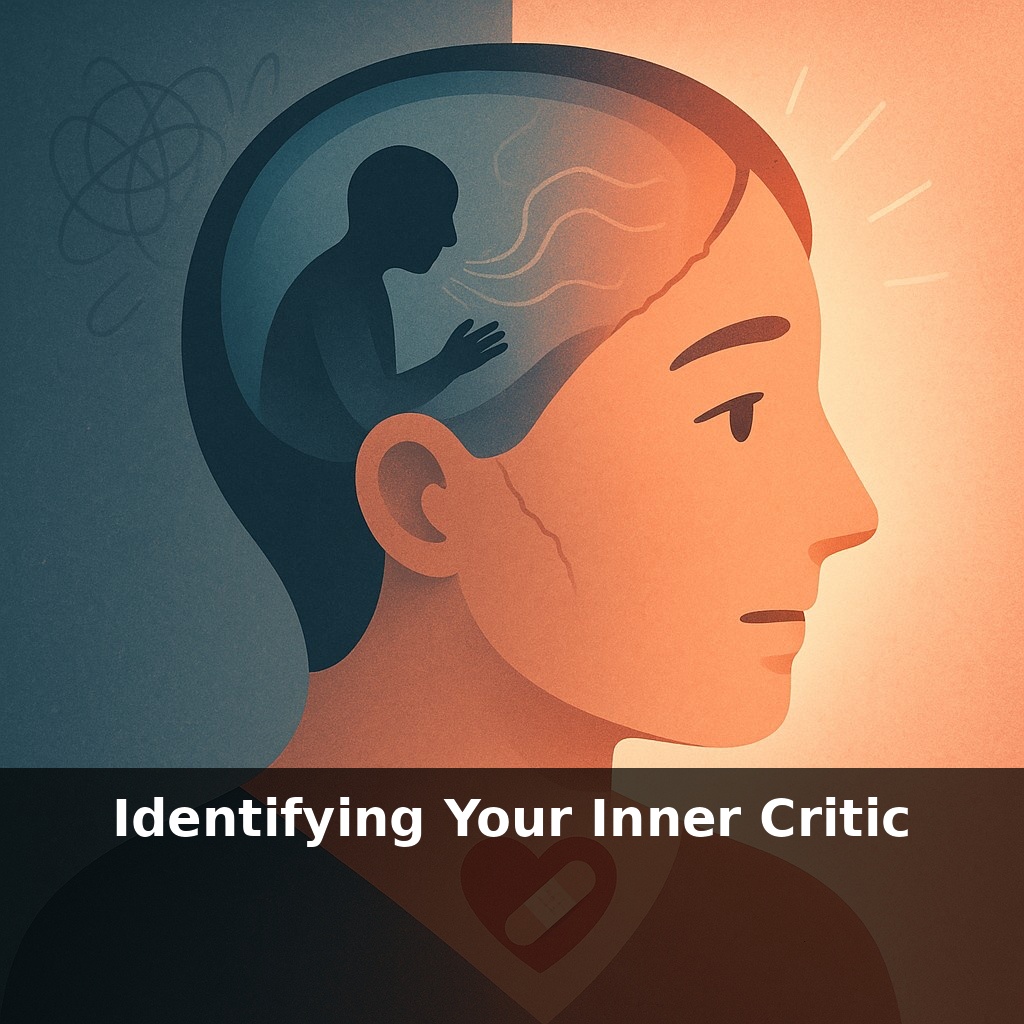
Identifying Your Inner Critic
📝 Transcript
In brain scans, your harsh self-talk lights up the same pain centers as a physical injury. Now, jump to a moment you messed up at work or snapped at your partner—did your inner voice attack or support you? Here’s the twist: that voice isn’t you, but it’s steering your relationships.
That attacking voice in your head didn’t appear out of nowhere. It was assembled, bit by bit, from comments you heard growing up, offhand jokes about your body or intelligence, performance reviews at work, even subtle signals like eye-rolls or sighs when you spoke up. Over time, your brain stored this feedback as “evidence” about who you are and when you’re in danger of being rejected or shamed.
Here’s where it gets tricky: the harsher that voice is, the more it distorts what’s happening right now. A delayed text becomes “They’re tired of me.” A partner’s quiet mood becomes “I’ve screwed everything up.” Your nervous system reacts as if you’re in trouble, not just having a conversation.
The goal in this episode isn’t to silence that voice, but to study it—its favorite phrases, tones, and timing—like a curious researcher running a careful experiment.
Sometimes that inner running commentary is loud and obvious—“You blew it.” Other times it hides inside “reasonable” thoughts: “I should know this by now,” “Other people handle this fine,” “Don’t make a big deal out of it.” It can even borrow other people’s voices: a teacher, a parent, an ex, a boss. What matters now is not arguing with it, but noticing its style. Is it sarcastic? Cold? Panicked? Does it sound older or younger than you are now? Think of this as tuning a radio: you’re learning exactly which station is the critic, so you can stop mistaking it for truth.
Your inner critic doesn’t just show up randomly; it tends to clock in on a schedule. Research finds it’s especially loud around three types of moments: threat to status (“I look stupid”), threat to belonging (“They’ll leave”), and threat to self-image (“This proves I’m not good enough”). Start noticing which category most of your attacks fall into. This tells you what your critic is secretly trying—clumsily—to protect.
Tone is your next clue. Some people hear a drill-sergeant style: blunt, harsh, swearing. Others get a disappointed, sighing tone, or a calm, icy one that sounds “objective” but leaves them feeling small. Tone matters because your body reacts differently to contempt than to urgency or fear. You’re not just cataloguing words; you’re mapping how each style lands in your chest, stomach, jaw.
Then there are triggers. For some, it spikes during conflict with a partner: “Don’t be so sensitive, you’re too much.” For others, it’s success: a compliment arrives, and the critic mutters, “If they really knew you…” Some people notice it most after scrolling social media; others, when they’re tired, hungry, or behind schedule. Track when it shows up in your day: mornings vs. nights, at home vs. work, texting vs. in-person.
Notice its favorite “evidence.” Does it constantly drag out one breakup, one bad grade, one argument? Does it compare you to a sibling, coworker, or your partner’s ex? That pattern shows you the old story it’s clinging to—often years out of date.
Finally, pay attention to what happens right after it speaks. Do you apologize too much, go quiet, pick a fight, overexplain, make a joke, start fixing everything? Those behaviors are the critic’s ripple effects in your relationships.
One analogy: think of debugging a glitchy app. You’re not smashing the phone; you’re checking when it crashes, what you were doing, what message popped up. The clearer that log, the easier it is to rewrite the code later—turning raw self-attack into guidance you can actually use.
Think about three everyday moments:
You’re late to meet a friend, traffic was awful, and your mind snaps to, “Of course. You can’t do anything right.” You share an idea with your partner, they pause to think, and instantly a quiet line appears: “Too needy. You talked too much.” You close your laptop after work and notice a tightness in your chest as a thought slides in: “Everyone else is further ahead by now.”
These are tiny, forgettable scenes on the surface, but they’re gold for spotting patterns. Notice how the theme might repeat: incompetence, being “too much,” falling behind. Over a week, you may realize it’s the same three or four accusations, just wearing different outfits.
Like tracking small expenses in a budgeting app, these “little” jabs add up. One or two in a day might not register, but twenty shape your mood, your posture, and how bravely you show up with the people you care about. The more specific you are about when and how they appear, the less invisible power they have.
A decade from now, knowing your inner critic’s habits may be as routine as checking your sleep stats. As CBT-style apps quietly log when and how that voice spikes, they’ll be able to flag “relational risk days” the way weather apps flag storms. In offices, sentiment data could function like a dashboard warning light, prompting workload tweaks before burnout hits. Neurofeedback might add a “live mix” slider, letting people watch in real time as gentler self-cues shift brain activity toward calm.
When you start spotting this pattern in real time, you gain options instead of just reactions. That’s the pivot point: moving from being dragged by old scripts to actively editing them. Like sanding a rough edge off a wooden table, each small moment of noticing smooths future conversations, making it easier to sit at that table with the people you love.
Try this experiment: For one day, every time you notice your inner critic say something harsh (like “You always mess this up” or “You’re so behind”), pause and say out loud: “Inner Critic, I hear you—but you don’t get the mic right now.” Then, imagine the supportive voice the host described and speak one specific, believable counter-line out loud, like you’re talking to a close friend in the same situation. At the end of the day, quickly rate (1–10) how intense your self-criticism felt compared to a normal day and note one moment where your inner critic’s power noticeably dropped.
From this course
Breaking the Silence: Transform Your Inner Dialogues
5 episodesUnlock all episodes
Full access to 5 episodes and everything on OwlUp.
Subscribe — $1.99/monthLess than a coffee ☕ · Cancel anytime