Many American households direct about a third of their income into housing without investigating the reasons or alternatives. As you visit the grocery store, gas pump, or check your banking app, it's essential to ask why prices fluctuate, because the forces shaping them are moving somewhere else entirely.
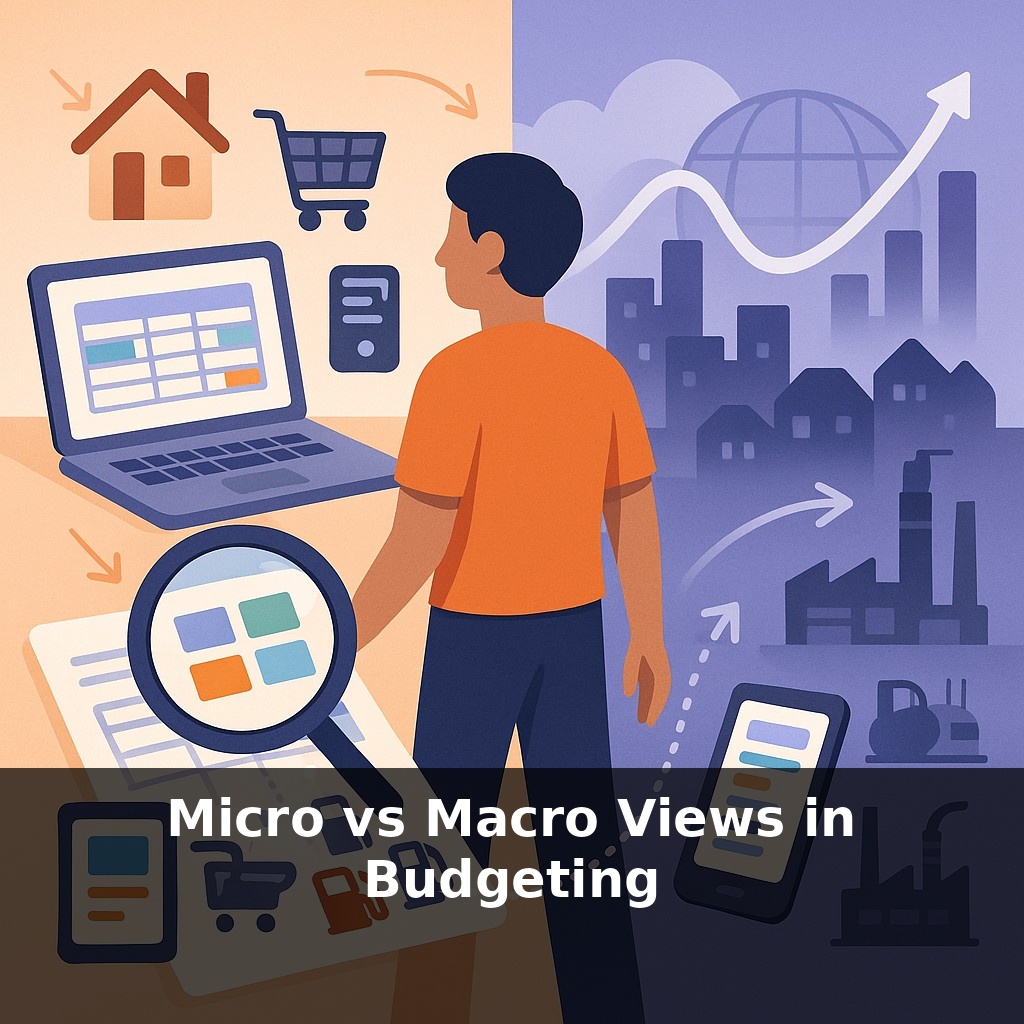
The tricky part is that our brains naturally prefer one scale over the other. Some people live in the “spreadsheet” view—meticulously tracking every subscription, chasing $5 savings, fine‑tuning categories. Others float in the “headline” view—following Fed announcements, market swings, and election news, then vaguely “feeling” more cautious or optimistic about money. Both styles miss something crucial on their own. The detail‑oriented budgeter can optimize themselves into a corner, cutting everywhere while ignoring how rising rates will hit their debt. The big‑picture thinker can anticipate recessions and booms, yet still overdraft because a few quiet habits keep bleeding cash in the background. Real resilience comes from learning to consciously switch views instead of living stuck in one.
So instead of asking “Am I a spreadsheet or headline person?” a better question is: “When do I need each, and how quickly can I switch?” That switch is where most people leave money on the table. A sudden rent hike, a bonus, a Fed announcement, or a new baby all demand different zoom levels. The households and businesses that adapt fastest don’t guess; they’ve already mapped which levers to pull in each mode—what to cut or renegotiate up close, and which rates, sectors, or skills to watch from afar—so adjustments feel more like a planned lane change than a skid on black ice.
Here’s where the “two views” become practical instead of philosophical.
At the micro level, budgeting is brutally concrete: dates, amounts, and who gets paid first. This is where you see that your credit‑card bill jumps within a month of a Fed move, or that a streaming bundle quietly crept up $6. It’s where you decide, “When my paycheck lands on the 1st, these five payments go out automatically; anything left is what I can actually spend.” Micro is about cash‑flow choreography.
Macro takes that same plan and asks, “How long does this stay true if the world shifts?” Every 1 % rise in inflation without a raise is a pay cut in disguise. If your budget leaves zero slack, even a small jump in groceries, utilities, or insurance forces you to use debt or cut essentials. Macro awareness says, “Food is running hot; my rent is fixed; I’ll pre‑emptively lock in an energy contract and push discretionary travel down a notch.”
Organizations already do this well. That Harvard Business Review study found firms that mixed rolling forecasts with tight cost‑center tracking didn’t just plan once; they kept asking, “What if input prices move 5 %? What if demand drops 10 %?” Then they nudged hiring, marketing, or inventory instead of waiting for a crisis. A household can copy that logic on a smaller scale.
For example: interest rates fall. Macro view: “Borrowing just got cheaper.” Micro response: “Refinance the car loan, then keep the payment amount the same so the term shortens,” or “Transfer the card balance to a cheaper line and set a hard payoff date.” Or unemployment ticks up in your sector. Macro: “Income risk is rising.” Micro: “Freeze lifestyle creep, boost cash buffer by one month of expenses over the next quarter.”
Think of a painter stepping back to assess the whole canvas, then leaning in to fix a single brushstroke. The power isn’t in either stance alone; it’s in the rhythm of moving between them on purpose, instead of only when something already hurts.
A simple way to feel the difference is to “zoom” on one real‑life change. Say your landlord emails that rent is increasing next renewal. Micro first: you’d pull out your calendar and numbers and ask, “On the exact day this hits, what has to shift so my account doesn’t go negative?” That might mean reshuffling which bills draft when, trimming one or two recurring charges, or delaying a nonessential purchase until after payday. Then flip to macro: “If this is happening in my city, what else might follow?” You might scan local listings to see if this is a neighborhood trend, check whether utilities or parking are likely to move next, or look at your city’s job market to gauge how risky it would be to relocate. By running both passes on the same event, you’re no longer just reacting to the rent increase; you’re quietly updating your view of your area’s cost trajectory, how long you plan to stay, and what skills or connections you’d want in place before the next renewal notice appears.
Rising carbon prices and live data feeds will quietly redraw the edges of both views. Your grocery run starts reflecting droughts on another continent; your utility bill whispers how regulators voted last year. Meanwhile, gig work and side hustles make income feel less like a salary staircase and more like a tide chart. The opportunity: treat your plan as a living map, refreshed by outside signals, not a static rulebook you only revisit when something breaks.
When you treat money decisions as experiments, each bill, raise, or policy change becomes a datapoint instead of a threat. Over a year, those tiny course corrections compound like interest—not just in your accounts, but in your confidence. You’re not trying to predict every storm; you’re learning to sail better, so changing winds become signals, not surprises.
Try this experiment: For the next 7 days, do your budget *twice* each day—once “micro” and once “macro.” In the morning, quickly list every dollar you expect to spend that day (coffee, gas, lunch, groceries) and cap it at a fixed number, like $40. In the evening, zoom out: update a simple weekly snapshot with just 5 categories (housing, food, transport, debt, fun) and see how the day’s micro choices shifted the bigger picture. At the end of the week, compare: did having a tight daily micro cap actually move the needle on your macro goal (like paying $50 extra to debt or adding $50 to savings)?