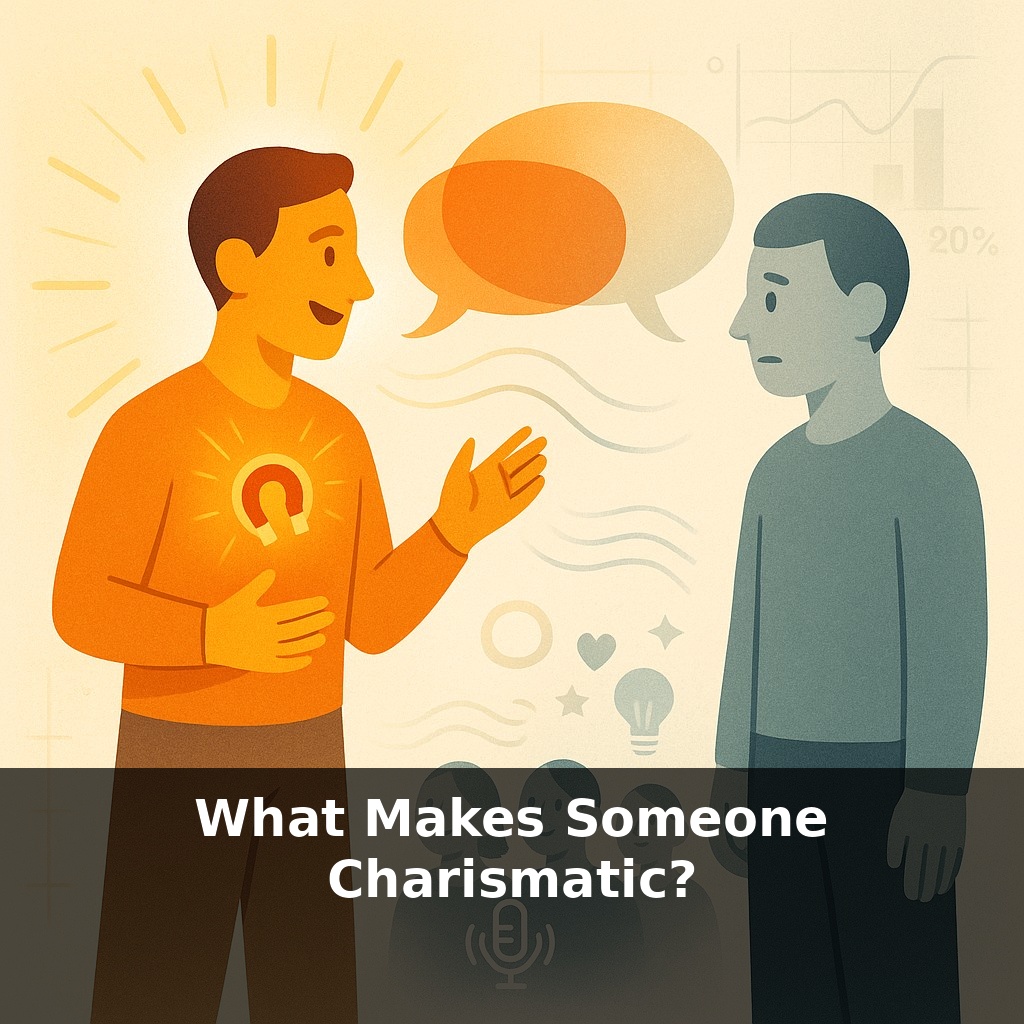
What Makes Someone Charismatic?
📝 Transcript
A Swiss Army experiment once turned average cadets into standout leaders in just a few days—simply by tweaking how they spoke, stood, and listened. Now picture two people saying the same words; one captivates, one bores. This episode asks: what’s really happening in that gap?
A 2021 Oxford study found that a tiny, invisible variable—how “charismatic” someone seems—can predict roughly 20% of whether strangers will give them money. Same platform, similar ideas, wildly different results. That’s the unsettling part: most of us still treat charisma like eye color—fixed, mysterious, unfair.
In this episode, we’re going to pull it apart like a sound engineer isolating tracks in a song. Not more tips about how to “talk better” or “stand up straight,” but the deeper pattern: why some people feel magnetic even when they’re quiet, introverted, or saying very little.
We’ll look at research-backed signals that quietly change how others rank your status, trust your intentions, and decide if they want to follow your lead—or forget you five minutes later. Then we’ll connect those signals to everyday moments: first meetings, group settings, and high-stakes conversations you actually care about.
Here’s the twist: those subtle signals you send—often without noticing—don’t add up equally in every context. The same traits that make you compelling in a pitch meeting can feel overwhelming on a first date, or too muted in a team debate. Think of this less as “be more charismatic” and more as “tune which dial matters most here.” Some moments reward visible confidence; others reward calm focus or quiet warmth. In this episode, we’ll map when presence does the heavy lifting, when power needs to step forward, and when warmth becomes your unfair advantage.
A good way to see what’s really going on is to zoom in on the three “dials” you’ve already met—presence, power, warmth—and ask a sharper question: what do they *look like* when they’re turned up or down in real life?
Presence, at high levels, stops being “good listening” and starts feeling like social gravity. You’ll notice people pause before replying, because they can tell you’re actually tracking their words, not waiting to speak. In group settings, the person with strong presence often becomes the reference point: others glance at them after a joke, a disagreement, or a new idea, as if to silently ask, “What do *you* make of this?” That’s presence operating as a subtle organizing force.
Power, when it’s skillfully expressed, isn’t loudness or domination. It’s the sense that your words will *have consequences*. Concrete markers: people remember your opinions later, repeat your phrases, or adjust their plans after talking to you. You might speak less often than others, but when you do, the room reorients. Notice this especially in meetings: who can calmly say, “Here’s the crux,” and actually reset the conversation? That’s power in action.
Warmth, as it becomes more deliberate, shifts from “being nice” to signaling alliance. Think of it as repeatedly conveying, “I’m on your side, and I see your stakes.” You can watch warmth land physically: shoulders drop, breathing slows, people start admitting what they *really* think instead of posturing. An openly warm person often becomes the “confessional booth” of a group; secrets and concerns find their way to them.
Here’s where it gets interesting: these dials don’t operate in isolation. People are constantly doing quick mental arithmetic:
- High power + low warmth? Respected, but kept at arm’s length. - High warmth + low power? Liked, but rarely followed. - High presence + shaky power/warmth? Intriguing, but unstable.
The sweet spot isn’t “max all three.” It’s matching the mix to the moment. A difficult feedback talk might call for high warmth and presence with measured power. A public pitch might need visible power, enough presence to feel responsive, and just enough warmth to avoid seeming ruthless.
In the next section, you’ll turn these fuzzy impressions into a concrete, week-long experiment that lets you feel these dials shifting in your everyday interactions.
At a crowded team lunch, notice who people physically angle toward when a tricky topic comes up. That’s usually the person whose “mix” feels safest to rely on in that moment. But the mix can shift by context. The same colleague who quietly stabilizes tense meetings might fade at office parties, while a joking, approachable peer suddenly becomes the social anchor.
Concrete example: in a product review, someone who summarizes trade‑offs clearly (power), keeps their eyes on whoever’s speaking (presence), and acknowledges each person’s constraints (“given your deadline…”) (warmth) will often end up steering the decision—even without a formal title. Contrast that with the high‑energy brainstormer who shines during idea generation but doesn’t get asked for the final call; others feel their warmth, not necessarily their weight.
Think of tuning these components like adjusting three sliders on a mixing board: different tracks—1:1, group, high‑stakes—need different balance if you want your “signal” to carry.
In the near future, those three dials—presence, power, warmth—may be tracked as easily as heart rate. Affective computing is already learning to label micro‑shifts in tone, timing, and expression, then feed that data into coaching tools. Think of a “Fitbit for influence” quietly suggesting, “Slow down here, soften there,” especially on video calls. The upside: faster growth. The risk: performances optimized for clicks or conversions, not genuine connection. Your task will be choosing when to follow the dashboard—and when to ignore it.
As you experiment, notice not just how others respond, but how *you* feel when the mix fits: conversations flow more like a rally than a serve, tension drops faster, and decisions land with less friction. The deeper shift isn’t becoming “larger than life”; it’s learning which version of you different moments seem quietly to invite.
Before next week, ask yourself: 1) “In my next real conversation (with a friend, coworker, or partner), how can I deliberately dial up *presence*—for example, by putting my phone out of sight, holding eye contact a few seconds longer, and letting them finish without jumping in?” 2) “Which specific story from my own life could I practice telling with more *expressiveness*—using a clearer emotional arc, a slightly slower pace, and one or two vivid details—so people feel pulled in instead of just informed?” 3) “Who is one person I’ll see this week that I can make feel genuinely important—by asking a follow-up question about something they care about, reflecting back what I heard, and noticing how their energy changes when I do?”
From this course

Charisma Unlocked: Building Magnetic Presence
8 episodesUnlock all episodes
Full access to 8 episodes and everything on OwlUp.
Subscribe — $1.99/monthLess than a coffee ☕ · Cancel anytime