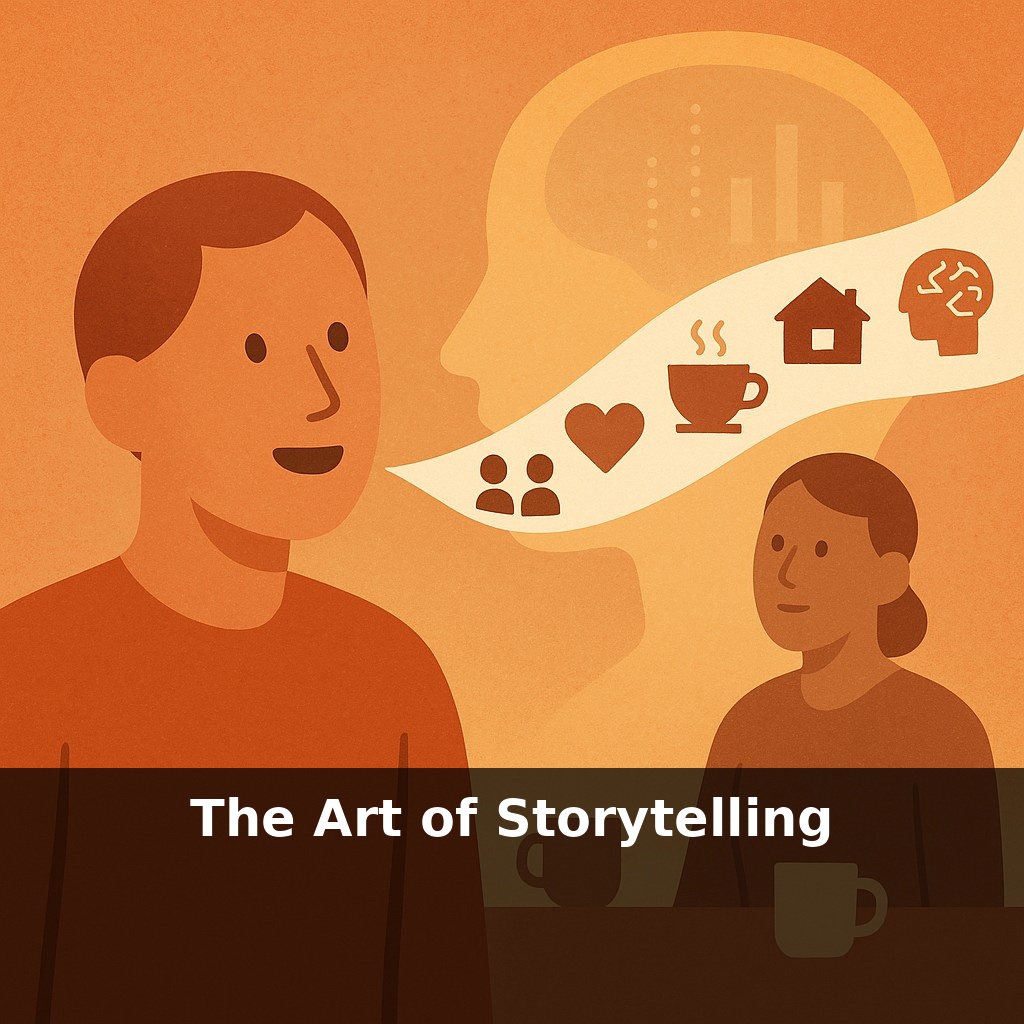
In a Stanford experiment, one speaker rattled off facts; another told a simple story. Listeners swore the data impressed them more—yet almost everyone later remembered the story. Today we’ll explore why your brain secretly trusts stories more than statistics, and how that shapes your charisma.
Here’s the twist: your most magnetic stories usually aren’t the epic, cinematic ones—you know, the “I quit my job, moved across the world, and started a company in a garage” type. They’re the small, specific moments most people overlook. The awkward silence in a meeting before you spoke up. The tiny argument with your partner that revealed a bigger fear. The offhand comment from a mentor that quietly changed your standards.
Think of these as “pocket stories”—short, lived moments you can pull out in a conversation to reveal something about who you are: what you notice, what you value, what you’ve learned. Charismatic people aren’t necessarily more interesting; they’re just better at turning raw life into these pocket stories on demand, instead of dumping opinions, advice, or data. In this episode, we’ll start turning your own experiences into that kind of social gravity.
Most people assume good storytellers are just “naturally interesting,” but under the surface they’re quietly doing something very practical: they’re tagging experiences as stories in real time. Think of your day like a busy kitchen—moments fly past like ingredients on a conveyor belt. A quick embarrassment, a small win, a strange thing you overhear on the subway. Most of us let those slip. Story-smart people pause for half a second and mentally label them: “That’s a scene. That’s tension. That’s a turning point.” In this episode, we’ll start building that tagging habit so your stories are always one step away.
Here’s the move most people miss: before you polish *how* you tell stories, you need a simple way to *find* the raw material. Not epic life chapters—single, zoomed-in moments. To do that, think in three tiny building blocks: scene, stakes, shift.
**1. Scene: where are we, and what’s happening right now?** Story-moments almost always start with something concrete: a place, a time, and a small piece of action.
- “I’m standing in the elevator, rehearsing what I’m about to say…” - “It’s 10:59 p.m., I’m staring at my inbox, pretend-working…” - “We’re in this cramped conference room, and no one will make eye contact…”
Notice: brief, specific, and “zoomed in,” not a life summary. When you’re scanning your day, look for these little “freeze frames” where something felt slightly charged.
**2. Stakes: why does this moment matter to *you*?** Most people skip this and their stories fall flat. Stakes don’t have to be dramatic; they just have to be *personal*.
- What were you afraid might happen? - What were you secretly hoping for? - What would this moment prove or threaten about you?
Example: “If this meeting goes badly, my manager will think I’m not ready.” That’s enough. The listener now knows what emotional game you’re playing.
**3. Shift: what changed—even a little?** Without a before/after, you just have an anecdote. With a shift, you have a story.
Shifts can be tiny:
- You changed your mind about something - Someone surprised you - The mood in the room flipped - You noticed a pattern you’d missed
As you review your day, ask: *“Did anything end differently than I expected?”* That’s a signal there’s a story hiding there.
**Putting it together in real life**
Let’s say your train was delayed. Boring… unless you zoom into a moment (scene), reveal why it mattered (stakes), and find the tiny twist (shift):
- Scene: “I’m stuck on the platform, train delayed again, already late for a one-on-one with my new boss.” - Stakes: “If I blow this first meeting, she’ll think I’m unreliable.” - Shift: “I finally arrive, apologizing—and she laughs and says she *scheduled* it knowing our trains are chaos. I realize I’ve been assuming everyone is judging me as harshly as I judge myself.”
Same event, different impact. You didn’t need drama; you needed structure at the moment-level.
Here’s where this gets fun: once you see scene–stakes–shift, you can start “collecting” moments like a quiet game you play with your day. You’re not chasing drama; you’re scanning for *texture*—the tiny “hm, that was interesting” beats most people scroll past.
Use unexpected categories. Look for:
- **Frictions:** a tiny annoyance that revealed more than you expected - **Firsts:** the first time you tried, said, or noticed something - **Reversals:** when your expectation and reality didn’t match - **Confessions:** a moment you almost didn’t admit something
Think of your attention like a budgeting app: most people let experiences drain away as untracked micro-transactions. You’re going to “log” the odd ones—not with paragraphs, just a 1–2 line note on your phone: place + feeling + what surprised you.
Over time, you’ll notice patterns: recurring fears, themes, or values. Those patterns quietly become your “signature stories”—the ones that feel the most *you*, and land the deepest with other people.
Stories are quietly becoming a kind of social technology. As interfaces shrink and feeds speed up, the people who can compress meaning into tiny, vivid arcs will shape how groups think, hire, vote, and even fall in love. Think of narrative fluency like compound interest on your interactions: small, consistent practice now yields outsized influence later—on a date, in a boardroom, or inside a group chat where attention is the rarest currency.
Your challenge this week: pick one daily interaction that feels forgettable—a commute, a status meeting, a checkout line. Each evening, turn just *one* of those moments into a 3–4 sentence story you could actually tell a friend. No polishing, no posting, just a private “story rep.” By day seven, notice how much faster you can spot the hidden arc in what used to feel like background noise.
As you play with these tiny arcs, notice how they quietly tune your “receiver,” too: other people’s throwaway comments start sounding like story seeds. Follow your own curiosity—ask one more question, linger one beat longer. Like learning a new language by ear, fluency sneaks up on you in small, awkward sentences long before it becomes poetry.
To go deeper, here are 3 next steps: (1) Watch Andrew Stanton’s TED Talk “The Clues to a Great Story” and pause after each main idea (like “make me care” and “promise me you’ll tell me a good story”) to jot 1 concrete change you’ll make to your own signature story. (2) Grab a copy of “Storyworthy” by Matthew Dicks and complete his “Homework for Life” exercise tonight—set a 5‑minute timer and mine your day for one tiny, emotionally charged moment you could turn into a story. (3) Open Canva or Keynote and build a single “story arc” slide using the Pixar storytelling framework discussed in the episode (“Once upon a time… / Every day… / Until one day… / Because of that… / Until finally…”), then practice telling it out loud into your phone’s voice recorder and listen back once to spot where your tension and release could be stronger.