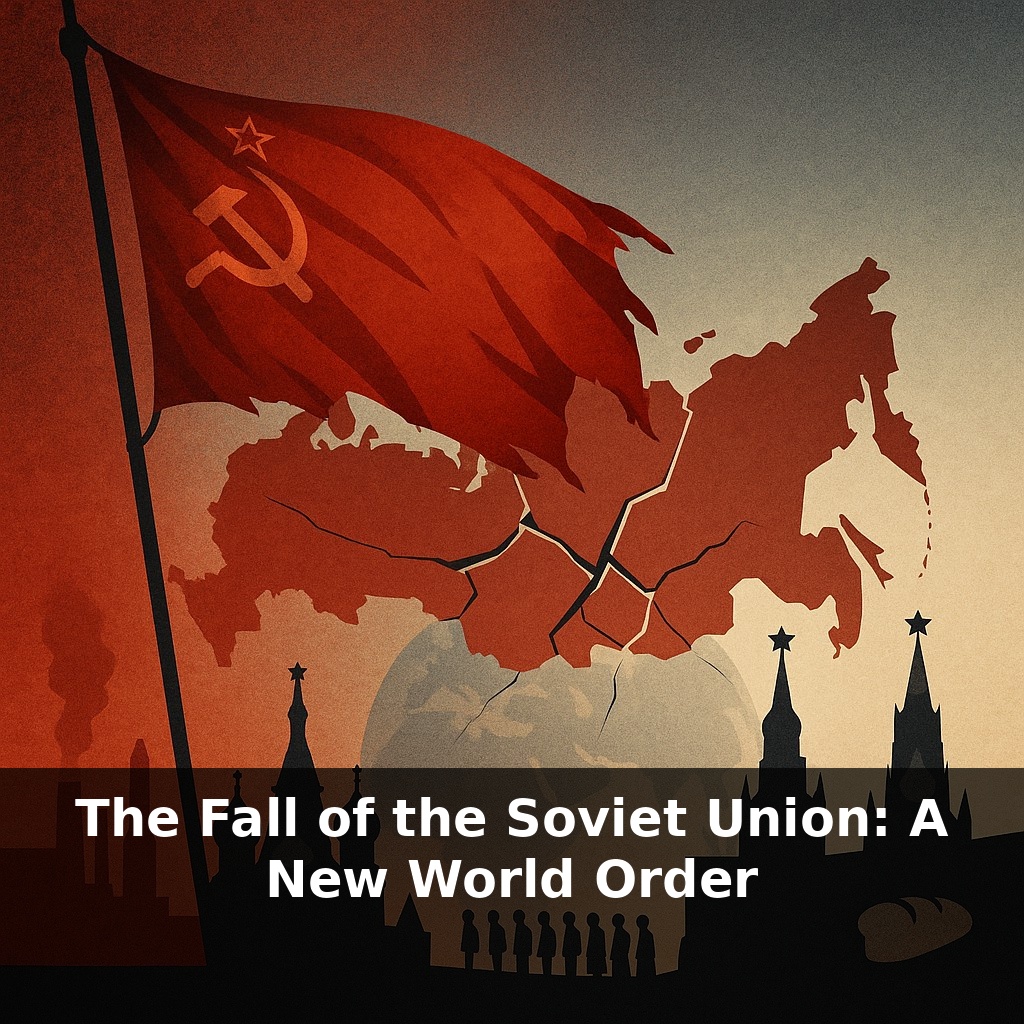
In 1991, a superpower with nearly 300 million people vanished without a single world war battle. One month, its red flag still flew over Moscow; soon after, it was gone. How does a nuclear giant crumble quietly—and what new world quietly takes its place?
By the late 1980s, Soviet citizens lived in a country that could launch rockets into space but couldn’t reliably stock grocery shelves. Lines for bread stretched around city blocks; factory workers met production quotas on paper while machines rusted in reality. At the same time, ideas once whispered in kitchens—about democracy, nationalism, and market reform—began surfacing in public debates, newspapers, and street protests. Gorbachev’s leadership didn’t start this crisis, but his attempt to fix it changed the rules of the game. As controls loosened, long-suppressed tensions between Moscow and the republics—Baltic, Caucasian, Central Asian, Slavic—pushed to the surface. In this episode, we’ll explore how economic breakdown, political opening, and nationalist aspirations combined to end the USSR and reshape the global balance of power.
Official statistics still painted a picture of stability, but beneath the numbers the system was fraying. Oil prices plunged in 1986, slashing Soviet hard-currency earnings just as Moscow needed cash to buy grain and advanced technology from abroad. At the same time, the Afghan war dragged on, draining resources and credibility. Military spending rivaled that of the United States, but from a far smaller economic base, forcing trade-offs that emptied store shelves. As glasnost widened public debate, these pressures became visible, like cracks spreading across river ice at the first serious thaw.
Gorbachev’s second big reform, perestroika, tried to make the command system more flexible without abandoning it. Limited private cooperatives were legalized; some managers got more say over production and wages; a few prices were cautiously adjusted. On paper, it was a controlled experiment. In practice, it scrambled incentives. Directors hoarded inputs, waiting for better terms. Workers knew the old guarantees were weakening but couldn’t see a clear new deal. Output figures still circulated, but they hid a growing mismatch between what people needed and what the system could actually deliver.
At the same time, a new political landscape was forming. In 1989, the first partially competitive elections to the Congress of People’s Deputies brought dissidents and critics into the spotlight—people like Andrei Sakharov, once exiled, now speaking on national television. Televised sessions exposed corruption, past crimes, and policy failures. For many viewers, this was their first unscripted look at how decisions were made. Authority shifted from the Communist Party’s back rooms to a messy, very public arena.
Republic-level elites quickly adjusted. Leaders in places like Lithuania, Georgia, and Ukraine realized they could win support by promising more control over local resources, language rights, and political power. Moscow’s attempt to design a looser “Union of Sovereign States” collided with these rising ambitions. The 1991 referendum showed most voters wanted some kind of common structure to survive, but the people who actually controlled parliaments and streets were increasingly betting on going their own way.
Meanwhile, the external environment was changing just as fast. Eastern European satellites broke free in 1989; the Berlin Wall fell; Germany unified inside NATO. Instead of sending tanks, the Kremlin stood down, which reassured the West but shook hard-liners at home. If the outer empire could go without a fight, why not the inner republics?
Then came the August 1991 coup attempt by conservative officials. For three days, tanks rolled into Moscow, TV broadcast Swan Lake, and Gorbachev disappeared from view. The coup failed, but its failure shattered the last illusions of unity. Boris Yeltsin emerged as the defender of Russia’s sovereignty against the old guard. By December, key republics signed the Belavezha Accords, declaring the USSR dissolved. The red flag over the Kremlin came down, not with an explosion, but with a quiet, final sunset.
Across the fifteen republics, the unraveling played out differently. In the Baltics, human chains like the 1989 “Baltic Way” linked millions across Lithuania, Latvia, and Estonia, turning geography into a political argument: the borders might be Soviet, but the people felt European. In Central Asia, leaders moved more cautiously, rebranding themselves presidents of new states while keeping much of the old party machinery intact. The same late-Soviet TV that had once projected monolithic power now carried debates, nationalist songs, and live images of crowds, giving distant regions a shared sense of motion. Western institutions also adjusted in real time: NATO shifted from pure containment to partnership programs; the IMF and World Bank arrived in former Soviet republics with “shock therapy” plans; the UN gained a Russian seat where the USSR had been. Like an orchestra that suddenly loses its conductor mid-performance, every section had to decide whether to keep playing the old score, improvise, or walk offstage entirely.
Borders shifted on maps, but the deeper legacy is still unfolding. Russia, the EU, and China now circle the former Soviet space like rival gardeners, each offering security or investment in exchange for influence. Energy routes, data cables, and satellite networks have replaced tank lines as fault zones. Your challenge this week: follow one current dispute in this region and trace how often history before 1991 is used to justify today’s claims.
The Soviet collapse didn’t settle the argument over how societies should be organized; it just moved it to new arenas—oligarchic capitalism, digital surveillance, revived empires. Think of today’s world like a forest after a wildfire: old trees gone, sunlight flooding in, fast-growing shoots competing to shape the next canopy of power and ideas.
To go deeper, here are 3 next steps: (1) Watch the first two episodes of the PBS series *The Rise and Fall of the Soviet Empire* on YouTube, pausing to compare its account of Gorbachev’s reforms and the 1991 coup attempt with how they were described in the podcast. (2) Grab a copy of Serhii Plokhy’s *The Last Empire: The Final Days of the Soviet Union* and, today, read the chapters covering August–December 1991, paying special attention to how Yeltsin, Gorbachev, and the republics negotiated the new power balance. (3) Open a free account on Our World in Data and pull up their charts on military expenditure and nuclear stockpiles from 1980–2000, then spend 10–15 minutes exploring how the end of the USSR reshaped the global “new world order” the episode talks about.